

 originally part of this post.
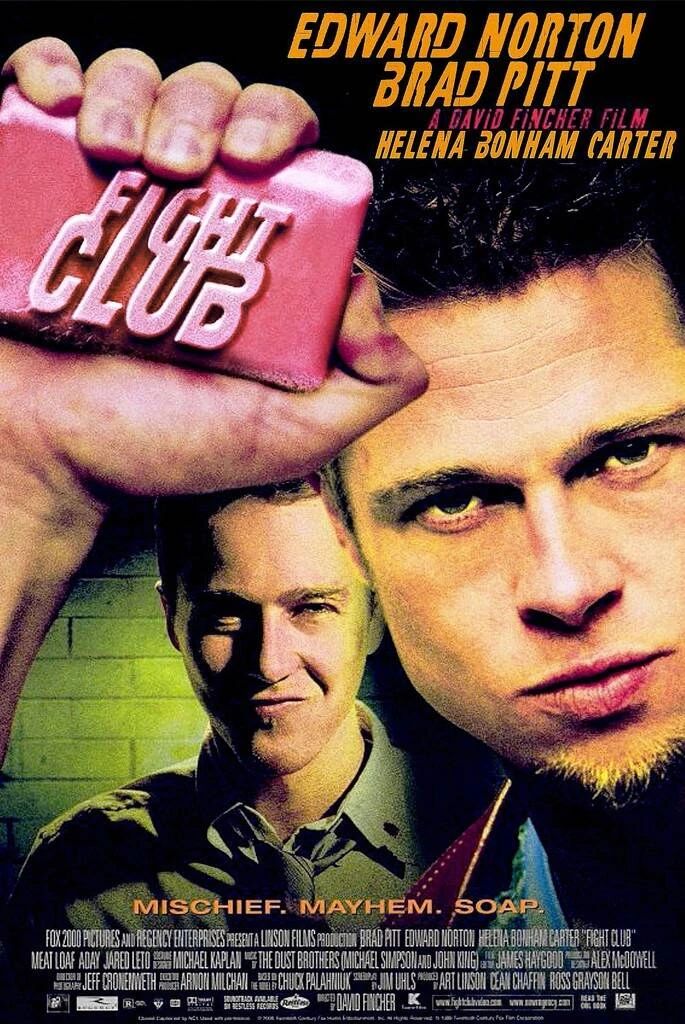
I might feel different from everyone else in some ways, but in other men I do recognise myself, at any rate in literature and film: for example in Fight Club. Have you seen it? Edward Norton’s character, the nameless narrator, was me. Through his eyes I too was fascinated by Brad Pitt’s character, Tyler Durden. In this film a man has two choices: to be dominated (by his office boss and the wondrous world of IKEA furniture) or to break out in nihilistic violence. Before he discovers the latter, he’s plagued by insomnia, & so sorry for himself that his doctor suggests he attends a testicular cancer support group, just to see some real suffering, and pull himself together. This works, but turns him into a support group junkie: the climax comes when you hug one another and cry. He meets a similar soul in Marla Singer, played by Helena Bonham Carter as a pallid chain-smoking Goth, who certainly doesn’t have testicular cancer but turns up there anyway. We expect romance but our hero treats her as an adversary, for when she’s there, he can’t cry any more, so his insomnia comes back. But then he meets his alter ego and true destiny, in the form of Tyler Durden, and learns that a real man must swagger and fight, and not mind getting bloodied, but indulge in sado-masochism & nihilistic terrorism, and help all the other real men out of their closets (bought in IKEA, of course):
Voiceover: It was in everyone’s face. Tyler & I just made it visible. It was on the tip of everyone’s tongue. Tyler & I just gave it a name.
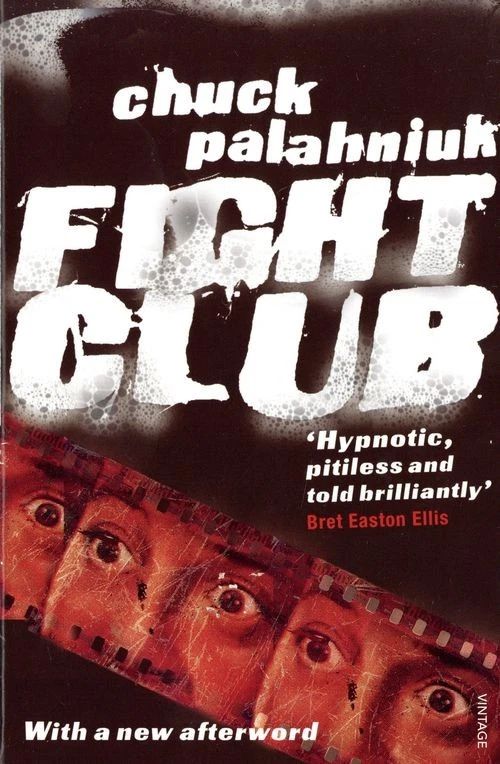
Now there was a sense of mission! Exactly what I want to do, though in my own terms. I used to hate violence in movies, before I learned to recognise the point of it, and the various kinds of restraint employed when it occurs in good movies which say something worth saying. The very title “Fight Club” would have put me off when the film came out in 1999. But now I see that it’s all satirical and metaphorical. At least if you’re sane. I hope for the director’s sake this one hasn’t been blamed for inspiring atrocities by the less-than-sane. The oddest thing was that I kept seeing my younger son in Brad Pitt’s character: not my son as he really is today but, as I guess from certain visual clues, the self-image of his inner movie as it played within him not long ago. Or perhaps Brad Pitt in this role makes manifest the inner nihilist in every male teenager, in those cultures where the word teenager exists. So, what with him and Helena, I feel intimately entangled in this film, as if it were based on my own life.
This digression may contribute little to expressing my own sense of mission: but perhaps it shows the lengths a male of the species homo sapiens will go, if only in his head, to escape the effete bondage of condos, office jobs and IKEA catalogues. (And where do we end up in life, we men? We retire, we potter in the garden, then our wives retire too, and we wonder who will go first and meanwhile we look at ocean-cruise catalogues, to have some last look at the world before we’re reduced to being shuffling stroke-survivors and dementia-surrenderers.)
Original post continues.
 a wayfarer’s notes