
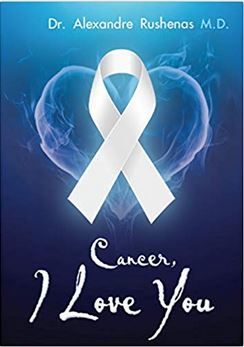
 I’ve been following Arash’s World for years, always enjoying his essays and book reviews. I found his latest review of particular interest, and bought a copy of the book, very reasonably priced on Kindle. It’s inspired me to submit a review of my own, not in rivalry to Arash’s, but because I was given a cancer diagnosis 2 years ago. It’s well under control but triggered a heart condition which got more and more troublesome over the last year. I’ve been able to read the book as one addressed to me directly. So here’s my own review.
“Cancer, I love you!” In the words of a recent commenter to this site, one of those spammers with poor English:
make sure that your titles may be compelling posted
Dr Rushenas has certainly chosen an eye-catching title. As I start to read, I wonder if the reader, hooked by the compelling title, will end disappointed.
The first part of his short book is a memoir of the author’s boyhood in Iran, idyllic until it’s disrupted by the sudden fall of the Shah. As the Ayatollah Khomeini’s reign of terror starts to bite, his father is shot dead outside the door of their flat. The resourceful mother organizes the family’s escape to Paris. There, he trains as a medical student and ends up in Canada.Thus far, it’s a captivating narrative, full of drama and insights into the author’s intellectual and spiritual development. In Iran, he has attended a Muslim-Jewish school; in Paris, one run by Catholic sisters. He’s impressed by the power of belief in people’s lives, recalls especially the story of when Jesus restored a man’s sight. Early in medical training, he’s assigned as an intern to observe and converse with elderly dying patients, becomes an avid observer of the human condition. He gets a degree in biology and sports medicine, dreams up a theory for fitness training. It involves programming your muscle cells. He finds he can do it:
Yes, I could communicate with my cells and program them, as I pleased, to do what I ordered them to do. All I needed to do was provide the right information . . .
He informs his gym colleagues, and notes that “they could not believe the results they achieved in such a short time.”
Armed with this power, he starts to dream of a world “in which everything would make sense, where happiness would reign”. For there’s a “cellular dimension”, and then another, where all the cells live happily in someone’s body, communicating between themselves. Why isn’t this harmony reflected in the macrocosm of living creatures on this earth? These nested dimensions inflame his soul, like a vision of Utopia.
We await the bursting of his balloon, the harsh fall to earth. But no! He watches his unborn daughter via ultra-sound. She starts from just one cell, the fertilized egg, known as a zygote. This is so wonderful. What is the meaning of life? What is our role in the Universe? He publishes his first novel, Le Sang-Graal, his “theory and vision of Utopia”.
Thus far, I’m carried along with this, wondering how he will reconcile this with being a hospital doctor. He starts talking about cancer. He observes that when the patient sees it as an enemy to be fought, hated and feared, such emotions may negatively affect the prognosis.
At this point, I have to say that this is a message already understood and practised, as I’ve observed from many hospital visits over the last two years. Doctors, nurses, ancillary staff of all kinds, even patients, emit a positive glow. and of course they offer more than just hope. There is bravery, generosity, dedication: I feel it as a manifestation of love. In reception and waiting rooms, there are free leaflets and booklets from various charities offering hope, support & practical assistance. “Fighting cancer” in this context means no more than doing something about it, acting on the the will to live.
Dr Rushenas says his duty to his patients includes “helping them heal cheerfully and joyfully, making hope and love the core and the source of their healing.” Fine words: I heartily concur.
But then, in the next sentences, he makes an astonishing leap.
In that situation, chemotherapy and radiotherapy are no longer to be experienced as an act of aggression and a war to be waged. Instead, there is a moment of fulfillment when all the body’s cells can work together for accelerated healing.
I didn’t mind the Utopian ramblings. They are part of the author’s story, or “journey”, if you like. But these two sentences stop me in my tracks. Whose experience is being described? This “moment of fulfillment”: is it from medical therapies, or in spite of them? Who is witness to “all the body’s cells working for accelerated healing”? The patient, or some recognized test of cancer cells or tumour shrinkage?
The author doesn’t care to answer these questions. From this point on, his prose is soaked in “woo”, a slang term used among sceptics. Medicine these days depends on evidence. A site called RationalWiki gives us this:
Woo: a term for pseudoscientific explanations that share certain common characteristics, often being too good to be true (aside from being unscientific). The term is common among skeptical writers. Woo is understood specifically as dressing itself in the trappings of science (but not the substance) while involving unscientific concepts, such as anecdotal evidence and sciencey-sounding words.
Woo is usually not the description of an effect but of the explanation as to why the effect occurs.
All subsequent chapters, making up the bulk of this short book, appeared to be tedious repetition as he strives to convince his reader to adopt his own set of beliefs, understand how they interlock with one another.
I’ll try to summarise those beliefs.
Our true reality is what we believe emotionally, based on our limited senses and bodily feelings. If we can change our beliefs we can change reality and heal ourselves. He doesn’t dare say this directly, indeed the only reason we keep reading is to learn precisely how it’s done, but he never tells us, merely hints. We read on fruitlessly, or find ourselves impatiently skipping.
I will provide more concrete examples and methods in the coming chapters.
In another “dimension” our “absolute reality” is that we are a bunch of cells.
Dimensions are a kind of microcosm and macrocosm below and above our ordinary perception
Emotions are a direct order to our cells, telling them how to behave. We must understand the concepts and master them, so that we can give clear instructions to the cells in our bodies. He uses “master” eleven times in this sense.
I should say at this point that I do believe it is possible to talk kindly to my body. I have noticed, more from desperation than any belief, that it tries to respond to my expectations with an appropriate level of endorphins, dopamine, heartbeat & breathing to meet a present or forthcoming challenge. I suspect it’s the same for everyone but we take it for granted and don’t even notice.
What brought me to this desperation is not cancer but an effect triggered by cancer medicine. Until yesterday I’d been affected by atrial fibrillation, for a whole year. When the prescribed digoxin and beta-blockers failed, or made it worse, I resorted to some kind of yogic mindfulness. It did help a bit, but did nothing to shift the condition itself. So yesterday I submitted to an electric shock treatment called cardioversion. In a few minutes my heart was behaving itself again. Now I shall use the mindfulness I’ve learned to try and stop it getting out of sync again.
Could this book by Dr Rushenas have helped me? No, it doesn’t provide answers, only vague pep-talks and guided meditations.
See yourself in shape. See and imagine sick people who are cured from contact with your energy.
I can’t imagine any of my doctors (general practitioner, haematologist, cardiologist) telling their patients how to master their emotions in this way. Any medical doctor—any hospital chaplain, of whatever religion—knows that patients come with their own ready-made systems of experience and beliefs. Few if any are open to direct preaching.
Yet I do like Rushenas, am sympathetic to the genuineness of his spiritual ardour, his desire to save the world with the practice of love, starting with loving our own selves and recognizing love as something which permeates the universe. I just can’t imagine his self-published book, promoted by a paid-for publicist, as meeting its intended purpose.
He never acknowledges that cancer is Nature’s method of culling us, making sure we don’t live forever. We can cheat Nature for a while, but we have to die of something.
6 thoughts on ““Cancer, I Love You””
Gentle Eye
I am very pleased to learn that the cardioversion has had such good results! This faithful reader who ought to comment more often wishes you strength and health to continue what you do so wonderfully – write!
Vincent
Thanks, Kathleen. What I said about the good results was premature, but there’s a story there that I hope to tell soon. With a happy outcome, I’m glad to say.
Vincent
Thank you, dear Kathleen, it is reassuring to know you are there, never mind the comments or lack of. I feel somehow reborn—again! Takes getting used to. The newborn crawl before it can walk, suckle before it can crawl. I look forward to some proper writing, sooner or later, now that the difficulties have been lifted.
Natalie
Vincent, very glad to hear the shock (electric) was benevolent rather than shocking. May all your cells sing, in perfect unison and harmony, an unending song of gratitude and well-being.
Vincent
Thanks, dear Natalie. The gratitude sings out regardless, but the cells remain a bit discordant. It’s hard to cope with the energy released by a heart that now beats much stronger. It’s still wild, irregular and sometimes too fast, and life sometimes feels almost literally like riding on a roller-coaster. Overall, I’m up-hearted!
Vincent
For the record, I was rushed to the hospital in an ambulance a month later for a repeat of the same procedure, this time carried out at the Cardiac and Stroke Receiving Unit. All very dramatic: wired up to a defibrillator and nasal cannula, strapped to a gurney. Again it was successful but this time I’m to take additional medication to prevent further recurrence.
Further (interim) thoughts on Rushenas: altogether too much generalized woo. Unhelpful, muddies the waters, mixes subjective with objective. I’d have been better off without being influenced by this book.
 a wayfarer’s notes