
 Abridged from
‘High Delights that satisfy all Appetites’: Thomas Traherne and Gender
Jean E. Graham
The College of New Jersey
graham@tcnj.edu
The poetry of Thomas Traherne (written sometime before his death in 1674) has often
seemed purely and innocently devotional in comparison with that of George Herbert, John
Donne, or Richard Crashaw, poets whose religious work, at least occasionally, is sexually
explicit. ‘Until recently’, Denise Inge comments in her work on Traherne’s prose,
Wanting Like a God (2009), ‘there has been so little sex in Traherne that, although some
scholars have noted sensuous imagery of feasting and treasure, discussing desire in terms
of sexuality has not been an issue for Traherne scholars’.1 The poem ‘Love’ is a notable
exception, expressing erotic pleasure in a relationship between a human speaker who is
figured both as a ‘boy’ and as a ‘bride’ and a masculine deity who possesses that speaker’s
womb and brings forth fruit from it. The few scholars who mention the sexual references
in ‘Love’ include Inge; Richard Rambuss in Closet Devotions (1998), his exploration of
the complex sexuality of metaphysical poetry; and Randolph Trumbach, who in a 2012
article on the history of sodomy mentions Traherne’s use of the Ganymede myth.2 Yet
although it was twenty years ago that Rambuss complained of ‘the ways in which the
Pioneering and still prevailing scholarship on devotion has too readily circumscribed both
the libidinal and the transgressive potentialities of the sacred body’, subsequent interpretations of Traherne have continued to overlook the undertones of eroticism, sexual possession, and sexual violence in Traherne’s poetry.
Like Traherne’s poetry in general, ‘Love’ (Ross 6.61-62) describes the speaker’s soul combining in mystical union with God
As the poem quickly vacillates between God’s bride and God himself (who is presumably
the ‘Caus of all’), suggesting a union or (con)fusion of the two figures, the speaker
acknowledges his poetic function as a recorder of this union, exclaiming:
[. . .] Where
Shall such another Theme
Inspire my Tongue with Joys, or pleas mine Ear! (3-5)
The singular ‘Theme’ evidently refers to the spiritual marriage, but the speaker also
‘covet[s] to behold’ a deity associated with ‘Palaces of Gold’ and material benefits he is
willing to distribute:
Did not I covet to behold
Som Endless Monarch, that did always live
In Palaces of Gold
Willing all Kingdoms Realms and Crowns to give
Unto my Soul! (13-17)
As the king transforms from the inhabitant of palaces to one who bestows ‘Kingdoms
Realms and Crowns’, the ‘Glorious Bride’ changes from the ‘Kingdom Wide’ into the
speaker’s soul, which is the recipient of ‘Kingdoms Realms’ and other gifts given by and
shared with her husband. In the early modern period, the soul – a word that is feminine
in Greek – was traditionally although not inevitably seen as female, as Rambuss points
out regarding Donne’s sonnets.6 Elsewhere, Traherne also identifies the individual soul
as God’s bride. ‘Fullnesse’ (Ross 6.30-31), for instance, appears to describe the soul as
God’s ‘Virgin Wife’; this ‘Wife’ represents the entirety of God’s creation enclosed in the
skin of one person, perhaps the skin of the (presumably male) speaker:
The Shadow of a Virgin Wife,
A Spiritual World Standing within,
An Univers enclosd in Skin
Thus the metaphorical relationship of God and the soul in ‘Love’ initially appears
conventional, except for the chaos in the speaker’s rapid exclamations about God and
God’s bride, as if the poet sees the two figures as almost too closely associated to
distinguish. Then, however, this union of human soul and divine ‘Power’ becomes an
experience which repeats – ‘beyond the Fiction’ – Jove’s rape of Danaë:
Did my Ambition ever Dream
Of such a Lord, of such a Love? Did I
Expect so Sweet a Stream
As this at any time! Could any Ey
Believ it? Why all Power
Is used here
Joys down from Heaven on my Head to shower
And Jove beyond the Fiction doth appear
Once more in Golden Rain to come
To Danae’s Pleasing Fruitfull Womb.
The abstractions of ‘Power’ and ‘Joys’ are accompanied by language which is concrete
and sensual: ‘Stream’ and ‘Rain’, ‘Head’ and ‘Womb’.
The subject’s ‘Head’ is the first to experience the stream of divine power; the next body part touched by the deity’s
‘Golden Rain’ is ‘Danae’s [. . .] Womb’: not the female sexual partner of the deity but the distinctively female organ itself, which is ‘Fruitfull’ and thus ‘Pleasing’. At least three
readings are possible at this point. One is that the rain has skipped from one person to another, from the speaker to Danaë. Another is that the speaker has transformed into a
woman, gaining a womb, a Tiresian metamorphosis that complements the deity’s selftransformation into gold. The third is that the speaker is spiritually hermaphroditic,
combining a male body and a female soul, possessing both a head and a womb which are penetrated by the divine shower.
In the fourth and final stanza, the speaker becomes a boy, or is now revealed to have been male all along (albeit a boy with a womb): Traherne also sometimes identifies the bride as mankind in general (e.g., ‘[t]he Bride is Man’, in The Kingdom of God [Ross 1.492]) or as the Church: for instance, in ‘Felicity’ (Ross 6.106): ‘the Bride / Of
God His Church’ (13-14).
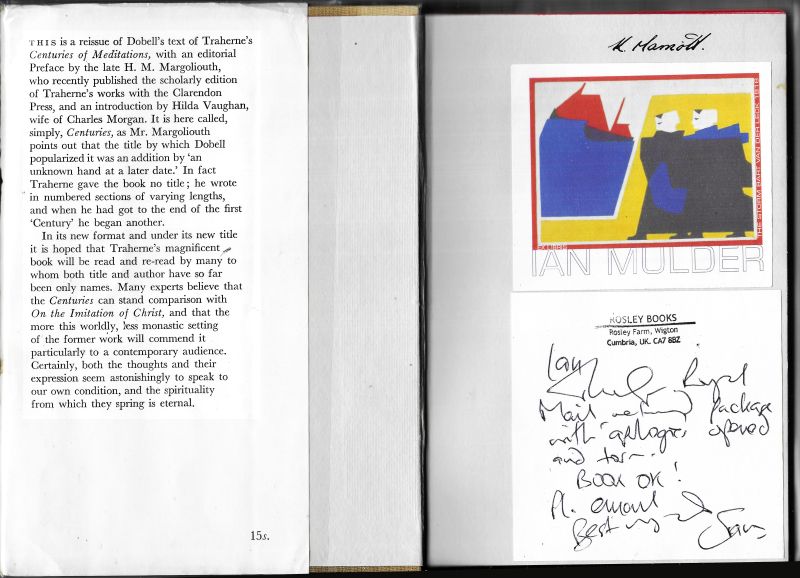
Then there are 6,000 words of footnotes, as befits academia. I’m glad I escaped with a mediocre BA and left it all behind. Can’t be anything more than curiosity. Here’s something from Centuries, as opened at random.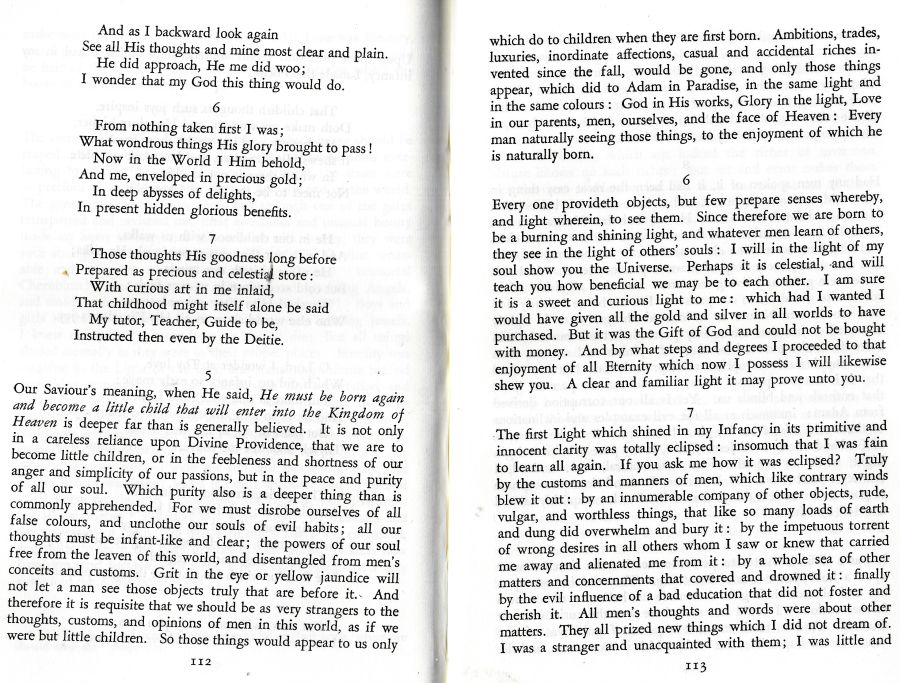
 a wayfarer’s notes