

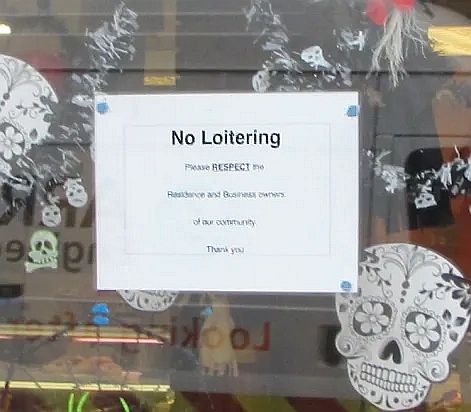
Words have a power of their own. Poets especially like to play with this power, like perfumiers combining ingredients. I often find myself brooding on a word or phrase, perhaps from what someone says, or a book, or as spoken to my inward ear. In my last piece, self-mocking at the time, I conveyed an intent to write about words, but then “consigned it to the great junkyard of unwritten ideas”. This, I fancy, is the very place where Phoenix is to be found, awaiting rebirth in due course. In that piece, I briefly mentioned the content of words, versus their underlying intent.
Since then I’ve found myself fastening on that single noun, “intent”. Its power is the greater these days on account of its restricted use, as in stereotyped legal contexts: “letter of intent”; “loitering with intent”.
Loiter: In early use: To idle, waste one’s time in idleness. Now only with more specific meaning: To linger indolently on the way when sent on an errand or when making a journey; to linger idly about a place; to waste time when engaged in some particular task, to dawdle. Freq. in legal phr. to loiter with intent (to commit a felony). (OED)
Loiter : v. to linger or hang around in a public place or business where one has no particular or legal purpose. In many states, cities, and towns there are statutes or ordinances against loitering by which the police can arrest someone who refuses to “move along.” There is a question as to whether such laws are constitutional. However, there is often another criminal statute or ordinance which can be applied specifically to control aggressive begging, soliciting prostitution, drug dealing, blocking entries to stores, public drunkenness, or being a public nuisance. (The Free Dictionary)
“Intent” scarcely occurs these days in common parlance. Instead, people talk about “motivation”, for we’ve all become amateur psychologists. What was the motivation behind such-and-such? Motivations are always there, lurking “behind”, waiting to be pulled out and analysed, in the light of day. People talk about “objectives”. Everyone must have them, and a “business plan” to match, as if we’re all amateur entrepreneurs from childhood onwards; from log cabin to President.
Many of us find it hard to imagine that “all this” can exist without a Creator, a Prime Mover. Yet if you are to be a true scientist, amateur or simply an atheist, you must dispense with such a notion. You are to imagine this whole shebang as the result of the Big Bang. Indeed it’s mysterious, but we are to have faith that all will be ultimately explainable in chains of cause and effect, an atheist Heaven when all is known, all is reconciled through man’s unceasing efforts. The great Watchmaker behind all this is blind of intent. To intuit any underlying intent is heresy. They call it Teleology.
shebang: more widely, almost any matter of present concern; thing; business; as, ‘tired of the whole shebang’ (Funk’s Stand. Dict. 1895). Freq. in phr. the whole shebang.
Even a sceptic would laugh at the idea of a divine being with motivations or objectives, for these are mental acts of humans. But it’s impossible to imagine a Prime Mover with no intent. That’s how powerful the word is.
I wish David Frost were alive, he who interviewed ex-President Nixon about “the tapes”. And then he could say, “Mr Trump, you already have everything. You are famous, you are rich, you are a happily married man, you are 70 years old, you can enjoy an untroubled retirement in Trump Towers. What is your intent?” He would go on politely probing till he reached the man’s soul, if that were possible. Frost would be the priest-confessor, winning the man’s trust, beaming to him a consummate respect and empathy; and thus eliciting the real reason why Trump wants to take four years out of his comfortable life to fulfil a promise to “make America great again.”
The reason I know “intent” is a powerful word is its effect when I apply it to myself. What is my intent? How is it furthered by spending my time writing these pieces for anyone in the world to read?
I like “intent” because it is singular. It stands aloof from a different word: “intentions”. Once a young man would be invited to meet the girl’s parents, their purpose being to elicit his “intentions” towards their daughter. As the song goes,
—I’m just a soul whose intentions are good
Oh Lord, please don’t let me be misunderstood
(written for Nina Simone, 1964)
“Intentions” used to be a serious matter. You could be prosecuted for Breach of Promise.
I’m avoiding my own Declaration of Intent. I believe that for those in public life, their intent should be made public too: a singular intent, not a manifesto full of weasel words, but more personal: “what do you think you are alive for?”
And for those in private life? We can meditate upon our intent, and it would be a good move if we were (voluntarily) to inscribe it within our Last Will and Testament. So then, at our funeral eulogy, it could be made public, and we would be assessed accordingly.
I wonder what I would say. “To care about the whole shebang”?
intent: The act or fact of intending or purposing; intention, purpose (formed in the mind). Formerly also, in more general sense, Will, inclination; that which is willed, pleasure, desire. Now chiefly in legal phraseology, and in the expressions with intent to (hurt, etc.), with good or malicious intent, etc.
9 thoughts on “Loitering”
BW
Hmm, you’re right that “intent” has become somewhat legalistic. I’m not sure why “intention” is more favored, or really what precisely the difference as far as definitions go (I agree they have a slightly different feel. “Intent” feels almost accusatory. I expect to be waiting on a corner only to have someone to pop out of the shadows and start grilling me about my intent. Maybe that’s the powerful affect you mentioned.)It’s kind of like “medicine” and “medication”, although in that case I’m guessing that “medicine” lost ground to different forms of woo and holistic quackery. “Medication” is the serious stuff.You’ve reminded me how word-associations attract and repel in different ways, & how far we are from a common language which unites instead of divides. But again, I would say it’s a matter of intent: to stay divided or reconcile.
Perrygrin
On the other hand – to be, perhaps, overtly cynical – a simplistic answer to the question “what do you think you are alive for?” …. is – to reproduce.
Vincent
That might be a scientist’s impersonal answer, yes. But for you personally, D. H., and for me personally, I.V.M., it’s not a guiding principle that puts a fresh light in our eyes every morning when we wake up. One has to say “What do I think I’m alive for?”
Perrygrin
yep . . . but self has to wonder, sometimes. What purpose do I have to remain alive. Been there done that, have one son.
Vincent . . . all I really have to do in the morning is wake up, feed the dog and pay the rent.
However, am not dead yet . . .
PS what happened to my, perhaps sly, comment relating to the comprehension of the word ‘just’?
Vincent
The ’ead ’itter ’it it on the ’ead. Rules of relevance apply, but they are elastic. The editor’s decision is not final.
BW
To be clear, my above comment was meant in a semi-facetious manner.
In the past I’ve tried a couple of “herbal remedies” for a number of different ailments. The pitch is usually some variation of: “The cure the pharmaceutical companies don’t want you to know about!”
To which I think, “Those shady bastards! And here this could be the discovery that blows the lid off of all my problems!!! *glug* *glug* *glug*”
Unfortunately, these experiments usually tend to yield a null result without even the cold comfort of a placebo effect. Also, I’ve found the quality control with some of these unregulated products to be … lacking. I won’t point any fingers at anything specific. I’ll just leave it at that.
Vincent
Yes, now I see through your eyes. For my part I was associating “medication” with side-effects, symptom-suppression (e.g. for depression), pre-emptive dosages prescribed when you reach a certain age; the bossiness of the National Health Service. “Medicine” by contrast, evoked traditional remedies such as ginger (for coughs etc); hot lemon and honey with rum or brandy; bicarbonate of soda; senna.
BW
Oh, yes. Being cheap, I’m always up for home remedies. Plus they have “home” in the title, which gives me nice warm feelings.
 a wayfarer’s notes