
What do you do with the rest of your life when in early adulthood you are admitted to a vision of universal oneness, in which what seems like God’s love is poured down and you can sensuously swim in it?
Paul Maurice Martin wrote notes: diary entries to be expanded later. He went on to study theology and be a schoolteacher, giving extra coaching to those who needed it, outside the normal hours. He would get up hours before dawn, sacrificing sleep in order to write. The result, many years later, is a magnificent book: Original Faith.
Whilst waiting for publication, he started a blog of the same name and gathered a number of readers to discuss spiritual topics of his choosing. I was one of them, a rather argumentative one at times, not sure I wanted to read his book when it finally got published, for I did not see myself as part of his target audience. But he won me over, and since receiving the finished work a few days ago I have been excited by its contents.
It’s not the done thing to write a review when you are only half-way through. So let’s not call this a review. It’s just another blog post, in which I record whatever I feel like. So I have to say that even after reaching page 105, the book still grips me like a “page-turner” novel. What next? I can’t imagine. In the genre of spiritual self-help books, which I have been mentioning here lately, Original Faith stands out from the throng. It certainly needs to, because it’s a member of a populous genre, mostly of little value because lacking originality. They don’t stick to personal experience. Their authors, moreover, imagine that they can tell a reader how to attain fulfilment.
I find Paul’s book to be written with a fresh honesty and originality that makes it a rare pleasure, whether to embrace the words in long-lost recognition of truths not previously articulated, or find something to pick on and challenge. Or simply to admire and absorb the poetry, often in exquisite verse, of his vision.
He writes beautifully about love. He is convincingly confident that what he has experienced can be the common possession of everyone. As a common reader I was lifted up by his vision. I had expected him to write from a religious background, with lots of biblical references, say, or taking some aspect of Christianity as his starting point. No. He is lyrical and flowing about his memories of cycling and jogging in communion with Nature, and the visions and dreams that became the basis of his inspiration. His inspiration, literally: I feel that in addition to the mystical encounters visited upon him, whose memories guide his thoughts, a clear, sure voice seems to speak through his words. I’m so convinced by the authenticity of his source that the other times stand out in contrast, when it seems to be just Paul, enunciating his personal theory, which doesn’t agree with my personal theory. Never mind that: something to take up at another time, another place. I mention the contentious side only to emphasize the sense of authoritative truth (experiential and not scripture-based) that comes from the rest.
The book is brilliant on despair and hope. For this alone it deserves wide popularity, perhaps immortality. In one reminiscence, he is suddenly transported by an experience in an old cemetery.
… a level of despair I had not previously known. I feel as if I could lie there forever, literally never bothering to get up again. Every muscle is lax and unwilling to move. Why bother? seems written across my soul, or in the place my soul had been.
Then something happens—I won’t attempt to paraphrase his account—and he is transformed.
It is hope as outroar—directed to the whole graying sky over that little graveyard, rooted from the floor of who I am and widening to include the whole overarching universe. I seem all at once to become hope for the world called into flight by love for the world.
Paul’s blog is here*, and the book can be ordered here. To reiterate, this isn’t a book review. I’ve only read half of it to date and it’s too important to rush through.
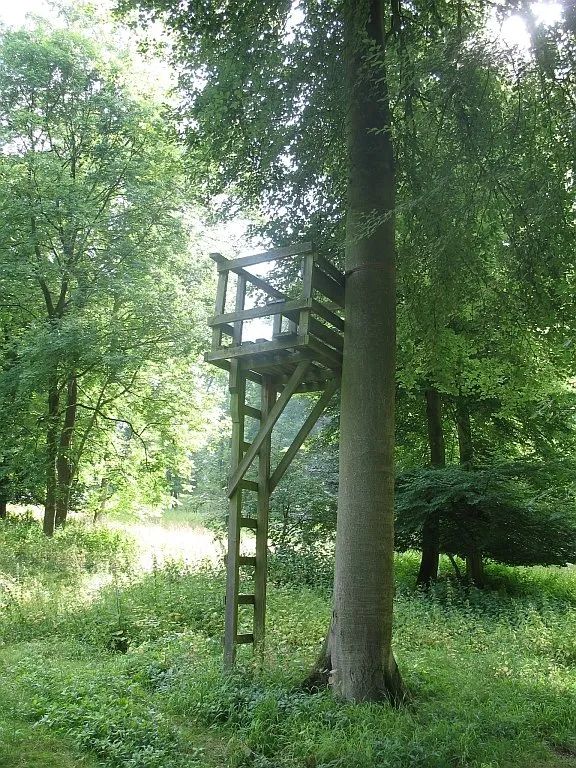
The picture is taken from one of my recent walks (see Blazing a Trail). I believe it is a platform from which to shoot pheasants. But I climbed up and sat there for a while, imagining myself some old-time hermit or pillar-saint.
* Paul died some years ago. His blog has not survived but various pages are viewable via the Internet Archive, such as the one linked to above.
 a wayfarer’s notes
VincentHere where I live they are called deer stands for shooting the same. The birds are hunted by walking…
Like
Yves, thanks for commenting on Paul’s book.I have it, but admittedly haven’t started reading it yet. It’s NOT the SORT OF BOOK I read. But then, his is not the sort of blog I read either, and I love his posts. What I gather from this is that the book is even better – guess I’d better open it up and start!
Like
Yves, thanks for commenting on Paul’s book.I have it, but admittedly haven’t started reading it yet. It’s NOT the SORT OF BOOK I read. But then, his is not the sort of blog I read either, and I love his posts. What I gather from this is that the book is even better – guess I’d better open it up and start!
Like
Yves, thanks for commenting on Paul’s book.I have it, but admittedly haven’t started reading it yet. It’s NOT the SORT OF BOOK I read. But then, his is not the sort of blog I read either, and I love his posts. What I gather from this is that the book is even better – guess I’d better open it up and start!
Like
I have loads more to say about it, Hayden, in the manner of arguing with it; though initially I was awed by it, and by a sense of loyalty to an author who has laid out his life so honestly therein. I do think you will get something out of it, but not as a “how-to” book. As you work your way through you see that that’s what it is, because it comes from a tradition: Christianity on the one hand and self-help spirituality on the other—twin pillars of American culture I suppose. He imagines himself a rebel by striking out on his own from the one, but falls into the arms of the other; leaving me to wish he were a real rebel of the kind who could declare a plague on both their houses. But then I see that that is what I aspire to do, but with scarcely a nod to acknowledge the existence of either.I want to pull to pieces some of the ideas in the book, but leave Paul intact, for I have the highest respect for him and his work. He can be proud of the results of his labours and for all I know it will be a life-changing book for many.
Like
Scot, they may do the same here, but I saw no signs of deer in that wood. Buckinghamshire is a prime place for pheasant shooting, on the other hand. It’s an organized thing, both in the rearing of the young (keeping foxes and red kites from eating them, and providing seeds of various kinds to support a large population of pheasants on the land) and the running of shooting parties for yuppies at weekends, making sure they kill only the birds and not each other.The whole idea would offend me if I thought about it, but I don’t. Its impact is the proliferation of “Private” signs at certain seasons, though the farmers are not allowed to prevent access to the network of public footpaths.
Like
Great I was going to have a peek. Nice to hear your comments.
Like
Vincent, really appreciate the post and links and so interesting to read people’s reactions. I’m also feeling like this is a “page turner” for me now because after reading your first-half impressions, I wonder what you’ll think by the end!
Like
Vincent, I believe you, you are certainly a discerner of spirits, no matter your aloofness from religions.And, having read a bit of his blog, I know you are right about him, a good man.
Like
vincent,you put the what I’ll call the deer stand to a good use. Sounds like a very thought-provoking book.Yes, one of America’s problems is with self-help spirituality, a paternal twin of the “pull yourself up by the bootstraps” mythology which underpins our free market Jesus.The other honorable journeys to enlightenment here are alcohol and overeating.
Like
What do you do with the rest of your life when in early adulthood you are admitted to a vision of universal onenessJust share, write, i guess.
Like
(but don’t let marclord distract you .. don’t let ANY person distract you. a unique voice is more valuable than you imagine)
Like
I don’t like self help books either.
Like
An admirable review, Vincent–and yes, it stands just fine as it is!I know Paul said that his book is much better than his blog– I hope he is not insulted that I agree…
Like
Firebird – no, I’m not – but I’m insulted about the self help book thing, lol! Not really though… (And I agree about this post, which I love.)But actually I’ve never read a self help book. The premise implicit to many of the titles – a sure formula with tangible and more or less “guaranteed results” -is something I’m as skeptical about as anyone.
Like
Paul, I am planning a real review, but I think it may be necessary to read the whole book two or three times to do it justice. It’s taken you 25 years, don’t expect anything too quick at this end.Firebird, I read your quickfire energetic firecracker of a review on amazon.com. Well done!Davo, I’m intrigued that a unique voice is more valuable than I imagine. there is a paradox in there, like when it says in the book Murphy’s Law that an IT project takes twice as long as it’s planned to, even when one builds that factor into the plan.Marc, I can imagine alcohol as a journey to enlightenment, whether honourable or not is rather dependent on one’s personal style; but I can idealize it safely because I’ve never been tempted to drink much. But overeating! There are a lot of things I know nothing about.Jim, I hope you will read Paul’s book, maybe the review I’ll write one day will persuade you.Pecos Blue, I just peeked at your blog post about urban chickens: lovely idea. I love to hear the sound of roosters echoing across valleys, no matter what time of the day or night. A plague on those who ban these wonderful creatures, mythical in their prehistoric grandeur. And the eggs are nice to have too.
Like
I love reading your post, Vincent, and am overjoyed to hear that Paul has his book published. I think perhaps the point you make that strikes me the most is about Paul’s experience. He reaches those parts of his own experience and meets them with words and is generous and courageous enough to share them. Whenever an author has cracked themselves open and written from the heart, it becomes a shared experience with their readers, guiding the readers to their own individual experience, but without ever really trying. The difference between self-help and a book such as you describe is in the shared experience. One is not being preached at and told what to do to get somewhere in their own heart and live, one is receiving an invitation into someone else’s heart and life, to walk on their path with them for a little while, and in so doing, perhaps come way with a little bit better understanding of themselves.Thank you for the initial review.
Like
The non-review makes the book sound tempting.I don’t normally read self-help books, or really any books for that matter, and I admit I would have originally had a fear that it would contain too much religion or biblical references, but thanks to your non-review it sounds like a book on universal spirituality.Unfortunately I haven’t really read a lot of his blog, but maybe I can change that and take a look every now and then.
Like
Vincent your words here as well as on the post are so thoughtful. Thank you.Serenity – that’s so articulate! One of those cases where I read something and recognize that I’ve perceived that myself, even though I’d never found the language for it – and so my awareness of it is heightened.Sophia – See my response immediately above to Serenity. That’s what I try to do in my book regarding spiritual matters.I should add that this is a case where the book came long before the blog. It in no way grew out of the blog, which is, overall, a very weak reflection of it. Frankly I only started blogging as about the only thing I could do as a housebound person to try to set up a degree of readership for the book.