

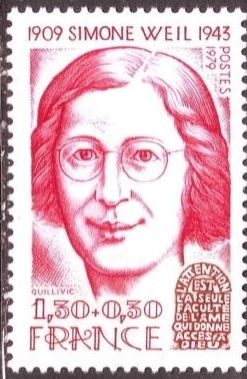
 The text below is a bold rendering in idiomatic English of Simone Weil’s La Pesanteur et laGrâce, chapter 15 “Le mal”. Much could be said to introduce the author and her writings, not to mention the approach I’ve taken, which some may condemn as a paraphrase. My view is that the language of French intellectuals doesn’t take kindly to literal translation.
I’ll say no more other than to invite you to comment, question and/or discuss, either using comment form as normal, or the contact form below for more extended correspondence. It’s wonderful that the Web offers this facility for interested persons to connect.
- Creation: good was torn into fragments and scattered across evil. Evil reigns unlimited and unbound; but it’s not infinite in extent. It is hemmed in and contained by the infinite.
- Monotony of evil: nothing is new under the sun, there is sameness everywhere. Nothing is real, all is imaginary. In the face of this cosmic monotony, quantity steps in and plays its part. Example: A bevy of women, as with Don Juan; or men, as with Célimène. Stuck in a sham infinity: this is hell !
- Evil is “do as you please”: that’s what makes it so monotonous. It all comes out of yourself. Creating something from nothing is not a gift from God to man. It’s a lousy shot at imitating God.
- Many mistakes arise from failing to grasp that we can’t actually be creators. We can only imitate the process of creation, in one of two ways. One is real—to conserve what we have ; the other is merely apparent—to paint over it, in a vandal’s attempt at destruction.
- Keeping what is requires nothing from the “I”. The “I” leaves its mark upon the world by painting over it.
- Morality in literature : Imaginary evil is romantic and takes many shapes. Real evil is dreary, monotonous, arid, boring ; imaginary good is boring.
- Real goodness is ever new, marvellous, intoxicating. Thus fantasy literature is boring, immoral, or a mixture of the two. There’s no escape from this either-or dilemma, unless, through art, it succeeds in reflecting reality. Which takes genius.
- There’s a lower kind of virtue, let’s call it goodness in a distorting mirror, or painted-on beauty. This needs to be cleaned off, this skin is harder to shed than evil itself. As with the Pharisee and the tax-collector.
- Goodness when considered against evil is, in one sense, like every pair of opposites.
- Evil can hurt anything but not goodness. Nothing can hurt goodness, only a degenerate form of goodness.
- Anything which tries to attack evil directly is never true goodness. Sometimes it barely rises above the evil it attacks!
Examples:
robbery fought off by bourgeois property-owners
adulteress condemned by a “virtuous woman”
waste reproached by a miser
lying defamed by a “sincere” politician
Good and evil don’t match. They are not the reverse of one another. Evil is fragmentary, its manifestations are many; but good is singular, all of a piece.
Bad shows itself, good is mysterious. Bad is made up of actions, goodness is often refraining from actions. Set good on the same level as bad and put them in opposition: you’ll get the book of criminal law. What passes there for goodness might not be very far from evil. It does nothing to hold back demagogues and their weasel words. When goodness is defined in the same way as evil, we must reject it. In any case Evil rejects it ; but in an evil fashion.
In those vowed to a life of evil, do their various vices coalesce into “evil” as an abstract force? I don’t think so. Their vices are subject to the downward pull of gravity, not any overarching principle.
[gravity as defined in “Gravity and Grace” ]
You can’t know what goodness is unless you do good. You can’t know what evil is unless you refrain from doing it; or if you have already done it, by repenting it. Those who do evil don’t know what it is, because evil shuns the light.
Does evil even exist, when we think of it without doing it ? When we do evil, doesn’t it seem a simple, natural thing that takes hold of us? Isn’t it a kind of illusion? When you are caught up in it, illusion feels like reality. Perhaps it’s the same with evil. When you’re caught in it, it doesn’t seem like evil, but a necessity—even a duty. Yes, once you’ve started on the path of evil, it does feel like a kind of duty. M0st of us have a sense that we’re only doing our duty, when the things we do are sometimes bad and sometimes good.
The same man considers it his duty to sell for the highest price he can get, and also not to steal. What they take to be within “goodness” is on the same level as evil; a dull kind of good which does not shine.
When an innocent victim suffers, he feels that a crime has been committed. The real crime has no feeling. The innocent victim knows the truth about his executioner, but the executioner doesn’t know it. The evil that the innocent feels in himself is actually in the executioner, but he cannot feel that. He cannot know the evil except in the form of suffering. The thing that the criminal doesn’t know about—is the crime itself. What the innocent cannot feel is his own innocence. It’s only the innocent who feels he’s in hell.
The sin which we hold inside spreads outward and beyond like a contagion. Thus when we are resentful, those around us get resentful too. Thus a boss’s anger strikes fear into his employee. But when it hits a perfectly pure being, there is a transformation : sin gets turned into suffering. This is what Isaiah came to say: “He was oppressed, and he was afflicted, yet he opened not his mouth: he is brought as a lamb to the slaughter, and as a sheep before her shearers is dumb, so he openeth not his mouth.” Such is the suffering that brings redemption. All the criminal violence of the Roman Empire was thrown at Christ, and in him it became pure suffering; while evil ones turn simple suffering, such as an illness, into sin.
We may imagine that this suffering which brings redemption has its origin in society. Wherever humans gather, unfairness and violence are found too.
A false God turns suffering into violence. The true God changes violence into suffering.
Atonement by way of suffering is a shock absorber in response to the evil done.
The suffering which brings redemption is the shadow of that pure goodness for which we have yearned.
In wickedness we pass on to others the sense of humiliation we carry within; as if taking it out on them could lift our own burden.
Every crime involves taking it out on someone else. It’s a transfer of evil from one who acts to one who endures. This is as true of tainted love as it is of murder. The criminal justice system has been contaminated over the centuries as to its treatment of malefactors.
Unless purified of all vengeance, the sentence meted out adds more evil to that person, even if he is guilty and the sentence disproportionate.
The only ones unscathed in this way by the penal system are the hardened criminals. To innocent prisoners it brings terrible harm. When evil is passed on to others, it is not diminished but made worse in the one who has passed on the infection. There’s a multiplier effect. It’s the same when the evil is passed on to things.
What can one do with evil, where can one put it? I have to move it from the impure side of myself to the pure side, transmuting it to pure suffering. The crime I find in myself must be inflicted upon myself. But my inner purity will be damaged unless I renew it from the one source whose purity cannot fail, being out of the reach of all violation.
It takes patience to stop suffering transmuting to crime. It’s more than enough when crime transmutes to suffering. When you pass on evil to things outside world, it sows discord among them. Only that which is exact and fixed— number, proportion, harmony—can resist this discord. Whether I’m brisk or weary, five miles is still the same length. This is where numbers get in the way. When I’m suffering, it gets in the way of this transmutation process. To put my attention on something too solid to be twisted.
The only way to transcend my fickle moods is to focus on something solid and rigorous. This gets me receptive to whatever is constant, and offers me access to the eternal.
Accept the evil done to us in payback for what we’ve done. The true remedy is not to impose suffering on oneself, but to endure what comes to us from outside, unjustly.
When we ourselves have acted unjustly, it’s not enough to suffer justly. We must suffer injustice ourselves.
Purity is sacrosanct by its nature, in the sense that violence can’t make it less pure. All the same, it’s exposed and vulnerable, in the sense that every attack from evil brings suffering, every sin that touches purity is transformed into suffering.
If someone treats me badly, let it not affect me, not bring me down. This is for the love of the one who inflicts it on me, to shield him from his own wrongdoing.
Saints—saints in waiting—are more exposed to the devil than others, because the full awareness of their misery makes the brightness of light almost intolerable.
The sin against the Holy Spirit is to know something as goodness and then to hate it for being good, We go through something like this in the form of resistance, every time we steer towards goodness. This is because contact with goodness makes us aware of the distance between evil and good. It will take arduous effort to come to terms with this distance. There will be pain, and fear too—fear when reality hits. It’s not a sin unless we despair at the magnitude of this gulf, and let the pain turn to hate.
Thus hope is one way out. A better one is indifference to one’s own wants, and joy in the in knowing that goodness exists, no matter how far it may be; even if we feel we will never attain it.
Once an atom of pure goodness has entered the soul, it doesn’t matter how wicked we are, compared with the evil of turning away from goodness, even for a moment, unless instantly recanted. This would be entering hell. The soul which hasn’t tasted pured goodness, is neither in hell not heaven. Hell is not available unless you are committed to salvation. If you don’t actively desire the the joy that can only come from God—if you find it enough to know this joy exists—gravity will operate, you’ll fall. You haven’t betrayed that joy because you don’t know it.
When we love God despite all the evil in this world, it truly is God that we love.
To love God despite the existence of evil : to love God despite the evil we especially hate, while hating this evil : to love God as the author of the evil which we are actually hating. Evil is to love what mystery is to the intelligence. As mystery moves us toward the power of faith in the supernatural, so evil moves us towards the power of forgiveness. Making excuses for evil gets in the way of forgiveness, just as rationality gets in the way of understanding mystery.
Speech of Ivan in The Brothers Karamazov:
Even though this immense factory were to produce the most extraordinary marvels and were to cost only a single tear from a single child, I refuse.
I couldn’t agree more. No possible excuse for a child’s tears would be acceptable to me: nothing that anyone could dream up. Except one, and this makes sense only in the context of supernatural love: ‘God willed it’. If this were the case, I’d just as soon accept a world full of nothing but evil.
Death-agony is the ultimate dark night which even a perfect soul needs, to reach absolute purity. All the better if it’s cruel.
Unreality is what takes goodness out of good; this is what makes evil. Evil is always the destruction of tangible things in which there is the real presence of goodness. Evildoers don’t know about this real presence; in which case it’s true that no one is wicked on purpose. Power relationships set up a vacuum where this presence is lost. It’s terrifying to think of how much evil a man can do and suffer. This is why God suffered crucifixion. How can we believe that anything can make amends for this evil?
Always the destruction of tangible things in which there is the real presence of goodness. Evildoers don’t know about this real presence; in which case it’s true that no one is wicked on purpose. Power relationships set up a vacuum where this presence is lost. It’s terrifying to think of how much evil a man can do and suffer. This is why God suffered crucifixion. How can we believe that anything can make amends for this evil?
Good and evil. Reality. Making beings and things more real is good, taking away their reality is evil. The Romans did evil by plundering statues from Greece: without them, the towns and temples, the whole of Greek society were deprived of some reality, without passing as much forward to Rome. The Greeks begged and begged to keep some of them, desperately trying to convey how precious these statues were in the lives of their own people. In this context, there was nothing base in the way the Greeks responded. But it was almost bound to be ineffectual. We should respect and weigh other people’s values, act fairly in matching ours with theirs.
There’s a cowardice in letting our minds dwell on evil acts, intending to enjoy them and gain advantage without actually committing them. Even to harbour improbable daydreams, without considering their practicality, which is the proper way, is to see ourselves there already. It’s curiosity which sends us in that direction. I can let myself conceive certain thoughts, but not dwell on them in fantasy.
We behave as if merely thinking about something doesn’t bind us, but it’s precisely this that does bind us. Giving our thoughts free rein leads us to licence in all things. The great skill is not to think about it for purity’s sake: a negative virtue. If we let our imagination dwell on something evil, if we mix with others whose words and deeds make it seem neutral, scrapping any taboo, we’re as good as lost aleady. What could be easier? There’s no clear boundary.We don’t see it till we’ve already crossed it.
As for goodness it’s quite otherwise; the ditch is visible before it’s crossed, at the moment when gravity wants to pull us downwards. There’s no falling into goodness. Baseness: the word expresses where evil takes us.
Even as an accomplished fact, evil retains the character of unreality; this perhaps explains the simplicity of criminals; in dreams everything is simple. Simplicity which runs parallel to that of the highest virtue.
Evil has to be made pure, else life is impossible. Only God can do this. It’s the idea behind the Bhagavad Gita. It’s also the idea of Moses, Mohammed, hitlerism… But Jehovah, Allah, Hitler are earthbound gods, their form of purity is pure fantasy.
The only thing that can keep us free from evil is virtue with a clear-eyed view of the possibility of evil, and of evil masquerading as goodness. Calling to mind our past illusions may be the touchstone of truth, and help protect us now.
We can’t hate doing harm to others until we’ve reached the point where nobody can hurt us any more. (Then, if pushed, we can love others for being as we once were.)
Looking at human misery pulls me towards God and it’s only in loving my fellow man as I love myself that I’m able to see this. I can’t see it in my own self, nor can I see it in others, seen from a distance,
It’s not when extreme misfortune grips someone that human misery is created; it simply comes to the surface at that time. Sin and the glamour of violence. So long as the soul hasn’t totally grasped the misery of humanity, we can’t see that we’re all in together. So we cannot behave justly: either because we envision a gulf between ourselves and others, or among those others there are only some that we can love as ourselves.
This is because we do not know that human misery is a constant and irreducible quantity, as great as it can be in every man, and that greatness comes only from God; so that one man is just like every other.
We are surprised to learn that adversity is not ennobling after all. That’s because we think of an afflicted person in terms of their adversity. That’s not the way they see themselves. They fill their heart with what scraps of comfort they can.
Why wouldn’t there be evil in the world? We must make the world foreign to our desires. Suppose it contained no evil: our desires would be for all the wrong things. This isn’t necessary.
There is every kind of distance between creature and God, such a distance as to render the love of God impossible. Animal, vegetable, mineral. Evil is so comprehensive that it cancels itself out, no evil is left, leaving a mirror of divine innocence. We find ourselves at a point where love is just possible, What a huge privilege it is, that the love which unites us is proportional to the distance.
This world that God has created is not the best possible, but includes every kind of good and evil. We’ve reached a stage where it is the worst possible. Go a step beyond, this evil becomes innocence.
 a wayfarer’s notes