
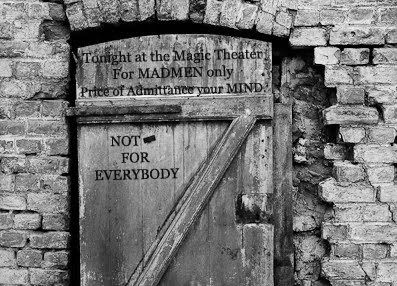
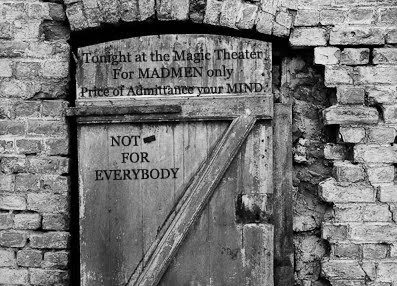
As an art form, the blog has extraordinary possibilities. It’s a “magic theatre: entrance not for everybody”. Anybody may come and peek, but those for whom it’s not intended will swiftly move on. This theatre’s producer—I mean the blog author—may put on a new show every day, or hardly ever. In the public imagination the “weblog”, now simply known as the blog (both words still rejected by Blogger’s own spell-checker) is a space for the brief and gaudy flowering of newsy content: perhaps world news, or just what’s new within the author’s horizon. What you see day to day is liable to be displaced any time by a newer entry and consigned to an archive of past exhibits, filed by date or topic. So it’s not just a fluttering ephemera but also a natural history museum of past efforts, past enthusiasms.
Ephemera: An insect that (in its imago or winged form) lives only for a day. In
modern entomology the name of a genus of pseudo-neuropterous insects
belonging to the group Ephemeridæ (Day-flies, May-flies).—OED
 Like many self-styled writers I once embraced the notion that a book-length book, preferably within hard covers, was the way to go. I had even chosen my publisher: Faber & Faber. I never dared test if they would choose me. It’s not that I have downsized my ambition since then. It’s simply the happy realization that the blog format suits me perfectly; or else that I’ve adjusted to its constraints, reframed them as virtues. I reject the printed book’s pretensions to completion and finality. My entries are essays, successive attempts to convey something, or at any rate to undergo something in the various processes involved in composition. The public imagination may see the blog as a spontaneous expression, like its baby brother, Twitter. They are not wrong. Within written literature, it approaches, but can never quite reach, the danger of live performance. I was recently invited to recite something from this blog on stage at a “Quiet Night Out” at our local arts centre. I said “yes”, until I thought about it later.
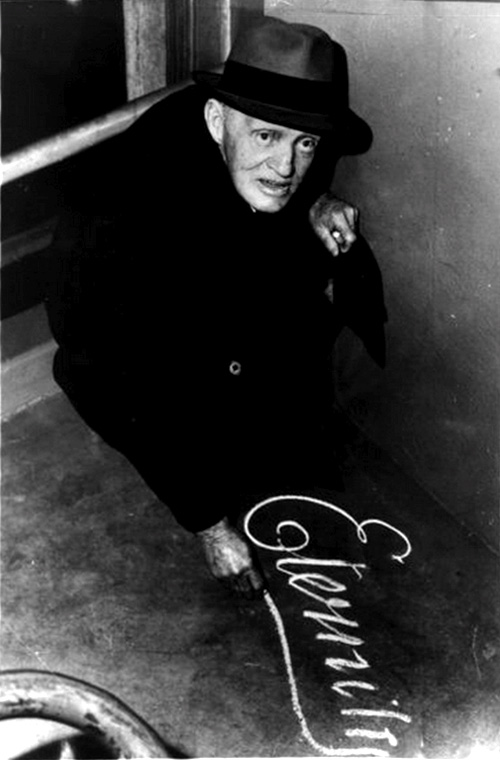
Arthur Stace was a scamp, a wastrel, a war casualty, a drunk, a tramp. He was also Sydney’s most famous author, even though he never had a book published and was so illiterate he could barely write his own name. But Stace—“a little bloke, just five foot three inches tall, with wispy white hair” according to Peter Carey’s 30 Days in Sydney—was also, “a shy mysterious poet… whose work was just one single mighty word”. One word. But, as artist Martin Sharp observed: “Arthur Stace wrote an entire novel in that word.” (from http://www.au.timeout.com/sydney/the-bridge/features/1235/arthur-stace)
Within my blog, I contemplate Eternity. I think that’s my one constant topic. “Eternity is in love with the productions of time”, said Blake in his Proverbs of Hell, themselves productions of time which he engraved on copper plates. So it is fitting that my own process is similarly laborious, involving old-fashioned pen and ink, and a great deal of silence in between. To produce an ephemera, such as a May-Fly or Day-fly, there’s a four-stage metamorphosis: ovum, larva, pupa and imago. I require no less than that delicate creature for this particular “production of time”.
Writing by hand can be a meditation on Eternity; which inevitably brings me to speak of Arthur Stace, and his own metamorphosis.
 His one word was Eternity, and he wrote it in chalk, in perfect copperplate-style handwriting, on the sidewalks of Sydney. He went on doing it for years in secret, till a journalist caught him at it. I can empathize with Stace, for Eternity’s a word which can induce a world-stopping moment, a subliminal satori, a moment sub specie aeternatis. Yes, I like the long words, the Latin and Greek ones, but I aspire to no more than Stace, himself sans Twitter, sans Blogger, sans education. I write in chalk every day on a section of kitchen wall done in blackboard paint: reminders and shopping lists mainly, but the act itself is joyful. It takes me back to my first schoolroom writing, on a slate with chalk; soon followed by copybooks, first traced in pencil, then in ink. We were taught “copperplate”, that is, to write in a flowing hand the whole word without lifting the chalk or the pen-nib. Then we would cross the t’s and dot the i’s.
It is only the sense of “I”, dotted, dotty or otherwise, that holds us back from dwelling in Eternity.
———————————-
The top illustration evokes a scene from The Steppenwolf, by Herman Hesse. Acknowledgements to http://macphisto-thefly.blogspot.co.uk/
Andrew Marr’s programme “Start the Week” on Monday was on “The Dying Art of Handwriting”. You can download it here. It was a joy to find others who voiced so well my own vague thoughts on the subject.
There were 32 comments :
-

Bryan White said…
- Bravo!Yes, one of the things I like most about blogging is how immediate it is – the feedback, the fact the post is instantly live. It feels more like putting on a show than writing a piece.
- October 12, 2012 2:16 pm

-

Da Rev said…
- And we will keep filling the seat and clapping our hands for more.
- October 12, 2012 3:55 pm
-

Vincent said…
- thanks guys, I just got back and embarrassedly corrected some errors thus proving the improvised and provisional nature of the show.
- October 12, 2012 4:56 pm
-
Charles Bergeman said…
- I keep journals that record meeting notes, action items, and observations when I am at work. Some of these end up in a myriad of digital forms that reside in systems that are used in our organization. I also doodle in these journals, random, organic looking pieces that come from my subconscious as I am listening to discussions or waiting for a meeting to start.At home, I keep sketchbooks handy to record ideas, try out techniques, and simply draw what I see.
Occasionally, I will post some of my drawings/doodles on Facebook, where my friends and family can enjoy them. I have not had the motivation to do this on a public blog as yet.
As some of you know I did, at one time, have a blog. It is still there, but I fall into the category of those who have abandoned the routine blogging I once did in favor of the more immediate and less public option of Facebook.
Will Facebook posts remain accessible indefinitely? What will happen to them after those who “friended” (an odd term used only in the realm of Facebook) you are long gone? Will it become the fertile ground of future archaeologists?
The same could be said of Blogs, long after we are gone and the blog becomes stagnant, will there be some who will search and find these writings? Will they take on a life after we are gone?
Eternity, what does in mean in the digital world we live in today, tomorrow and beyond. I wonder.
- October 12, 2012 7:11 pm
-

joanne said…
- I still enjoy the format of blogging, especially when longer term connections have been established. I enjoy following the experiments and performances and the change in scenes and characters and costumes. It’s a different stage than a book, but nonetheless an added valuable addition as a form of expression that allows us to draw a little closer to one another and allows us to become participants in one another’s performances, rather than merely spectators in the audience.
- October 13, 2012 12:34 am
-
Vincent said…
- Charles, in response to your questions, Eternity doesn’t exist in the same axis as the world of phenomena, including the digital world. I nearly included a few lines distinguishing the mortality/immortality axis from that of the temporal/eternal.”Eternity is in love with the productions of time [the temporal]”, said Blake. The temporal includes the creations of Nature and of Man.
Immortal in common usage is a relative word. At the least it means outlasting a human lifetime.
Though I sometimes have a Facebook presence, I don’t really understand how it works. But with blogs there are ways to preserve their content. I’m making a Kindle omnibus version of mine, indexed in various ways, just in case any part of it interests others in the future.
- October 13, 2012 6:22 pm
-
Vincent said…
- Yes, Joanne, it allows us to draw a little closer and be participants to one another’s performances, and have some mementoes of encounters with those one has never met face to face.And yet I feel that the blog format can be used for almost unlimited purposes, like the Web itself.
- October 13, 2012 6:25 pm
-
Gina said…
- For me the blog format is like publishing entries in an art journal but with the added attractions of curating an art show or an exhibition of one’s own.Those connections Joanne wrote about – the fact that a few people have found it entertaining or fulfilling enough to return again and again…that lends a lot of meaning to my blogging experience.
At one time I kept art postcards and notes in a lovely museum store notebook and a half dozen people have looked at it once in a while over the course of several years. Now I have a blog that has put me in touch with so many people from around the world. Some of them I even consider my friends.
Eternity. Mr. Stace writes the word with some letters connected and others not. That is how I write – a hybrid of print and cursive where each combination of letters has its own way of joining or not joining together. I don’t make flourishes, though, as Mr. Stace does with the E. I have never liked curly letters.
By the way, Vincent, I have never encountered the word “wastrel”. I said it aloud and Wayne awoke from his nap… 🙂
- October 14, 2012 10:51 pm
-
Vincent said…
- “Wastrel” is a lovely word: “A good-for-nothing, idle, worthless, disreputable person” (OED). Yes, I echo your words, dear Gina.I should have included in my post an acknowledgement to a couple of writing groups which have sprung up within walking distance of home. We talk and showcase our works and encourage one another to bold feats. this experience perhaps more than any other has hardened my realization that my ambition stops here–realizing I’ll never be a performance poet, novelist, SF writer, short-story teller or playwright like the others, but am content to go on doing what I do plus reading their manuscripts admiringly …
- October 15, 2012 1:59 pm
-
Vincent said…
- On your point about Stace’s cursive chalk script, I got my picture from here: http://louerchezsoi.files.wordpress.com/2011/01/etern1.jpg and I think the left-hand picture doesn’t show the faint upstrokes which keep all the letters joined up as shown on the facsimile at right. Certainly I find that when writing on the blackboard with only a tiny remnant of chalk, it is easier not to lift the chalk between letters for risk of letting it drop. It’s a seemingly unimportant detail until you experience its ritual value, to help offer a glimpse of Eternity itself. One of a billion ways.
- October 15, 2012 3:16 pm
-

Rebb said…
- I don’t have any words, except to say how much I enjoyed your essay, Vincent. Oftentimes your essays will stick with me or I’ll recognize similar processes and feelings that I have but am not able to fully articulate. Even though we are so very different, I always feel a familiar vibration in you.
- October 15, 2012 4:50 pm
-

Davoh said…
- Hand writing – the land of painted caves. (yer, i know; a book imagined by Jean M Auel, published; and printed via recent technology).Who knows how much electronic technology will survive for the next 3-4 thousand years;?
- October 21, 2012 10:51 am
-

ZACL said…
- Writers of old would have had little idea, if any, that their their rock created doodles and various styles of writings would still be with us and studied today. Who is to say that modern technological communications will not make an eternal mark? They are likely to be viewed differently, though the analytical mind and the perceptive eye will see similarities, and in some instances a oneness produced via another means to gain the same or similar ends.Communicative technologies are precious. The pen is a lovely artistic means of production, as is the art of using the quill, or the paint brush. The illuminated manuscripts of the monks are glorious. We are fortunate to be able to see copies of them because of the burgeoning of information technology. Current communication skills can be very beautiful too and give large numbers of people the means of accessing all sorts of personal imprints.
- October 21, 2012 3:57 pm
-
Vincent said…
- Davoh and ZACL: I ought to clarify a point about Eternity, in the sense I used it in this piece: a very old-fashioned sense, wherein everything in our sublunary universe will pass away. “Sublunary” itself is a very old-fashioned word, predating Copernicus, never mind space travel.So by Eternity I meant the perhaps imaginary realm beyond Time itself.
Davoh, I followed up your book-hint re Jean M Auel The Land of Painted Caves. Have you read it? Would you recommend it? I didn’t feel it was my kind of thing, I must confess.
ZACL, I concur completely with your comments about all the different kinds of communicative technology. they have always fascinated me, ever since as a boy of 7 I tried to grapple with the notion of printing. There was a thing called the John Bull Printing Outfit, in which you had rubber letters which you could place in wooden racks with tweezers to create your own rubber stamps. they were used by adults for various purposes and were also toys for those interested like me. I fantasized about starting my own publishing company using such an outfit. Sixty-odd years later that has come true.
“Lector, si monumentum requiris, circumspice.”
I also had the idea, about ten years ago, of software which could aid production of those illuminated manuscripts, with electronic versions of ink in gold, vermilion, lapis lazuli etc. (See also this post.)
- October 28, 2012 6:21 am
-
Davoh said…
- um, ok, have to admit that the writings of Jean Auel is ‘not my thing’ .. merely mention her/it because she has obviously done an enormous amount of research into the history of ancient peoples.Tried, as it were, to ‘bring them to life’, but within the understanding of ‘modern’ teenagers.
Am, at this time, reading “the Autobiography of Henry VIII – with notes by his fool Will Somers” – written, of course – with a title like that – by Margaret George [published by Pan].
Yet another apparently well, and deeply researched ‘fiction’.
Who knows, Vincent – what is ‘real’ ….
- October 31, 2012 2:43 pm
-
Davoh said…
- … and while am here (i.e. commenting) – it seems to me that human beings have trouble contemplating concepts like “infinity” and “eternity”.’Tis more ‘comfortable’ to view existence with ‘boundaries’.
- October 31, 2012 3:02 pm
-
Davoh said…
- ..your yard,fence, concept – is yours, this is my fence; draw the line; defence; offence.
- October 31, 2012 3:05 pm
-
Davoh said…
- .. the cosmos cares not a whit
for twits. - October 31, 2012 3:08 pm
-
Davoh said…
- Meanwhile – back on the original premise of this post – handwriting; where would we be without the ancient Babylonians (clay), indeed, the Egyptians (writing in, and on, stone).Where DID ‘written’ language – and ‘communication’ – come from. Think about it.
- October 31, 2012 3:15 pm
-
Vincent said…
- The latest in your rash of welcome comments, dear Davoh, is the only one to stir me out of idleness of the digits into a reply.For there is something we should all know, whether twits, non-twits or anti-twits. The cosmos, however allegedly large it may appear compared with you and me, cares a myriad whits, for we are children of the cosmos and in a sense its parents too. For we are woven into its very weft, not to men
 tion its woof. We are rearrangements of cosmic dust according to some mysterious and magical formula. Perhaps we are the greatest in creation, or perhaps we are just temporarily-animated dust that dreams, and then is.
Perhaps we are just part of the great Lila, or play of the gods.
But whatever we are, as children of the Cosmos, we ourselves do care. Whence did that caring arise? Did we ourselves invent it? How did that come about.
Personally I find it more comfortable to contemplate Eternity than any boundary you care to name, though my garden fence is looking pretty this Autumn (yeah, I know, it’s probably your spring) with the leaves of the creeper turning polychromatic. Wondrous enough . . .
- October 31, 2012 3:24 pm
-
Vincent said…
- Ah, you sandwiched in another comment whilst I was writing mine. I think we would easily have invented handwriting a hundred times over if the Babylonians ran out of mud and never invented cuneiform.I heard on the radio this morning that they handed out tablets (some kind of mobile phone, not pills) to little children in Ethiopia who had no prospect of ever going to school. Everything was written on these devices in English. they very quickly learned to use them by playing endlessly and sharing their discoveries with one another. Apparently they learned much more rapidly than if they had gone to school.
- October 31, 2012 3:29 pm
-
Vincent said…
- To prove that I didn’t imagine the above, see http://news.bbc.co.uk/today/hi/today/newsid_9765000/9765200.stm
- October 31, 2012 3:31 pm
-
Davoh said…
- (and if if makes any sense, have been talking with one Australian aboriginal elder. He has no need to “write” … simply ‘remembers things’.
- October 31, 2012 3:33 pm
-
Davoh said…
- wow .. GMT vs Auest.
- October 31, 2012 3:36 pm
-
Vincent said…
- if certainly makes good sense. He says he has no need to write, but I suggest he has a need to defend his dignity in the face of illiteracy. Can he read? I respect the aborigines greatly, but …
- October 31, 2012 3:40 pm
-
Vincent said…
- Yeah, who needs instant messaging, or whatever it’s called?
- October 31, 2012 3:41 pm
-
Davoh said…
- um, yep Vincent, was hoping that youse guys wuz all asleep up there .. oops.
- October 31, 2012 3:43 pm
-
Vincent said…
- To be honest, it’s the time when I often take my afternoon nap, but you’re keeping me awake.
- October 31, 2012 3:45 pm
-
Unknown said…
- I looked up weft and woof. I was previously unfamiliar with these words (woof is something a dog does.) Sometimes I think you’ve lived forever, Vincent. :-)Oh, no. I see all those bloody links down there…they’ll drown us…do you think perhaps they appear because of some blogger setting that’s enabled?
- November 01, 2012 2:05 am
-
Vincent said…
- Don’t you dare do anything to remove those links, Gina. They are to this site an ornament and a diadem. And when Satan finds some mischief still, for idle hands to do, each of those links opens up a different chamber of Aladdin’s cave, to amaze and edify. Only the most petty-minded will think that Gina Duarte is brazenly flaunting & disproportionately showcasing! I love to choose one at random. it’s never time wasted. In those moments, I’m like one of those Ethiopian boys (forgive me, I see them all as boys) discovering the secrets of Western civilization from a tablet foud in the desert, a kind of reverse Rosetta stone.
- November 01, 2012 5:05 am
-
Vincent said…
- I meant warp and woof, of course. Weft and woof are the same thing.
- November 01, 2012 3:15 pm
-
Davoh said…
- Ah, the weft and warps of life’s tapestry …
- November 03, 2012 2:34 am
 a wayfarer’s notes

Thanks for your Like, Phil. If you look up “Arthur Stace” on Google, there’s an enormous amount of information on him, including a long article on Wikipedia. Also if you put his name in Search, above, you’ll see two other posts which talk about him on this blog
LikeLike