

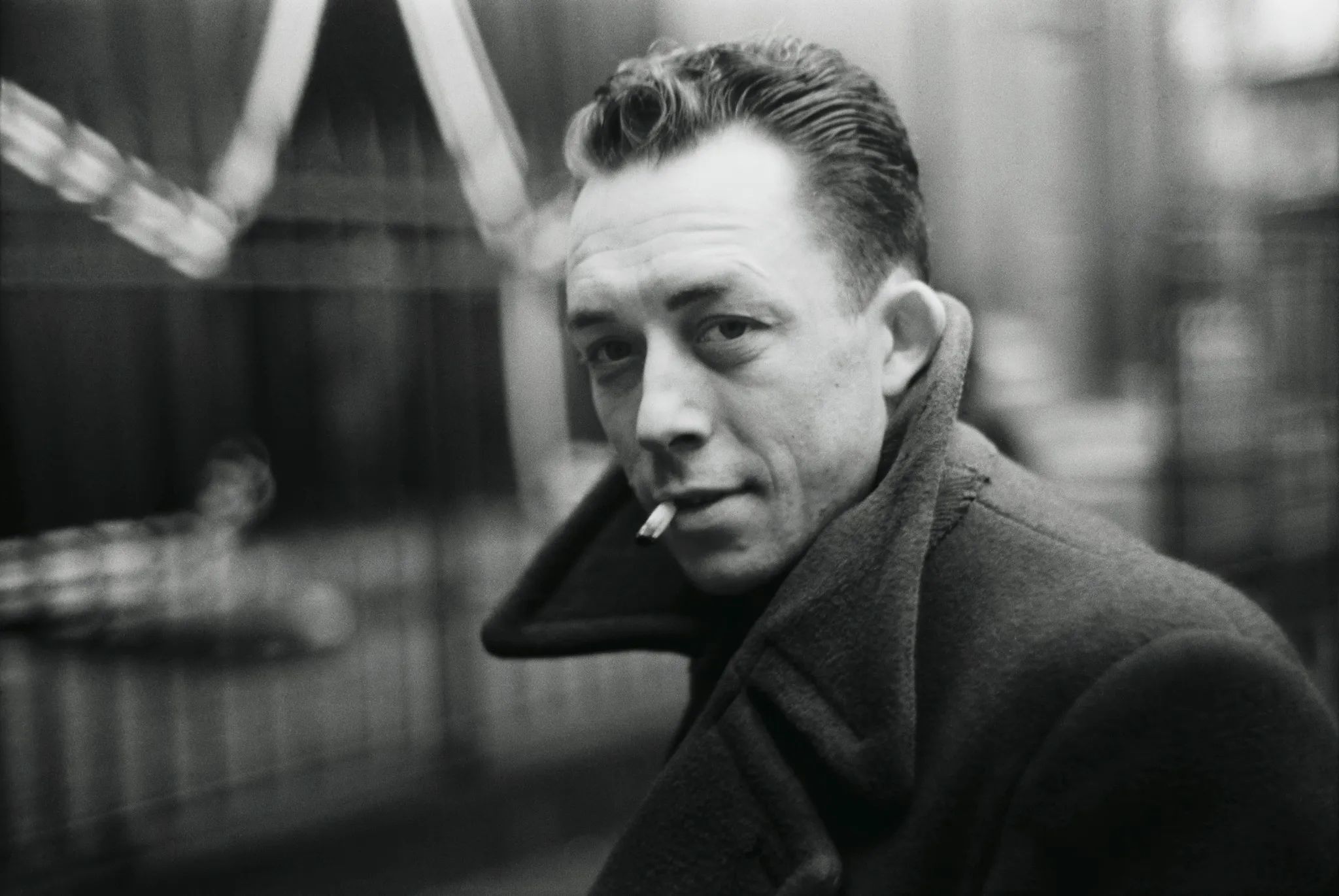
Le Mythe de Sisyphe: essai sur l’absurde
Albert Camus © 1942 Éditions Gallimard
Translation © 2010 Ian Vincent Mulder
I’ve decided to publish extracts of my new translation, which remains unfinished, on this blog, starting below:
This book is about a certain sensitivity, which I call “the absurd”. You will find traces of it scattered throughout the present century. It doesn’t cover a philosophy of the absurd. That doesn’t exist in our time, though basic honesty demands that I declare my debt to certain contemporary thinkers. Far from hiding this debt, I’ve taken pains throughout to quote them, and discuss their thought.
In the meantime it’s worth noting that this essay takes “the absurd”, which others have made into a conclusion, as a jumping-off point. In this sense you could call my remarks tentative: you can’t know in advance where they may go. All you will find here is the description, pure and simple, of a spiritual affliction. We step out unencumbered by metaphysics or beliefs, but with an open mind. The book confines itself within these limits, and with no other bias.
Suicide and the Absurd
There’s only one truly serious philosophical problem: suicide. “Is life worth living?”: that is the fundamental question of philosophy. As for the rest: “Does the world have three dimensions?” “How many ways can you divide up the human mind?”: these come later. They are just games: the main question still waits unanswered. And if it’s true, as Nietzsche would have it, that a philosopher can only gain respect if he teaches by example, we hang on to his reply, expecting words to be followed by deeds in due course. Deeds are enough to convince the heart, but to get things clear in our mind too, we must dig deeper.
When I ask myself how to tell if one question is more urgent than another, my reply is “See what actions follow”. I never heard of anybody dying for the sake of the ontological argument.(1) Galileo set great store by scientific truth, but he let it all go without a qualm the moment it put his life in peril; and thereby did well, for his truth wasn’t worth being burnt at the stake. Who cares if the earth goes round the sun, or the other way round? It doesn’t matter a jot; the question is plainly futile. On the other hand, I see many people choose to die because they find life not worth the living. I see others who get killed for the sake of ideas or illusions which give them a reason to live. What a paradox, that a reason to live should make an excellent reason to die! So I see that the meaning of life is the most urgent question we have. How to answer it? On all the essential problems, those to die for and those to live for, there can’t be more than two schools of thought: that of La Palisse (2) or that of Don Quixote. The one is evidential and obvious, the other quixotic and lyrical. Only a balance between the two can appeal both to emotions and the need for clarity. Faced with a subject so lowly and full of pathos, classical learning and dialectic must give way to common sense and compassion.
Suicide has never been considered as anything but a social phenomenon. What we shall discuss here, on the other hand, is the relationship between suicide and individual thought. The act is gestated over time in the heart’s deep silence, just like a great deed or work of art. The person himself knows nothing about it. One night, he pulls the trigger, or jumps. Someone told me about a property manager who killed himself. Five years before, he had lost his daughter. From then on, he became a changed man. It was eating him all that time: yes, the expression could not be more precise. What starts with a man thinking, ends with a man chewed up by his thoughts. Society has nothing to do with it. The worm is there in your own heart; look no further. This deadly pursuit, which starts with a clear-eyed vision of existence and ends with a plunge into darkness, is the thing we shall trace here.
A suicide has many causes, the most obvious being usually the least relevant. It’s rarely the result of conscious reflection, though that can’t be ruled out. The final trigger can seldom be verified. Newspapers often speak of “depression” or “incurable illness”: these are useful enough explanations. But we need to know if the despairing person’s friend had spoken to him that day in an offhand manner. Blame that! That’s when all the bitter weariness, held in suspension till that moment, would be suddenly precipitated (3).
But if it’s difficult to pinpoint the exact moment in the game where the wager is placed on death, it’s easier to work out the act’s significance. It’s a gesture in a melodrama—confessing on open stage that you find life overwhelming, impossible to understand. In everyday terms, it’s a confession that it’s “not worth the trouble of living”. But then, living is never easy. You continue to go through the motions as life dictates—out of habit, for a start. To die from choice presupposes that you’ve instinctively recognised how pathetic it is to live just by habit, devoid of meaning, enduring each day’s crazy turmoil, and the uselessness of merely putting up with it.
Notes
1. “Ontological arguments are arguments, for the conclusion that God exists, from premises which are supposed to derive from some source other than observation of the world—e.g., from reason alone.”—Graham Oppy, Stanford Encyclopedia of Philosophy. [Translator’s note]
2. La Palisse gained posthumous fame from his epitaph. Read properly it meant “Here lies Monsieur de la Palice: If he wasn’t dead, he would still be envied.” A misreading of the French (an f mistaken for a long s and envie read as en vie) produced “Here lies Monsieur de la Palice: if he wasn’t dead, he would be still alive”. Comic songs were later written containing similar truisms, which came to be known as Lapalissades. [Translator’s note]
3. Let us not forget that this essay considers one side only. Suicide can manifest for much more honourable motives, for example a means of political protest in the Chinese Revolution. [Author’s note]
—To be continued.
 a wayfarer’s notes
Hayden said…
“a philosopher can only gain respect if he teaches by example, we hang on to his reply”
preferring, for my morning humor, to mentally omit the “to” and take the last clause literally.
I wonder, though, if suicide IS a social phenomenon. Is it simply a topic always hushed up, or is it something we see more commonly today than we did in ancient times? Wish I could recall what the Greeks said on the subject, but the pace of work is intense on the farm right now, so I’m not apt to look it up. I agree with you that the decision is made in solitude – what I wonder is about the loss of community that has created so much solitude in the last 100 years or more. In short, I’m not certain one can ignore it as a social phenomenon.
What I’m most confused about in your argument, however, is that you seem to say that it is a conclusion arrived at by thought “What we shall discuss here, on the other hand, is the relationship between suicide and individual thought. ” then go on to say…It’s rarely the result of conscious reflection, though that can’t be ruled out.” and conclude that the final act is “instinctive.”
Why/how do you get to the idea that it’s instinctive, rather than a case of intellectual water torture, the constant ‘drip drip drip’ of mental irritation continuing until finally one can take no more?
In the case sited, the property owner changed by his daughter’s death seems easy for me to imagine…. after catastrophic loss one waits and waits for the pain to subside, waits for life to take up the reins again and to be able to move on…. and then finally, little by little the recognition comes that the pain will never end, that nothing will be the same, that the death was irrevocable not only for the daughter, but for the part of his life that depended on her existence for his happiness.
For myself, I remember often playing those waiting games, wondering when it would stop hurting to remember.
Our society expects us to thoroughly “bury” people in a couple of weeks, but even a year is not always enough. For me, it took nearly ten before I was effectively able to bury my losses.
Vincent said…
Vincent said…
As the book progresses, he clarifies where reason and instinct diverge, in fact this is the very nub of the Absurd. I’ve been continuing the translation today, about 5000 word further on, and he says:
“I said that the world is absurd, but I went too fast. The world itself isn’t reasonable, that’s all one can say about it. What’s actually absurd is the conflict between this unreason and this hopeless desire for clarity which so profoundly resonates in man.”
After that he looks at various philosophers, particularly the Existentialists, from Kierkegaard onwards, to see how they prefigure and inspire his own ideas of the Absurd.
Vincent said…
Vincent said…
raymond said…
Camus is assuming a normative world where everyone has the same serious philosophical problem. I don’t see the warrant for that conclusion.
In my case the only interesting question is whether or not I am enjoying myself enough. What keeps me alive at times, is that I also enjoy considering why I am not, when I am not. But that’s just me, as far as I know.
Vincent said…
And you may find his attitude interesting to compare with that of Ernest Becker, about whom I wrote whilst thinking of you on your peace pilgrimage to Jerusalem (if I may characterise it thus!)
And in your absence I also wrote a little about Chuang Tzu.
Vincent said…
Hayden said…
I love the refinement of the ‘absurd’ as a dicotomy between the unreasonableness of life, and our own drive for clarity. I recall now someone once argued w/ my existential despair by saying that ‘Life doesn’t have meaning, it simply ‘IS.’ It’s up to you what you make of it.” It didn’t ease my anguish, but it the idea took hold, as is evidenced by the fact that I’ve remembered it for so long.
Vincent said…
Your summary “Life doesn’t have meaning, it simply ‘IS.’ It’s up to you what you make of it” might be a simple summary of Camus’ book too, not that he would have approved anything so simple.
raymond said…
I find that it is useful for me to entertain the notion of absurdity as being possibly the authentic summary of the human situation. But I find it absurd to prescribe this position to others.
Vincent said…
raymond said…
Wiki quotes Camus as saying, “From the moment absurdity is recognized, it becomes a passion, the most harrowing of all.”
It also seems to produce a non-absolute form of spiritual “deliverance.” The freedom to feel as good or as terrible as one likes.
brad4d said…
raymond said…
If all is illusion, (“a chase after the wind” Ecclesiastes 1:14) it may still be the case that uncertainty provides the most effective (enjoyable) illusion.
Vincent said…
It’s a certain way to make your wish to come true, if your wish is not to be here on earth.
But there is the uncertainty as to what happens a few moments after your last breath.
raymond said…
Anonymous said…
That sounds all rather intellectual and abstract. In my experience (not huge, but actual) of suicide and suicide attempts, it is anything but intellectual, and is preceded by an immense emotional struggle, not least with one’s own body, which has its own views on the matter and will go to unbelievable lengths to keep right on breathing.
“Chewed up by his thoughts” sound pretty accurate to me.
Vincent said…
As for the accuracy of “chewed up by his thoughts”, that was one of my boldest attempts at translation. But you can judge for yourself. Here is Camus’ original:
D’un gérant d’immeubles qui s’était tué, on me disait un jour qu’il avait perdu sa fille depuis cinq ans, qu’il avait beaucoup changé depuis et que cette histoire “l’avait miné”. On ne peut souhaiter de mot plus exact. Commencer à penser, c’est commencé d’être miné.
The official and only existing English translation, by Justin O’Brien, is literal:
Of an apartment- building manager who had killed himself I was told that he had lost his daughter five years before, that he had changed greatly since and that that experience had ‘undermined’ him. A more exact word cannot be imagined. Beginning to think is beginning to be undermined.
French can be dry and conceptual. I felt the translator needs to do more. Pictorially, to “undermine” is to eat up the ground beneath your feet. My strategy throughout is to reconstruct what Camus might have written if he were English:
Someone told me about a property manager who killed himself. Five years before, he had lost his daughter. From then on, he became a changed man. It was eating him all that time: yes, the expression could not be more precise. What starts with a man thinking, ends with a man chewed up by his thoughts.
Anonymous said…
I think ‘chewed up by his thoughts’ is powerfully emotionally telling, although there is still something to be said for ‘undermined’, as, at least in English, it carries the connotation of betrayal, which is apposite in the circumstances – betrayed by your own thoughts. I don’t know if carries the same connotation in French.
Vincent said…
But there is more to be said about animal suicide, I think. I shall put this down in a new post.