
 I like opening extraordinary and special books at random, such as The Book of Disquiet (Pessoa), Centuries (Traherne) and Anam Ċara (O’Donohue).
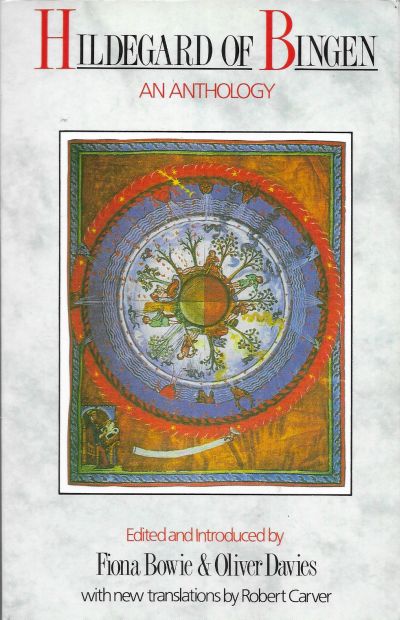
This is what came up when I did the same with our current book. It’s the section titled CAUSES AND CURES, pp 108-11.
The four elements
That there are only four elements: There cannot be more than four, or fewer. They consist of two kinds: upper and lower The upper are celestial, the lower terrestrial. The things flu. live in the upper ones are impalpable and are made of fire an air; those that move in the lower are palpable, formed bodies, and consist of water and mud. For spirits are fiery and airy, but man is watery and muddy. When God created man, the mud from which he was formed was stuck together with water, and God put a fiery and airy breath of life into that form.
Adam and Eve
When God created Adam, Adam experienced a sense of great love in the sleep that God instilled in him. And God gave a form to that love of the man, and so woman is the man’s love. And as soon as woman was formed God gave man the power of creating, that through his love — which is woman — he might procreate children. When Adam gazed at Eve, he was entirely filled with wisdom, for he saw in her the mother of the children to come. And when she gazed at Adam, it was as if she were gazing into heaven, or as the human soul strives upwards, longing for heavenly things — for her hope was fixed in him. And so there will be and must be one and the same love in man and woman, and no other. The man’s love, compared with the woman’s, is a heat of ardour like a fire on blazing mountains, which can hardly be put out, whilst hers is a wood-fire that is easily quenched; but the woman’s love, compared with the man’s, is like a sweet warmth proceeding from the sun, which brings forth fruits. But the great love that was in Adam when Eve came forth from him, and the sweetness of the sleep with which he then slept, were turned in his transgression into a contrary mode of sweetness. And so, because a man still feels this great sweetness in himself, and is like a stag thirsting for the fountain, he races swiftly to the woman and she to him — she like a threshing-floor pounded by his many strokes and brought to heat when the grains are threshed inside her.
The four temperaments of woman
Some women are inclined to plumpness, and have soft and delectable flesh and slender veins, and well-constituted blood free of impurities . . . And these have a clear and light colouring, and in love’s embraces are themselves lovable; they are subtle in arts, and show self-restraint in their disposition. At menstruation they suffer only a moderate loss of blood, and their womb is well developed for childbearing, so they are fertile and can take in the man’s seed. Yet they do not bear many children, and if they are without husbands, so that they remain childless, they easily have physical pains; but if they have husbands, they are well.
There are other women whose flesh does not develop as much, because they have thick veins and healthy, whitish blood (though it does contain a little impurity, which is the source of its light colour). They have severe features, and are darkish in colouring; they are vigorous and practical, and have a somewhat mannish disposition. At menstruation their menstrual blood flows neither too little nor too abundantly. And because they have thick veins they are very fertile and conceive easily, for their womb and all their inner organs, too, are well developed. They attract men and make men pursue them, and so men love them well. If they want to stay away from men, they can do so without being affected by it badly, though they are slightly affected. However, if they do avoid making love with men they will become difficult and un-pleasant in their behaviour. But if they go with men and do not wish to avoid men’s love-making, they will be unbridled and over-lascivious, according to men’s report. And because they are to some extent mannish on account of vital force within them, a little down sometimes grows on their chin.
There are other women who have slender flesh but big bones, moderately sized veins and dense red blood. They are pallid in colouring, prudent and benevolent, and men show them reverence and are afraid of them. They suffer much loss of blood in menstruation; their womb is well developed and they are fertile. And men like their conduct, yet flee from them and avoid them to some extent, for they can interest men but not make men desire them. If they do get married, they are chaste, they remain loyal wives and live healthily with their husband; and if they are unmarried, they tend to be ailing — as much because they do not know to what man they might pledge their womanly loyalty as because they lack a husband. But there are other women who have gaunt flesh and thick veins and moderately sized bones; their blood is more lead-coloured than sanguine, and their colouring is as it were blended with grey and black. They are changeable and free-roaming in their thoughts, and wearisomely wasted away in affliction; they also have little power of resistance, so that at times they are worn out by melancholy. They suffer much loss of blood in menstruation, and they are sterile, because they have a weak and fragile womb. So they cannot lodge or retain or warm a man’s seed, and thus they are also healthier, stronger and happier without husbands than with them—especially because, if they lie with their husbands, they will tend to feel weak afterwards. But men turn away from them and shun them, because they do not speak to men affectionate-ly, and love them only a little. If for some hour they experience sexual joy, it quickly passes in them. Yet some such women, if they unite with robust and sanguine husbands, can at times, when they reach a fair age, such as fifty, bear at least one child
. . . If their menopause comes before the just age, they will sometimes suffer gout or swellings of the legs, or will incur an insanity which their melancholy arouses, or else back-ache or a kidney-ailment . . . If they are not helped in their illness, so that they are not freed from it either by God’s help or by medicine, they will quickly die.
After this, there are 12 short poems, which I hope to publish in my next.
in haste;
Waking up on Thursday 4th December, it occurs to me that what you and I now want to know is “who was Hildegarde? How did she get to be an Abbess? What life experiences gave her the insight to write stuff like this, which seems very different from any 11th-century manuscripts that we know of?” —as if I’ve ever seen any?
Next post coming soon …
 a wayfarer’s notes
excellent! She seems to have been a real free thinker.
LikeLike