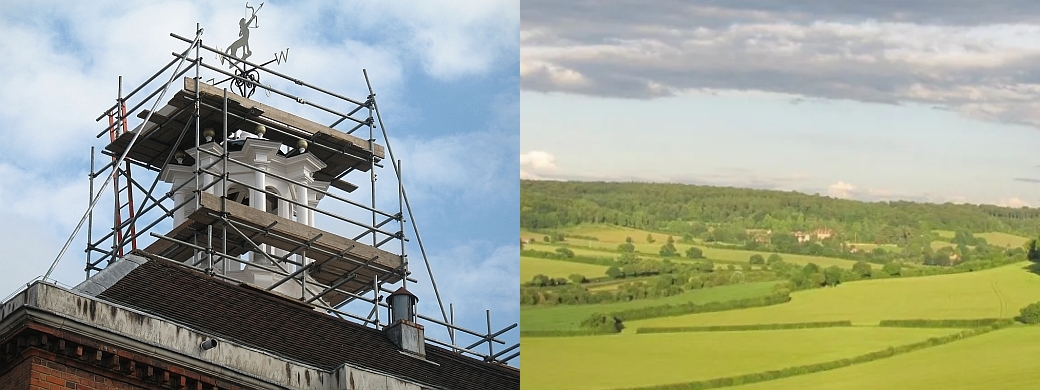


I found this on my computer as a Word document. Checking online, I discover it’s from Museum without Walls, by Jonathan Meades
We are surrounded by the greatest of free shows. Places.

Most of them made by man, remade by man. Deserted streets, seething boulevards, teeming beaches, empty steppes, black reservoirs, fields of agricultural scrap, cute villages and disappearing points which have an unparalleled capacity to promote hope (I am thinking of the aspect north up Rue de Paradis in Marseille).
This book is the product of an obsessive preoccupation with places, mainly British places, with their ingredients, with how and why they were made, with their power over us with their capacity to illumine the societies that inhabit them and above all, with the ideas they foment.
Much of it evidently concerns buildings, the gaps between them, their serendipitous conjunctions and grotesque collisions. High architecture comes into it, but so too do inspired bricolage, plutocratic boasts, arid estates, mighty sprawl. The catastrophic cock-ups of grandiloquent visionaries are as grimly appealing as the imaginatively bereft efforts of volume builders. There is an emphasis on buildings which are overlooked or which, should they be noticed, are unthinkingly despised, just as there is on topographies which are routinely neglected: the banal is a thing of joy. Everything is fantastical if you stare at it long enough, everything is interesting. There is no such thing as a boring place.
These lectures, essays, polemics, squibs and telly scripts are intended to entertain, to instruct, to inform and to question the orthodoxies of the architectural heritage and construction industries, to draw attention to the rich oddness of what we take for granted. But before that they are written because I want to read them. If that sounds selfish and immodest so be it. But it is surely more honest to to write for an audience of one whose peccadilloes and limitations I understand than for an inchoate mass of opinionated individuals whose multiple and conflicting tastes I can only guess at and which I have, above all else, to be indifferent to. Regis Jauffret got it right when he said that he was disgusted by writers who think of their readers.
This is a pretty basic point which the cretinocracy that has seized control of television cannot begin to understand. There is much that it cannot understand: the unknown, alien opinions, intelligence. And that it cannot understand it seeks to squash. One becomes inured to censorship by dolts: mocking the INLA (Irish National Liberation Army) can cause the impressionable to take up terrorism; Muslims must be treated with a respect that is not accorded to other delusionists (who are less sensitive, less heavily armed); the sight of dead rabbits may offend—who? Living rabbits? I am inured, too, to being accused of bigotry and bias by persons who are blind to their own bigotry and bias, which they perceive as unexceptionable opinions or even the Truth. The scripts collected here include a number of passages deemed unfit for human consumption as well as the omission of half-witted health warnings to the effect that my observations do not concur with the BBC’s pensée unique.We are surrounded by the greatest of free shows. Places.
Most of them made by man, remade by man. Deserted streets, seething boulevards, teeming beaches, empty steppes, black reservoirs, fields of agricultural scrap, cute villages and disappearing points which have an unparalleled capacity to promote hope (I am thinking of the aspect north up Rue de Paradis in Marseille).
This book is the product of an obsessive preoccupation with places, mainly British places, with their ingredients, with how and why they were made, with their power over us with their capacity to illumine the societies that inhabit them and above all, with the ideas they foment.
Much of it evidently concerns buildings, the gaps between them, their serendipitous conjunctions and grotesque collisions. High architecture comes into it, but so too do inspired bricolage, plutocratic boasts, arid estates, mighty sprawl. The catastrophic cock-ups of grandiloquent visionaries are as grimly appealing as the imaginatively bereft efforts of volume builders. There is an emphasis on buildings which are overlooked or which, should they be noticed, are unthinkingly despised, just as there is on topographies which are routinely neglected: the banal is a thing of joy. Everything is fantastical if you stare at it long enough, everything is interesting. There is no such thing as a boring place.
These lectures, essays, polemics, squibs and telly scripts are intended to entertain, to instruct, to inform and to question the orthodoxies of the architectural heritage and construction industries, to draw attention to the rich oddness of what we take for granted. But before that they are written because I want to read them. If that sounds selfish and immodest so be it. But it is surely more honest to to write for an audience of one whose peccadilloes and limitations I understand than for an inchoate mass of opinionated individuals whose multiple and conflicting tastes I can only guess at and which I have, above all else, to be indifferent to. Regis Jauffret got it right when he said that he was disgusted by writers who think of their readers.
This is a pretty basic point which the cretinocracy that has seized control of television cannot begin to understand. There is much that it cannot understand: the unknown, alien opinions, intelligence. And that it cannot understand it seeks to squash. One becomes inured to censorship by dolts: mocking the INLA (Irish National Liberation Army) can cause the impressionable to take up terrorism; Muslims must be treated with a respect that is not accorded to other delusionists (who are less sensitive, less heavily armed); the sight of dead rabbits may offend—who? Living rabbits? I am inured, too, to being accused of bigotry and bias by persons who are blind to their own bigotry and bias, which they perceive as unexceptionable opinions or even the Truth. The scripts collected here include a number of passages deemed unfit for human consumption as well as the omission of half-witted health warnings to the effect that my observations do not concur with the BBC’s pensée unique.
 a wayfarer’s notes