

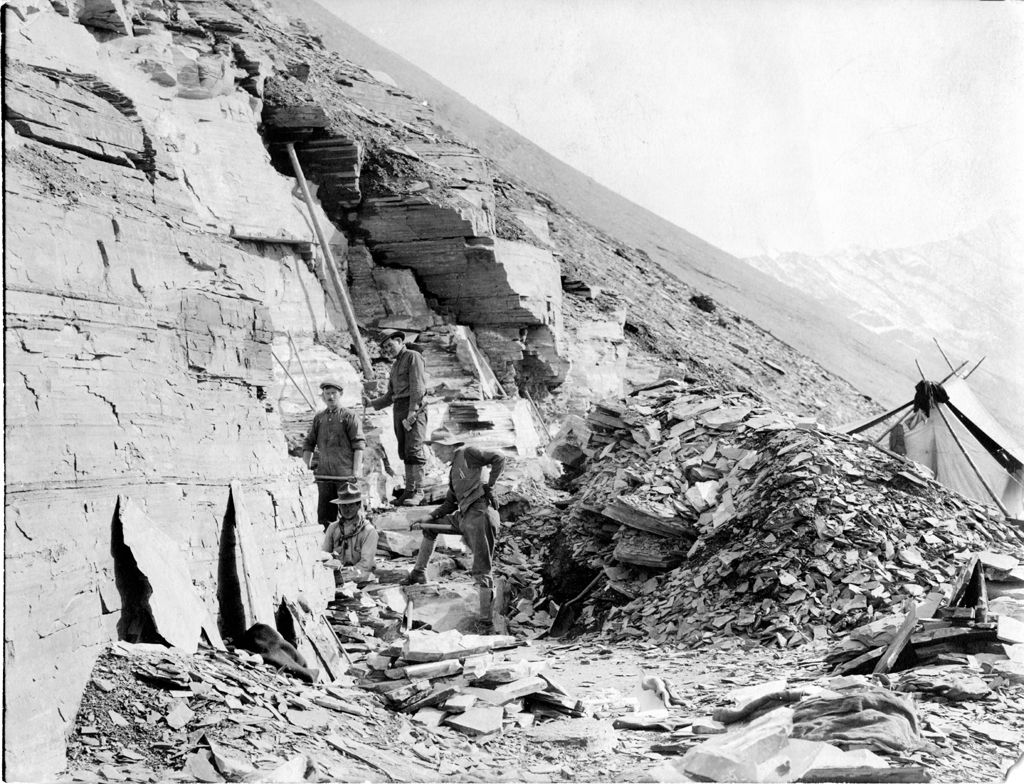
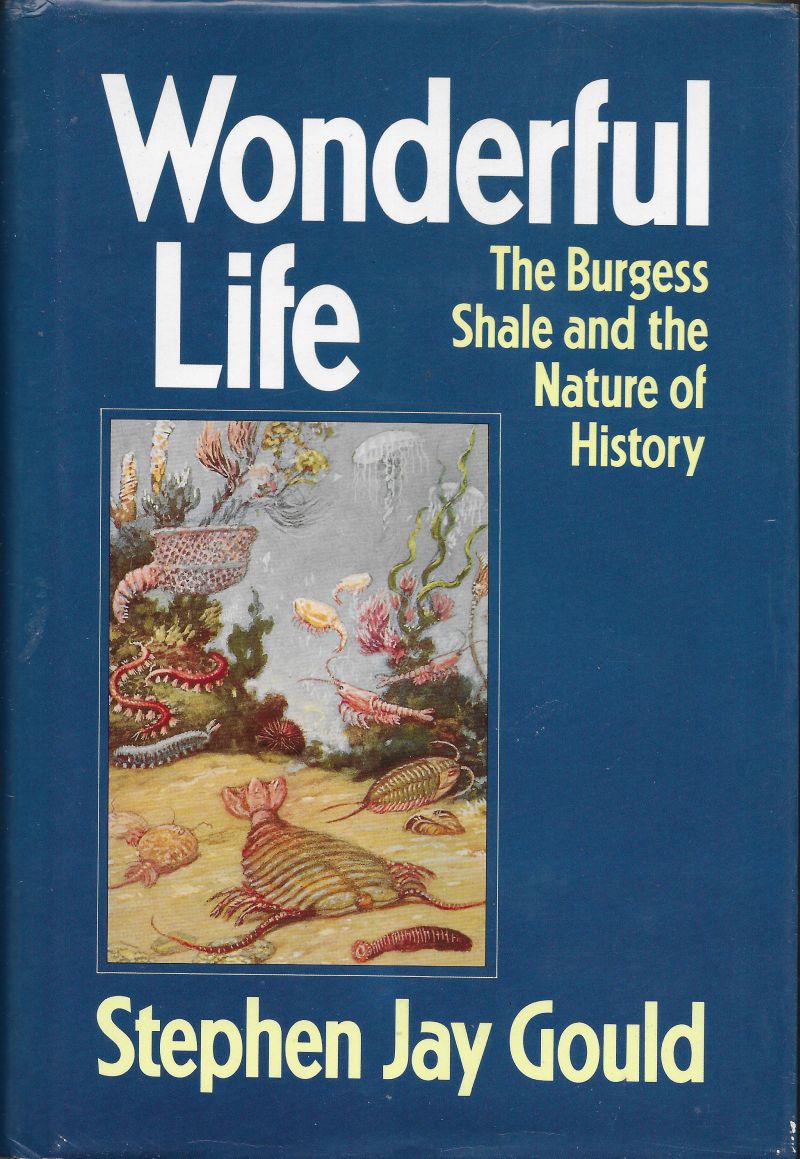
 Today I had another look at Wonderful Life, and skimmed through to the end of the last chapter: The origin of Homo Sapiens. How did we arrive at “mentality at our modern level”?. The author’s own mentality is at an extraordinary high level, taking us through 300 pages of highly detailed description, based on the detailed notes and photos of Charles Walcott and members of his family over several years. He speaks very clearly about our origins as human beings: I’ve paraphrased and summarised some of his text indented below.
The survival of Pikaia was a contingency of “just history.” I do not think that any “higher” answer can be given, and I cannot imagine that any resolution could be more fascinating. We are the offspring of history, and must establish our own paths in this most diverse and interesting of conceivable universes—one indifferent to our suffering, and therefore offering us maximal freedom to thrive, or to fail, in our own chosen way…
Other creatures came a lot later than the Burgess Pikaia.
I don’t claim that Pikaia itself is the actual ancestor of vertebrate, only that it’s the missing and final link in our story of contingency—the direct connection between Burgess decimation and eventual human evolution. We need no longer talk of subjects peripheral to our parochial concerns—of alternative worlds crowded with little penis worms but no mosquitoes, of fearsome creatures gobbling fishes. Wind the tape of life back to Burgess times, and let it play again.
If Pikaia does not survive in the replay, we are wiped out of future history—all of us, from shark to robin to orangutan. And I don’t think that any handicapper, given Burgess evidence as known today, would have granted very favourable odds for the persistence of Pikaia. And so, if you wish to ask the question of the ages—why do humans exist—the answer must surely be the survival of Pikaia out of most other creatures fossilized in the Burgess Shales.
We’re not here by “accident”, that’s the wrong word, but contingency. That’s simply what happened, the way things turned out.
So how does this result square with Christian beliefs? I find that there’s something exciting at the end of this saga.
I looked up an AI Overview, it’s a tool I find increasingly helpful, and got this:
Most Christian denominations believe in a creator God. Christianity as a whole is built on the foundation of God as the creator of the universe and all life, as described in the book of Genesis. While specific interpretations of creation may exist (e.g. literal six-day creation vs theistic evolution), the core belief in God as the ultimate creator remains central to the faith.
Theistic evolution is the view that religious teachings about God creating the world are compatible with the scientific understanding of evolution. It posits that God guided or directed the evolutionary process, rather than creating each species separately. This perspective is also known as evolutionary creationism.
My own understanding is that the presence of God in a person’s life can only happen via conscious awareness. You and I are the products of evolution, which uniquely came up with us. Countless teachers and texts have tried to take us on this journey.
I remember with affection reading this book: The Practice of the Presence of God, by Brother Lawrence.
 a wayfarer’s notes