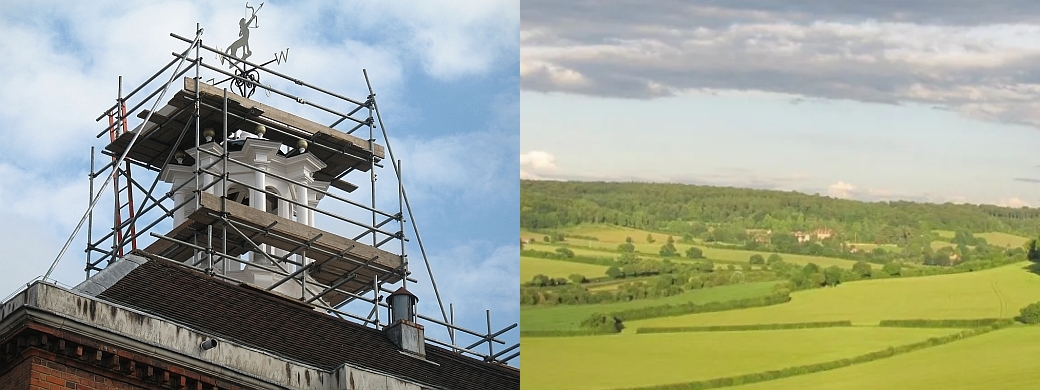

 Of all the wayfaring experiences recorded in a blog, this was the most wonderful. I was able to capture moment-to-moment feelings on my voice recorder, as transcribed below, Originally published in August 2010 on perpetual-lab.blogspot.com, which no longer exists. Fortunately I found a perfect copy to enjoy and share today
(I’m on a section of the “Round Aylesbury Walk”. If you go clockwise, the town is on your right and level countryside is on your left. I talk to myself as I go, into a digital recorder.
‘Suppose everything is just as it should be, already? Suppose everything goes on being just right, no matter what? So whatever creatures do—even mankind—then Nature as a whole (which includes mankind) bounces back, fixing the consequences as best it may?’ …

‘…This is what James Lovelock calls Gaia, the intelligent Earth trying to heal itself despite all our efforts to the contrary. What is this allegedly intelligent Earth? Isn’t it a vast freewill machine? Yes! That’s it! So when the things come which cause pain, we cannot accuse, saying “This is God’s fault”—because it just goes on being as it is, trying to right itself. And suppose that all the religions are product of freewill too, trying to fix the fallen state, the loss of Eden’s innocence.
‘I certainly don’t believe that religions are God’s gift to man, a ladder to escape original sin.* They are just part of the general freewill, nothing more than that. They have no holiness above anything else: just people trying.
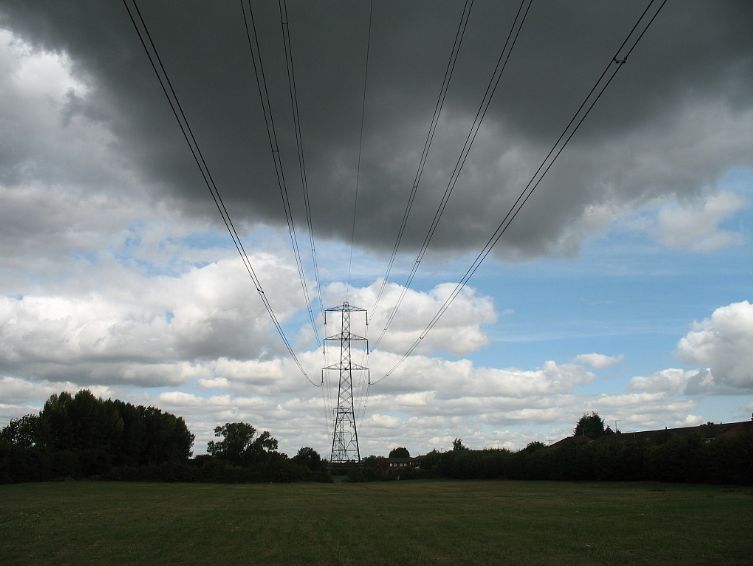
‘I hear a crackling in the power-lines hanging down over me. The sky has gone black. I wonder if it is man’s electricity responding to God’s electricity, or vice versa. The crackling is faint and almost constant, like hailstones bouncing off a small drum.
‘So, in this model which appears quite clear to me now, it’s not even for us to identify the problems. It’s for us to disturb as little as possible the workings of Nature, which constantly tries to clean everything up. Technology has become overwrought. But then, reason itself has become overwrought. Can technology and reason save us from technology and reason? It doesn’t sound likely†.
‘Suppose I eliminate from my thought, the phrase “We should …”? The next thing would be to eliminate the phrase “I should …”. It doesn’t come easy, because this is my culture, to constantly see problems and the need for me to participate in their solution. Then I must help fix the problems caused by solutions; and so it goes on. I don’t deny that the word “should” properly belongs in the English language. But I challenge its power over my life. I shall merely follow instinct, which is Nature in action.
‘I walk freely, because it is part of God’s gift: God’s gift of this body that’s a little awkwardly, yet quite definitely, designed for bipedal locomotion.
‘And as I speak these words, striding across a meadow under the powerlines, I see shining in the grass at my feet a £1 coin. I stoop to put it in my pocket, thinking, “This is my deserved reward. I can buy something with this.” And as with the four-leaved clover that day with Michael, I ask myself, “Will there be another?” I look for another pound coin, as if there were going to be a trail of them. This too is Nature, human nature.
‘If only I could convey the manner in which, as I walk, I think these thoughts and feel my feelings. It’s as if I’m leaping up to a ceiling that’s suddenly become reachable, and I touch Heaven. Then again, and again. And because the ceiling is not low enough, or I am not tall enough, I can only do it with little leaps. But this is all, or enough. I don’t ask for more. I’m not impatient. Why should I be? To touch Heaven once might be enough for a lifetime. But as soon as we discover a pleasure, we want to repeat it. Addictiveness is a human trait.
‘Suppose we didn’t ask for the same pleasure again, suppose we didn’t try and make it happen again and again. Would that improve things? It wouldn’t. We are made that way, programmed to seek pleasure and avoid pain. Why would we try and escape the cycle of that? Or if we find ourself drawn to self-sacrifice and renunciation, welcoming the hair shirt and eschewing the ice-cream, why shouldn’t we go for it, if that’s what we want to do?. Surely there is value in accepting our nature.
‘I arrive at the heavenly Pebble Way cycle path. I feel close kinship towards all, not exactly to embrace every person I see today, not literally. But in imagination I slip out of my skin, of being this particular white man aged 68, to be one with people of all ages, people who cycle on this path, walk along it, live in houses alongside it, who live in the cottage in my illustration below, with its beautiful back garden—and all, who like me, don’t live anywhere near this cycle path.
 a wayfarer’s notes
I’m very honoured that my post has led to you bringing this forward again, such a wide-ranging and thought-provoking piece, but also, a joyous one, a walk it’s a pleasure to share.
Since we’re progressing in a rather slantwise way, I hope you’ll forgive me for picking up on the mysterious realm above our heads and taking it as a cue to post this short poem, written about when I crossed the Arctic Circle during a trip to Lapland:
I won’t often stretch to this. It is a real frontier:
northward, a sunny nail rides round midsummer night.
But a good country, also, lies an inch above my head.
There I go straight and handsome; I never read or write.
(From here: http://michaelpeverett.blogspot.com/2016/02/f-o-t-o-poems-1-10.html )
The zenith has always intrigued me, this place directly above our heads where we hardly ever look, because our eyes aren’t positioned to look upwards (the zenith had no relevance for us, we couldn’t go there and our species had no aerial predators). Part of the joy of summer is lying down on the grass and, for once, gazing up at the zenith, at the wheeling swifts and the slow clouds. Such a restful sight to contemplate. Heaven? yes, I can see that.
LikeLiked by 1 person
We struggle to grasp The Grand Scheme of Things. Blake offers this suggestion:
“And we are put on earth a little space,
That we may learn to bear the beams of love,
And these black bodies and this sun-burnt face
Is but a cloud, and like a shady grove.”
LITTLE BLACK BOY from ‘Songs of Innocence’
LikeLike
Did he ever encounter a little black boy, I wonder? I know that in the days of slavery they were known in London. The widowed Sam Johnson was given one, Francis Barber, after he was widowed who stayed with him till he died, and was then set free with a small income as legacy.
A casual glance at the Web doesn’t reveal that Blake based his poem on any knowledge of a real black child.
Indeed, his poem makes the assumption that being black is a handicap, which can only be rewarded in heaven.
I’ve skimmed through this blog post https://williamblakeandenlightenmentmedia.wordpress.com/2012/01/27/race-and-the-little-black-boy/ which says more on the subject, and would be interested in your comments!
LikeLike
Thanks for connecting to the post about Little Black Boy. I think it demonstrates the conundrum of subjecting poetry to literal analysis. Blake taught that one must enter into a visionary poem intuitively and allow it to open itself like a blossom unfolding or a seed sprouting, not like a frog being dissected.
Marriage of Heaven and Hell
“in it were a [PL 20] number of monkeys,
baboons, & all of that species chaind by the middle, grinning and
snatching at one another, but witheld by the shortness of their
chains: however I saw that they sometimes grew numerous, and then
the weak were caught by the strong and with a grinning aspect,
first coupled with & then devourd, by plucking off first one limb
and then another till the body was left a helpless trunk. this
after grinning & kissing it with seeming fondness they devourd
too; and here & there I saw one savourily picking the flesh off
of his own tail; as the stench terribly annoyd us both we went
into the mill, & I in my hand brought the skeleton of a body,
which in the mill was Aristotles Analytics.
So the Angel said: thy phantasy has imposed upon me & thou
oughtest to be ashamed.
I answerd: we impose on one another, & it is but lost time
to converse with you whose works are only Analytics.
LikeLike