
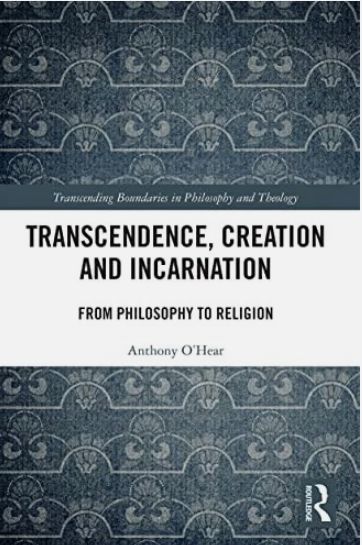
 Anthony O’Hear is a philosopher by trade. The latest of his many books is titled Transcendence, Creation and Incarnation: From Philosophy to Religion (Transcending Boundaries in Philosophy and Theology); leaving us in no doubt that he’s an academic addressing other academics. Every chapter has its own cluster of end-notes. He’s read every philosopher I’ve heard of, and refers to numerous poets, artists & composers.
Despite such obstacles, I’m avidly reading this weighty tome—weightless and more affordable on Amazon Kindle. As a page-turner, it’s slow-going but the suspense is there. We see many obstacles in the way, as in a romantic novel. You get a rough idea as to where it may end up, but how?
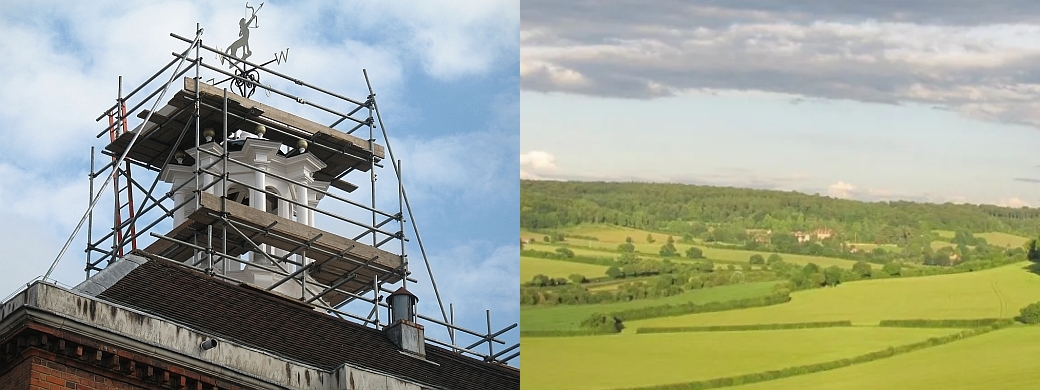
If a more popular version of his ideas could be released to the world, assuming it could be written at all by eliding much of the intricacy; and if I had the stamina to write it myself, I’d call it “Grasping the Sky”. A poetic metaphor, if you will, representing the human urge to see what’s beyond the concrete reality perceived with our senses and reason.
He surveys the different views—pretty much all the possible views about “Life, the Universe and Everything”, the whole shebang, whether there is a grand scheme of things or not. He weeds out those which can be proved wrong, and points out those, however bizarre they may appear to some, cannot be proved wrong.
His aim, I think, is to use philosophy as a tool, or rather a precision instrument, for mapping and reconciling these views, and performing a task that science, religion and politics have never managed to achieve on their own.
Think of him as a one-man truth & reconciliation commission. He uses the methods of philosophy to identify claims made by the combatants that cannot in all reason be sustained. Thus, Christian creationists have every right to a God who can say
. . . to every beast of the earth, and to every fowl of the air, and to every thing that creepeth upon the earth, wherein there is life, I have given every green herb for meat
because this is a manner of conveying an idea whose truth cannot be disproved. But these same Creationists cannot deny the fossil record whose solid evidence of evolution over a long period cannot be dismissed.
He invokes Christian theologians, Greek philosophers, atheists and non Christians like Simone Weil, as well as inspiration expressed in sculpture and music. What kind of claims can be made about a God, in terms of intervention in the world? How can great joy and beauty go alongside great suffering and ugliness? Can we envisage a God who hides his face, so to speak, waiting for a human soul to invite him in?
As it turns out, we the readers are not surprised by the ending. It’s been hinted and trailed all the way through. Indeed the slow-witted non-scholar like me is grateful for reiterations of main threads as we traverse the terrain our author is mapping.
So it’s not a spoiler, I hope, for any reader here who (unfinished)
3 thoughts on “Grasping the Sky”
Vincent
There’s an excellent article here on the subject
Vincent
PS Just after posting the above, I was sent a link to an essay titled “A Possible Future”. Giving historical examples such as the French Revolution, the author argues that the consequences could be dire and out of control, making things ever worse and out of control.
The author offers some examples to ilustrate his concept of “possible”, such as the French Revolution. In the same way, he argues, from a British perspective, the combination of Brexit and Covid-19 could destabilize us big-time.
In contrast, when I speak of “possible”, I mean it in the sense of “practically achievable”, something that we, i.e. humanity, can control ourselves if the Augean stable of politics can be cleansed. A Herculean task: does Radical Love offer some much-needed pointers? It worked for the ousting of Erdogan from the mayorship of Istanbul.
Vincent
PS Just after posting the above, I was sent a link to an essay titled “A Possible Future”. Giving historical examples such as the French Revolution, the author argues that the consequences could be dire and out of control, making things ever worse and out of control
The author offers some examples to ilustrate his concept of “possible”, such as the French Revolution. In the same way, he argues, from a British perspective, the combination of Brexit and Covid-19 could destabilize us big-time.
In contrast, when I speak of “possible”, I mean it in the sense of “practically achievable”, something that we, i.e. humanity, can control ourselves if the Augean stable of politics can be cleansed. A Herculean task: does Radical Love offer some much-needed pointers? It worked for the ousting of Erdogan from the mayorship of Istanbul.
 a wayfarer’s notes