

 to Phil Ebersole, demonstrating Simone Weil’s deep commitment as a thinker and activist; as well as, I suggest, her particular relevance to a world which has lost its once-revered guiding principles. See our exchange of comments in my last.
*************
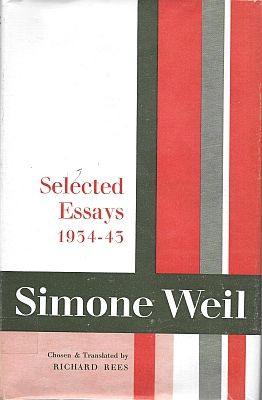
This is the last section of her essay on Human Personality: the Just and the Unjust, written in 1943. (From Selected Essays, 1934 to 1943, translated by Richard Rees.)
“By the power of words we always mean their power of illusion and error. But, thanks to a providential arrangement, there are certain words which possess, in themselves, when properly used, a virtue which illumines and lifts up towards the good. These are the words which refer to an absolute perfection which we cannot conceive. Since the proper use of these words involves not trying to make them fit any conception, it is in the words themselves, as words, that the power to enlighten and draw upward resides. What they express is beyond our conception.
“God and truth are such words; also justice, love, and good.
“It is dangerous to use words of this kind. They are like an ordeal. To use them legitimately one must avoid referring them to anything humanly conceivable and at the same time one must associate with them ideas and actions which are derived solely and directly from the light which they shed. Otherwise, everyone quickly recognizes them for lies.
“They are uncomfortable companions. Words like right, democracy and person are more accommodating and are therefore naturally preferred by even the best intentioned of those who assume public functions. Public functions have no other meaning except the possibility of doing good to men, and those who assume them with good intentions do in fact want to procure good for their contemporaries; but they usually make the mistake of thinking they can begin by getting it at bargain prices.
“Words of the middle region, such as right, democracy, person, are valid in their own region, which is that of ordinary institutions. But for the sustaining inspiration of which all institutions are, as it were, the projection, a different language is needed. The subordination of the person to the collectivity is in the nature of things, like the inferiority of a gram to a kilogram on the scales. But there can be a scales on which the gram outweighs the kilogram. It is only necessary for one arm to be more than a thousand times as long as the other. The law of equilibrium easily overcomes an inequality of weight. But the lesser will never outweigh the greater unless the relation between them is regulated by the law of equilibrium.
“In the same way, there is no guarantee for democracy, or for the protection of the person against the collectivity, without a disposition of public life relating it to the higher good which is impersonal and unrelated to any political form.
“It is true that the word person is often applied to God. But in the passage where Christ offers God himself as an example to men of the perfection which they are told to achieve, he uses not only the image of a person but also, above all, that of an impersonal order: ‘That ye may be like the children of your Father which is in heaven; for he maketh his sun to rise on the evil and on the good, and sendeth rain on the just and on the unjust.’ Justice, truth, and beauty are the image in our world of this impersonal and divine order of the universe. Nothing inferior to them is worthy to be the inspiration of men who accept the fact of death.
“Above those institutions which are concerned with protecting rights and persons and democratic freedoms, others must be invented for the purpose of exposing and abolishing everything in contemporary life which buries the soul under injustice, lies, and ugliness.
“They must be invented, for they are unknown, and it is impossible to doubt that they are indispensable.”
Comments:
mpeverett
Thank you Vincent, ever thought-provoking!
philebersole
Vincent, I appreciate you writing a post aimed specifically at me. But I’m afraid I still can’t get my mind around Simone Weil’s thinking. This post is like sending an excellent essay by a music critic to someone who is tone deaf.
Vincent
thanks for this! I’m aware of the problem, Phil. Looking at the piece again, it takes too much unravelling. I’m even wondering whether to take it down. It’s not my translation, I don’t have access to the original French. I’m about to put up another post, on Evil. I’ve spent more than 48 hours working on her original scribblings, trying to unscramble her thinking and put it in idiomatic English.
Some of what she has to say is initially startling, because we aren’t used to thinking like her. But I believe that she says things of vital importance for today’s world, and I’m determined (unless forced to give up) to do justice to her thought whilst at the same time expressing it in terms that don’t obscure the sense.
Vincent
Thanks Michael for your encouraging remark. Reading the piece again, I incline more to Phil’s view, that it is provoking in a negative way, more than thought-provoking. Too much effort required to extract the essence.
 a wayfarer’s notes