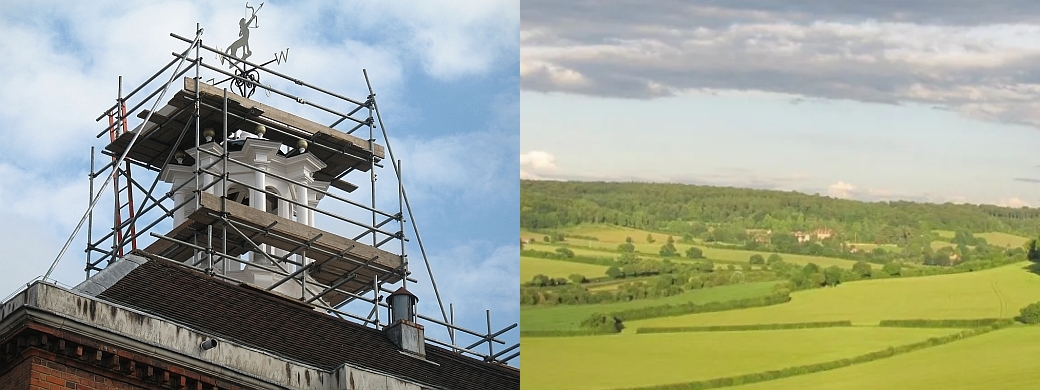

 I went up the hill, the one at left with the rainbow. That’s how I view it from my study window, which I’ve outlined in black in the righthand picture; which in turn was photographed from the grassy slope outlined in black on the left. It’s certainly a town for lifting up one’s eyes unto the hills.
I will lift up mine eyes unto the hills, from whence cometh my help.
It’s a plateau really, you can only see the initial slope in the photo. The second photo is taken from near the lamp-post at bottom left, pointing back across the valley towards my house. My study window is bottom right in that second photo, above the white-painted ground-floor wall.
I went up in the early morning drizzle, wandering through the suburban maze, while most were driving off to work. Past the crowded houses you see in the photo, it thins out, and many of the residences stand detached in their own grounds. Along one such road, I heard from a distance workmen’s emphatic voices and as I got nearer expected the normal banter of a gang happy in their work, peppered with expletives, on any subject under the sun. But as I passed without slackening my pace
I heard this through a hedge: “What allegiance do I have to my brother, and my father, and my father’s brother? Only one thing. To work. And there ain’t any work around at the moment.” Then there was a gap in the hedge and I saw that the speaker was a young man pacing back and forth on a scaffold platform, beside a half-built brick wall on a building site; waving his arms in agitation. Two or three men on other parts of the site paused from their work and stared perplexed. Were they the brother, father and uncle in question? It was a Hamlet moment, or even a Jacob and Esau moment: but it wasn’t enacted for eavesdroppers. This one snippet was enough for the theme of a whole play, a topical drama showing the effect of the world credit crisis on a family.
Up to that moment, I’d been mentally composing something, wrestling to understand my own current family dilemma. In an odd way my thoughts echoed what I just heard, for they went like this: “My late mother and her sister, my own self, my four children, my three grandchildren: we are linked in a certain way, as if we carry a ‘rebel gene’. We flout the conventions: I admit this in sorrow, not pride. For I am the patriarch now and I don’t like what is happening. (There’s a particular thing I’ve been brooding on for days). This family waywardness has put us through unnecessary travail. And now it’s affecting the grandchildren, not by accident, but through deliberate ideology. And I desperately want to fight it.”
I don’t regret any of what I’ve been through in my own life, despite everything. But I don’t want to see my grandchildren handicapped so needlessly, so senselessly. Oh, I’d be glad if I could see it differently. But my dander is up and I want to fight, even though I’m no longer the troop’s alpha male. I want to stand on a scaffold platform too, and rant like that young man: “What allegiance do I have to you? Only one thing: to give your children what they need—a grandfather.” Perhaps I’m King Lear, victim of his own foolishness. I have a film version on DVD, with Paul Scofield in the title role. I saw his famous performance in the same role at Stratford-on-Avon in 1962; but I’m finding it too harrowing these days. I’ve been reading Huckleberry Finn, which makes me laugh out loud, but it gets heavy too, and I wonder if I am like Huck’s Pap, wanting to force my ideas on my eldest son; ideas exactly opposite to those of that disgraceful drunk, as it happens, but does that excuse me?
“Don’t read too much into coincidences, Vincent! Lear; Huck
Finn’s father; the man’s speech on the building site; they’re not about you!”
Well, excuse me. What is life at all, if not coincidences? It’s the fabric into which we are born. Naturally we pick and choose which ones we find of interest when we tell a story, and leave the rest of the fabric on the cutting-room floor, denying it any significance.
I’m wishing I had what it takes to be tactful, persuasive, influential: the honeyed tongue of a politician, I suppose. As it is, ability to influence lies out of my control. They copy the things I’ve renounced, and ignore what I say. All I want to tell them is this: “You pay a big price for swimming against the current: more than you imagine.” “You’ll just have to trust me,” said my son.
The LORD shall preserve thy going out and thy coming in from this time forth, and even for evermore.
17 thoughts on “Hilltop Reverie”
Scot
good post Vincent. What we can see from the hills or the valleys if we just use our eyes. Huck Finn is one of my favorites because it can be read from so many levels from primary school to graduate school.
Rob
From my experience, I would have to agree with you about the high cost of swimming against the tide.
Vincent
Rob, indeed, you have an insight into these matters. I haven’t specified exactly what the issue is that has been troubling me, but I could discuss it with you privately and I would in fact value your input!
Vincent
Thanks Scot. I thought I had read Huckleberry Finn as a child, but now I see that it was a retelling for children, that kept the outline of the adventure but sacrificed the comedy, the horror and the depth.
Hayden
Ahh, Vincent! This made my heart swell and ache! Can one heal the past, and in so doing – the present and future? Jill Purce says you can, but my head is clouded by doubt.
Charles Bergeman
Interesting post indeed.
My daughter has adopted a portion of my philosophy, while introducing an unanticipated adjunct.
I have always been somewhat anti-capitalist. While I can appreciate the merits of establishing a business and reaping the benefits of your hard work, I am hard pressed to find any virtue in the practices of Wall Street gamblers.
My daughter has begun to rant about the “system” and how she hates money.
She objects to any kind of authority, resents being told what is important in terms of her education, work ethic, handling responsibilities, etc.
While some of this is normal teenage angst, clearly I have contributed to her attitude.
I believe strongly in hard work, working for a living and finding a way to contribute in a positive way to society. While some of this fuels the “system”, I have not adopted any of the lifestyle or career goals of most it’s participants.
I feel it is possible to have a different personal philosophy from the culture around you, while adopting the parts of it that are required to survive.
The reality of what it takes to survive in this world is still a bit of a mystery to some teenagers.
In the end, I am proud of her for considering such things at such a young age. And yet, I am deeply disturbed by the implications of her attitude towards education, work, etc.
Funny how things turn out.
Rob
I think you told me what the problem is.
I would encourage you to speak your mind even if it upsets your son.
Best wishes, Rob
Serenity
The trouble is when we are standing on a hill we believe we are at the highest point of perspective and indeed we may have a very good view, but we neglect to notice the giant mountain behind us.
Vincent
Serenity, your observation reveals an interesting point of view! Reading it at first, I thought, “So what about the giant mountain behind us? Giant mountains are inhospitable to man. There is only one thing to do when you’ve managed to climb up one: climb down again to a level where you can live comfortably.”
I was pleased with this answer until it occurred to me, with help of other comments here and Hayden’s latest post, that one isn’t necessarily so rational. the urge to climb to the top may overcome the sense of comfort.
Vincent
Rob, you are right. I think we have spoken about this. I did speak, he was indeed upset. Now what? I have to change myself in order to change the situation.
Vincent
Charles, yes, what you describe is very familiar to me too. And yet I am not sure that any outcome whatsoever in one’s offspring’s lives will leave one free of worry.
The answer that comes to me in relation to your daughter is that like most teenagers she is setting herself up to learn for herself what she cannot accept as given from you and other adults. Such learning can be painful at times. This is what we want to spare them.
Vincent
Hayden, reading your latest post Transformation I see that you are deeply involved in all kinds of healing. Correction, not just your latest post but entire blog and your entire life is dedicated to that.
I had a long conversation with someone wise and dear yesterday, in which I realised my own need, as Serenity puts it so well, to climb further up the mountain. I’ve been assuming I was much nearer the top.
It is of course uncomfortable to discover, like a child on a journey, that we are not “nearly there yet”. Until we embrace it.
Vincent
Oh, and Hayden. Yesterday I collected 2 books from the library that they had purchased at my request: Bill Plotkin’s Nature and the Human Soul (sequel to the one you’ve been reading) and Theodore Roszak’s Ecopsychology: restoring the earth, healing the mind (sequel to another by him that I have been reading).
Will say more about these no doubt. How are you getting on with the Plotkin you’ve been reading?
serenity
Vincent,
I think there are times we all assume we are closer to the top than we are. I know a few teenagers who think they have it all figured out and who think they are on the top of Mt. Everest looking down.
The ironic thing for me is that as I age, I discover how low the hill actually is that I am perched on!
Hayden
whew. they say that others have a clearer view of the individual than the individual him/herself.
Your comment really set me back on my heels and started me thinking. Am I really all about healing? Perhaps you are correct. As I think about it, even my tendency to “bull through things” is often a determination to lance a (figurative) boil.
Finished Plotkin 1, started Plotkin 2 and put it aside. Didn’t find it at all compelling. Perhaps I’m mentally ‘not ready’ and need to attempt it again later.
Vincent
Am reading Morphic Resonance & The Presence of the Past,” the book that made Rupert Sheldrake persona non grata in his academic circles (considered too “woo-woo” to be respectable.)
I read that book by Sheldrake when it came out – & met him once when he gave a talk somewhere.
Plotkin 2 is fascinating, but I’m only at page 14 so far. Too many words for my taste. I want to cut to the chase. But the subject-matter is exactly what I feel ready for & I’m most grateful to you for putting me on to him (remembering that I spoke disparagingly all the same of New-Age self-help books). He is confronting the argumentative teenager in me. But then he says we are in an adolescent era.
Anonymous
I am not a grandparent, but I am an aunt. I cherish the memory of the only two aunts I myself had, my father’s sisters. I did not know either of them very deeply, or very long (in terms of actual time spent with them). If I try to sum up what their contribution to my development as a person was, I can say that they were like beacons to me.
We are all subject to family myths, and I believe I was particularly wrapped up in our family myth. But these two sisters were ‘signs’ that there was another reality beyond the myth. It still took me a long time to break out of the myth and find my own way, but when I look back now I can recognise more of their role. And I have, in my way, emulated them for those of my nieces and nephews with whom I have had any involvement. I have tried to be a sign that the reality they know is not the only possible reality, without necessarily trying to persuade them to adopt my own view of reality. How successful I have been in this, I have no idea. But I doubt my aunts knew how much they influenced me either.
In the end, we all have to find our own way, and there is no escaping the painful lessons.
(like, from Kathleen)
 a wayfarer’s notes