

. . . or all the philosophy you don’t need to know, in 711 crisp words, by Bryan White.
“How can I help seeing what is in front of my eyes? Two and two are four.”
“Sometimes, Winston. Sometimes they are five. Sometimes they are three. Sometimes they are all of them at once. You must try harder. It is not easy to become sane.”
George Orwell, 1984
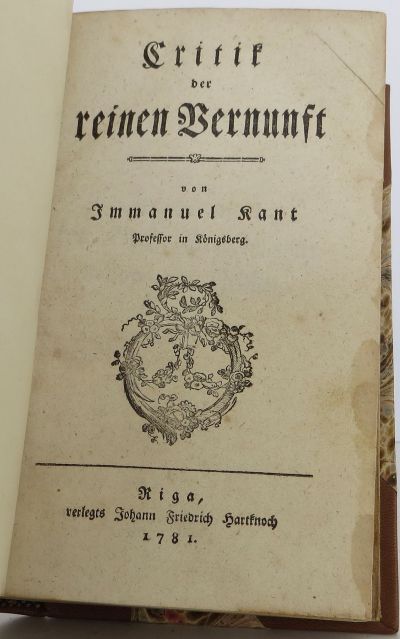
Out of some subconscious desire to torture myself, I have been taking another crack at Immanuel Kant’s Critique of Pure Reason. It’s not an easy book, and I’m not sure it’s really worth the effort. Kant draws from a very limited bag of tricks and he draws from it repeatedly. His most basic and fundamental trick, the one he calls on most frequently, the rock on which the entire edifice of the Critique is built, is to swap out the impossible and replace it with the inconceivable. This is the trick O’Brien is pulling with Winston in the quote above. “2 + 2 can certainly equal five; it can equal anything at all. You just can’t wrap your head around the idea. The problem is you.”
The argument goes like this: if there is anything that we can claim to know with mathematical certainty, then that thing must be attributed to the mind’s own machinery by virtue of that very certainty. After all, you didn’t learn that 2+2=4 strictly from experience; you didn’t go to the far side of the Andromeda galaxy to see if 2+2 will equal four over there; you know already that it will (a priori, as he loves to say); you know it in your mind; therefore the idea that 2+2=4 must begin and end in your mind.
 Another way of putting it would be to say that any proposition that isn’t inherently falsifiable arouses Kant’s suspicion that it’s bumping up against the limits of the human mind. If we say “all frogs are green” and a blue frog comes hopping into view, we can say, “Well, except for this one” without completely blowing out our conception of reality. This is just field work; this is good science in Kant’s opinion. Since 2+2=4 doesn’t allow for that same possibility, Kant writes it off as some sort of introspective navel-gazing. “You didn’t even have to get out of your chair to prove that one! Hmm, there must be something weird about your chair.” If the mind can’t conceive of a possibility, then it must follow (by Kant’s logic) that it’s the mind making it impossible. There’s never any consideration (at least so far as I’ve read) that reality itself might play host to any sort of universally recognizable limitations, that 2+2 might in fact and by necessity and in all situations have to equal four. Nope. Kant be.
I’m not going to attempt anything here as ambitious as a full scale dissection of this trick, looking for all the hidden strings and levers behind it. I’m not planning on formulating a comprehensive counter-argument anytime in the near future nor am I even necessarily planning to revisit the subject in another post, not unless some revelation comes to me in the shower or something.
It may be premature to even call it a “trick.” Maybe it’s the “real thing”, genuine wizardry. I don’t really believe that. But to be fair, you need to at least try to start from a neutral place; you have to allow for the possibility of being wrong. For now, I just wanted to post the “trick” and open the floor to get some thoughts on it.
P.S. I’m sure someone out there would tell me that I’m misunderstanding Kant. There always seems to be people in the philosophical community that treat Kant like their loud-mouth uncle. “Awww shucks, he didn’t really mean that.” If anyone can tell me how the argument for his Transcendental Aesthetic is anything other than “we can’t fathom a universe without space or time, therefore space and time must be products of our fathoming apparatus”, then I’m all ears. As far as I can tell, that’s what he’s saying. Unfortunately he doesn’t put it as bluntly as that — you have inch your way through thick passages of run on sentences — but when you get down to brass tacks and bare ass, that’s pretty much what it amounts to.
 a wayfarer’s notes
This is so witty and readable, I’ll take on trust that it’s a true and fair summary of Kant’s daunting Critique and hereby vow before witnesses that I’ll never bother reading the original.
I think I don’t like Kant, without being able to say why, in accordance with everyday man-in-the-street mindless prejudice against that which I cannot be bothered to understand—if that in itself is not mindless prejudice against some imaginary man in the street.
Having said that, though, it seems to me Kant is right, I mean Kant as summarised by Bryan White. I do think that time and space are products of our fathoming apparatus.
In the same way, I think any possible notion of God comes entirely from the same apparatus. For this reason alone, I reject most such notions except the one which says that for God, time and space are just like the dimensions of one side of a sheet of paper. God sees it all in a glance, where you and I can only stumble blindly in the dot over this
LikeLiked by 1 person
I originally had a different P.S. amended to this post, but I retracted it because it dwelt on a different issue, and I felt that this other issue, possibly being more familiar, would become more the focus of discussion and would distract from the main point of the post, which I felt was a more novel and interesting point.
For what it’s worth, though, I’ll copy the former P.S. here, possibly as relevant to your comment, possibly not. Who knows? Anyway:
‘P.S. Another one of Kant’s favorite tricks, one that kind of plays wingman to this trick, is the old “You don’t know what the world REALLY looks like” trick that’s at least as old as Plato. I’ve talked about this elsewhere. I don’t believe that there is any such thing as what the world “really” looks like. There is a world, and there are beings capable of looking at it in various ways. The worlds “looks” like it looks to them. There is no other sense in which the world can look a certain way. True, there are different limitations on how those beings look at the world, but there is no secret way of “looking” that’s transcends the act of looking itself to which human perception is but a pale, distorted shadow merely by virtue of BEING A FORM OF LOOKING! To maintain such a concept is basically to say, “To really see the world, you’d have to somehow see it without seeing it, because as soon as you’re seeing it, you’re not really seeing it.”‘
LikeLiked by 1 person
I do see a relevance to my earlier comment. An all-seeing God, as we may or may not be able to imagine, would be able to see the world as it really looks. But this God would not be a “being”. Thus we have this unfortunate capability of imagining that we can imagine the unimaginable. It’s called theology, I guess.
LikeLiked by 1 person
If space is curved, doesn’t that affect all measurements.
I once did an experiment which required precise measurements. Unfortunately the ruler I used was not accurate. All the calculations turned our weird.
I don’t know Kant but I do know that we make inaccurate assumptions which have consequences (often unexplained.)
LikeLiked by 1 person
yes, a point I hope to touch on in my next, Ellie!
LikeLiked by 1 person
“Ooooh, Immanuel Kant was a real pissant who was very rarely stable”.
Sorry. I couldn’t resist. I’ll go now. But I do like your post. Just not the part about the frogs. I don’t like them puttin’ chemicals in the water that turn the friggin’ frogs BLUE!! Do you understand that?? I’m sick of being socially engineered!! It’s not funny!!!
LikeLiked by 2 people
Reading this again, because it comes up in my Jetpack blog statistics, I realize that I’m not that Vincent any more. I used to have many books of philosophy on my hand-built shelves, but these days take the view that ‘Philosophy is Bunk’ — who first uttered that famous phrase? — so I give them to the Salvation Army for their work with the homeless while keeping the biogs and autobiogs of same for the human interest.
This moment is all we have. I give thanks to whatever comes. That’s mine, in 12 words.
LikeLike
philosophy is bunk — it was Richard Feynman, scientist and wit.
LikeLike