

From Bryan White
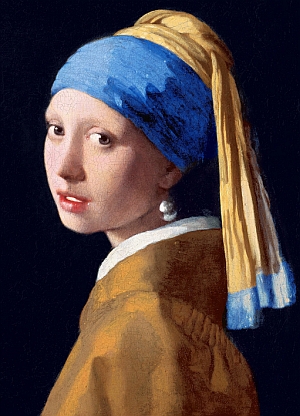 I just finished reading Girl with a Pearl Earring by Tracy Chevalier. A few posts back, when Vincent said that he was “inspired” by books that he was waiting to get in the mail, I was in a similar situation at the time with this book. It was sitting on my bookshelf, and I was eager to read it as soon as I got the chance. I like novels that blend historical facts with fictional speculation. I like the idea of a writer packing real people and real history into a box and then taking them off somewhere to be alone with them. It might be a questionable undertaking — there’s always a chance that the bones of the dead might stir in objection and moan, “Lies! Lies! All lies!!!” — but there is history, and then there are our dreams of history, which we normally only get passing glimpses of. Watching someone linger on these dreams, working their finer details with a set of close brushes, has a peculiar fascination. In a sense, they’re engaging with history in the same way that Vincent or I or anyone who’s anticipating a story is engaging with the books we’re waiting to read. They’re clearing a place for it in their mind, a place where they can play with the material through an investment of their own vitality.
I was already pretty well prepared for the book, more than I would be with most books. I had seen the movie version of it years ago. I had seen a very interesting Ted Talk that the author had given about how she had developed the idea for the novel. And I was familiar with the painting itself, and with Vermeer’s work in general. The only truly unformed aspect of my expectations concerned the writing. I expected something “poetic” in the sense that I described in my previous post. The setting and the nature of the story seemed like it would lend itself perfectly to that style.
I was surprised by the writing, but not disappointed. The book was tastefully written, but it never felt like it was reaching for its eloquence. It was poignant when it needed to be poignant, and it drew on just the right details to bring its scenes to life, but it always went about it in a very natural way and it never felt overstated. Reaching for eloquence isn’t a completely unforgivable sin in writing, and God knows I’m guilty enough of it myself, but it’s all the more impressive when someone can achieve the same effects with as little fuss as possible. There are very few lines or passages in the book that are genuinely quotable, but everything is solid, load-bearing, and it gets the job done.
I think there’s an element of restraint that’s responsible for this, and it extends to the treatment of the plot and characters as well. For instance, whenever you have a story like this that inevitably touches even lightly on feminist themes, the heroine is often written as though they had the mind of a modern woman and they’ve just been plunked down in a historical setting which restricts them like a straitjacket with unfamiliar buckles. They see a little too far past the horizon of their station in life. They emancipate themselves into some unorthodox mode of living a little too easily. It’s all just taken a little too far to be credible. Griet, the girl with the earring in question, is obviously keen, obviously perceptive, but she’s also a believable girl of her time, with her Protestant virtues, her somewhat superstitious bewilderment over Catholic life, her sense of propriety, and so forth.* She strains at the limited choices available to her, but she isn’t surprised by them. She doesn’t stand outside those choices and marvel at them, as one couldn’t rightly expect her to. She knows this life, and she knows no other life. The result isn’t just a more fully realized character, but also a more interesting take on the internal realities of being a woman in that world, rather than just the external realities. Even as it is, it could probably be argued that the story isn’t entirely realistic in its portrayal of characters of this time and place. But I think it still manages to achieve verisimilitude, which is the thing that I think people are usually really after when they complain about “realism.” God help us if there was ever a truly realistic story.
As the centerpiece of the story’s climax, much is made of the pearl earring, why it’s needed in the painting, the commotion it causes in the household, the outright sexual significance surrounding Griet wearing the damn thing.* But really, why shouldn’t it? The earring is mentioned in the title of the painting after all. The title draws the mind’s attention to it, just as the light reflected off its surface draws the eye’s attention to it where it dangles partly in shadow. Baroque art often catches scenes in motion, giving them the sense of capturing a passing moment, rather than something fixed and posed. And you see this in Vermeer’s work as well, but there’s usually a quieter and gentler feel to it. There’s often some element of stasis that serves as a counterpoint to the movement. The pearl earring is this element of stasis. Without it, the girl might just be glancing quickly over her shoulder. But the earring holds that glance anchored. It doesn’t move or sway. It hangs straight and still. So you’re left with the sense that’s she’s been glancing over her shoulder forever and will go on glancing for eternity.
* “As the novel progresses, Griet becomes increasingly aware that she is ‘for sale’”. She is given no choice by her parents over whether or where she will work. Van Ruijven and other characters assume she is sexually available simply because she is an unchaperoned maid.” (Wikipedia)
 a wayfarer’s notes
Brilliant piece, a proper review, evaluates the book and provides guidance to a reader who might or might not want to read it. Having watched the film long ago, I can recognize the way you refer to the plot and its treatment.
At which point I started to watch it again on YouTube . . . before deciding we could rent the DVD and see it in comfort. Definitely worth while, especially in view of your insights on the book.
LikeLiked by 1 person