

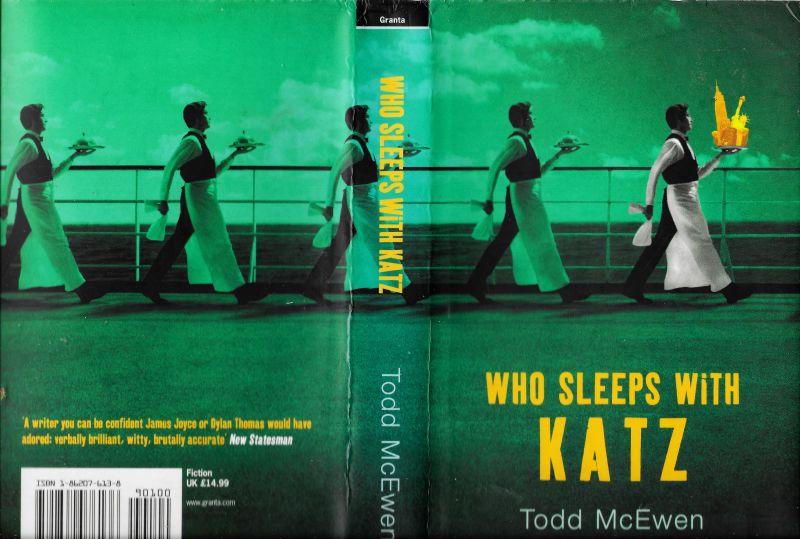
 There are certain authors, that is to say certain books, that we are especially glad to have discovered. And when we discover something new and significant in our lives, the moment when it occurred is memorable. I discovered Todd Mcewen by looking up “happenstance” in the OED and finding an illustration of its use in a quote from one of his novels. Which itself was in instance of happenstance. I might otherwise have ended my days bereft of his soul, wit & verbal skills.
I wonder what impressed the dictionary compilers so much that they decided to scan McEwen’s works.* His entry in Wikipedia is brief, being accused of “multiple issues” and hence demoted to a “stub”: evidence of his modesty and/or disinterest in marketing. His wife is Lucy Ellmann, daughter of an illustrious biographer (Joyce, Wilde, Yeats), and a prize-winning novelist in her own right. Her Wikipedia entry is almost as terse, also dismissed as a stub.
Impulsively, I bought 3 of Todd’s books straight off and another soon after. Who Sleeps with Katz is surely his masterpiece to date. I’m not attempting a review here, just putting down my own thoughts on it to share with the few who read these pages.
 It’s a proper novel, setting out as you might say “The Lives and Opinions of McK & Katz, Gentlemen”†: two old friends who love and hate “this our town” (New York), sometimes dreaming of escape. It’s a compendium, a “laugh-aloud bittersweet threnody”‡, of obsessions, fetishes, sex, tobacco, books, bars, Martinis and close encounters with women. Nothing lasts. The intricate plot with all its thoughts, flashbacks and insights emanates from looming awareness of McK’s lung cancer. The sense that nothing can last: everything we hold precious is doomed. We are in a masculine world where dignity is to be maintained at all costs. Our heroes clutch at personal exoneration, ulterior blame. McK likes to believe it was one careless cigarette out of an estimated 273,500 over 25 years which was solely responsible for his disease. He wants to rule out the pipes and cigars—too pleasurable, surely innocent.
But Isidor Katz, whose grief is no less, cannot seize comfort from such illusion. In the final chapter, Martini III, he cries out, in his cups and in extremis:
I mean, what I want to know is, WHAT IS THIS PLANT FOR? Does everything we like have to kill us? Loving something, and knowing that love, causes your death? Inevitably? Maybe that’s the way we all die, thrusting ourselves into the perfect drink, the girl with the highest heels, the best job, the best book . . . you eventually find the best book to read and it kills you.
Together or separately, McK & Isidor spend their days clinging—in fantasy, memory or deed—to whatever precious thing can be rescued from oblivion.
* A suspicion forms in my mind that the OED harbours someone who respects the literary judgement of Granta Books.
Here are the illustrative quotes it draws from Who Sleeps with Katz:
pastrami 2003 T. McEwen Who sleeps with Katz p187 People who think they ought to like pastrami since they now live in New York—in timid slices out of vacuum ‘paks’ from the supermarkets of suburb.
merthiolate 2003 T. McEwen Who sleeps with Katz p193 The sense of emergency in the park, the time of bandaging, the smell of tincture merthiolate iced their blood.
ice (to make cold, chill) 2003 T. McEwen Who sleeps with Katz p193 The sense of emergency in the park, the time of bandaging, the smell of tincture merthiolate iced their blood.
‡ From the front cover:
A laugh-aloud and bittersweet threnody … an exquisite Joycean prayer to the daily Gods of New York—Alan Warner
Comments
Cindy
If it’s o.k. I’d like to leave my comment here.
It was interesting reading your thoughts. I wish you would write that review. Your reviews are always amazing!
It’s a happy coincidence that you posted this on the same day that the used copy I ordered of ‘How Not To Be An American’ arrived.
To be honest I wasn’t expecting to like it. I just wanted it out of curiosity, because you seem to admire the way he writes.
Awe, and I can see why. Like this from chapter, ‘Trout Farm’ (he just puked while watching the guy fillet their fish) lol:
“That guy was pretty surprised”, said Dad. “At least you threw up in the pond and not the cooler”.
When we got home Mom exhibited her querulous attitude towards food that did not come from the supermarket. “Whaddya think they raise ’em for?” growled Dad. “They’re not tropical fish for looking at.” “I’ll have to make a hamburger for your son”, she said. “And what”, he said, turning on me, “is the matter with eating the fish you caught? That is the goddamndest thing. Do you realize that I ate a fish I caught myself every day of my life when I was your age? And in winter I sawed through the ice to get them.” He stamped outside to wash his hands under the garden hose, a sign that he was really vexed; when faucets were too fancy a thing. It was true that I hated fish. I only liked being with him.
😀 The whole book is like that. His writing style is similar to Bryan. I wonder if that could partially be, because of his dad’s down to earth Ohio roots. Great writer, that’s all I got to say. It’s kind of hard to hate somebody who loves bluegrass and Bill Monroe’s high whiny 2 yr old voice as much as my dad did. The guy knows his bluegrass I give him that. Not bad writing for an atheist from California. Not bad at all.
Vincent
It’s true that McEwen could do with some proper Amazon reviews but I’m in no mood to write them, only something quick & easy from time to time. And I don’t like repeating myself. Already made the point about “chronic exiles” in “Art as Generosity”. In my view, exiledom is what makes some writers able to summon up the absent places and persons with such clairvoyance. Only if I left Wye Vale—not its real name—would I be able to express the physical & spiritual sense of living here. And how it feels walking down the Ledborough Road—ditto. Or so I like to think. I cannot foresee ever leaving it, except by the route McK would finally leave Manhattan.
The vividness of McEwen’s writing tells me in minute details what it must be like to live in America, whether North or South California, Ohio, or different streets in New York. Enough to transport me there, and feel I know it, the whole feel of what it’s like in the moment. It’s a very personal relationship. And then there is McX, a novel about the narrowness of Scotland, its repression, its decline since the great emigrations of past centuries, the real & imaginary lives of a few of its inhabitants. All summed up in the adjective “dour”. Like Dr Aitchison, my haematologist!
I was thinking of Bryan too when he writes about Ohio, but didn’t see any resemblance in writing styles—if you mean choice of words, sentence construction & so forth. Both meticulous though, both stuffed with concrete observation creating vivid impressions. I’d say Bryan’s is classical expressive good English. Todd’s is equally controlled. He knows the rules, but defiantly transgresses them, especially in Katz.
I like your grudging “kind of hard to hate”, “not bad for an atheist from California”.
Keep commenting – everything is permitted! And how about an original diatribe in the form of a post?
 a wayfarer’s notes