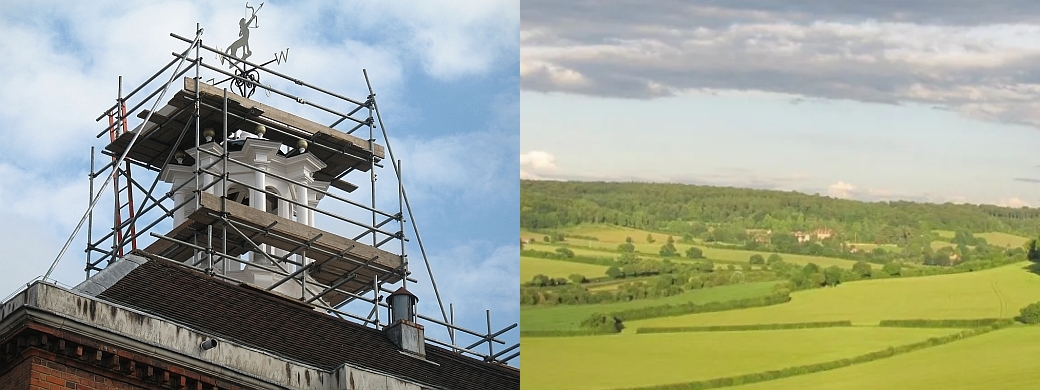

It’s definitely time for another post. Ideally, some inner process would prompt me into bursting forth, some natural impulse like buds and blossoms in Spring. For something had been going on while the trees were still bare in winter; a preparation, invisible to the untrained eye. But this morning I’m starting from cold. My conscious intent is to bury my last piece, distract attention from it; for it didn’t work. I had something to say but failed to get it across; couldn’t fix it. There’s always that risk, and there’d be no creation without risk. Our earthly Great-Great-Great-Grand-Daddy, I mean Evolution, didn’t put us where we are today by playing safe. We are the riskiest species of all, the spawn of adventure and wild experiment.
Mainly, in these past weeks, I’ve been selecting pieces for posterity, perhaps posthumous publication, for time is on my side here. The one thing I won’t post here is health bulletins, let alone what might pass as a “cancer diary”. Not relevant. I shall go on writing till I can’t any more. Then there’ll be something complete, not before. This is a work in progress. The master copy is coming along, as ready as can be at any moment.
Looking back over eleven years of this blog, it’s apparent that mortality is not a new element, but a recurring theme, or even a basso continuo; not to mention our common destination. So I’m simply continuing in harmony with that, and see that my situation presents its own clear set of blessings and responsibilities, with time enough to execute them properly.
Looking at old posts—the more worthy ones—fixing their faults while staying faithful to the feeling they still evoke, I see a pattern. It’s not one that would yield to being summarized. All the same I perceive a fractal quality, in that each bears the stamp of that pattern; while at the same time there is a development over time. As in the Goldberg Variations, for example, as mentioned here.
An odd thing I notice is how it was easy to write the early posts; while today it takes so long, so many attempts are abandoned. Why is this? I’m seldom short of “ideas”, but they aren’t enough. I have to “get out of the way”, and that doesn’t come easy. The clue is in the epigraph:
Practise not-doing, and everything will fall into place
—an instruction meant for me as opposed to my reader. For this “I” wants to be the doer and not the instrument, despite knowing better; and doesn’t seem to learn.
One thing, however, has remained constant: that the impetus for writing has always been related to ecstatic experience: sometimes in the moment of attempting the words, as captured in a voice recorder, sometimes through recent recall, sometimes by deduction or induction—concluding that others, whether poets, prophets, followers of religion or people I meet in the street, have been touched by similar moments or states of being.
And the constant difficulty with such a topic, or such a content, is to know how to put it in words.
And lately, in a blessed routine, almost ritualized in its reduced scope, where you might say nothing happens, I’ve been unable to express what has been felt.
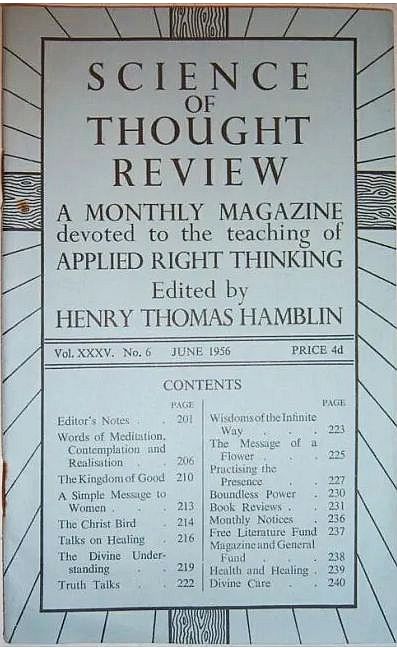 It’s a kind of arrogance, maybe, to imagine that we can find original words for every feeling. The other day I opened a book I’ve had for a while. It arrived shortly before a week’s holiday on the Island, as shown here and I took it along and ever since have meant to say something about it. I found a bookmark showing the page I left off reading, while staying there, two years ago. It’s called The Way of the Practical Mystic, by Henry Thomas Hamblin, and I bought it because I remembered its author as the editor of The Science of Thought Review, that my mother used to subscribe to in the Fifties, and which, as an omnivorous reader, I devoured like everything else, and in this case remembered years later.
So on a whim I opened it at the bookmark, in “Lesson VII” of a Course which HTH designed as a replacement to his original course, designed in the 1920s, one which he burned in the garden, where it smouldered for days, HTH being
a self-confessed ‘whole-hogger’ who did nothing by half-measures. After a good deal of time had passed, from the ashes of that fire arose a new Phoenix, a Course of twenty-six lessons.
Lesson VII is called “No Evil in the Divine Plan of your Life”. Part way through, his posthumous editor says
At this point, HTH commends to us the very comforting Psalm 91 . . .
so I looked it up in my Bible Designed to be Read as Literature, and found this. Which evoked in me the exact same feeling that I’ve been having lately, for which it would be impossible to find adequate words myself. And now finding the words there, firmly ensconced in the world’s literature, is a great relief. No one needs to find unique words, when they are there to be discovered, as millions know. I don’t have to do anything, for now I know that countless others must have shared the same feeling, when they discovered the essence bottled up in a poem, which just happens to be a Hebrew Psalm—and a Christian one too, translated into Elizabethan English by men with poetry in their souls.
And it made me want to do something, so as to possess it and make it mine. Perhaps, I thought, I should transcribe it in pen and ink—but my handwriting is too bad. Should I emulate Blake, find a suitable font, create a page in the style or spirit of his illuminated printing, on a colour-wash background? I told myself this doing was a form of meditation. (I didn’t at this stage realize how many have done this, in their own way, including a blogger called Rex Tossicomane, “a self-confessed addict”, with many handwritten transcriptions of psalms.) For me, as I now realize, it was another instance of avoidance of not-doing.
I was doodling in this fashion, getting disgusted with my efforts, when the doorbell rang, a brace of eager evangelists. I asked who they were representing, meaning which church. The lady pointed up to the sky. Ah, Him up there! I said it wasn’t a good time for me, not for doorstep sermons today. These people cannot be got rid of so easily, as everyone knows. They throw out lines to catch you. She asked what I thought of what’s going on in the world today. Did I know what’s to be done about it? I said things are as they are. They won’t be fixed by religions; nor atheists either. She didn’t know where I was coming from, assumed I was a Muslim. I’m convinced the Jehovah people are drawn to this street especially. They have more in common with them (most of my neighbours) than those who know nothing of scriptures and almighty gods. Later, when I spoke about loving one’s neighbour & lovingkindness generally, she was convinced I must be a disciple of Jesus. And when I mentioned reading Psalm 91, she impressed me by quoting its first verse with hardly a moment’s hesitation:
He that dwelleth in the secret place of the most High shall abide under the shadow of the Almighty.
Then I was stumped by her question: “Do you know what it means?” I was silent, trying to think of an honest answer. Realizing I had no curiosity to be told “what it means”, and that our surprising conversation had already taken twenty minutes, the Witnesses got restless. It was time to wind up. We agreed that we’d agreed more than we disagreed, said farewells with dignity intact.
I suspect many turn to Psalm 91 for its words of comfort. Who could grudge them that? For me, when I found it, there was a recognition of what I’d been feeling lately, especially at night when I’d wake and not sleep again; when that “secret place of the most High” showed itself to me as an inexpressible stillness, as did every other image in the poem. The ultimate safe place, an unshakeable refuge. Or as HTH says in his Course:
There can be no evil in your life if you dwell in the secret place of the Most High.
I go back through my writings, and memories never yet written, and see a pattern, a guidance through dark days which lightened across the decades, till this. I was delivered from the snare of the fowler. His truth is my shield and buckler. The angels have charge over me . . .
Or as Julian of Norwich says, recounting a vision in which Jesus had spoken these words to her:
It was necessary that there should be sin; but all shall be well, and all shall be well, and all manner of thing shall be well.
Shall be? Is.
6 thoughts on “Seeing a Pattern”
“An odd thing I notice is how it was easy to write the early posts; while today it takes so long, so many attempts are abandoned.”
I’ve noticed this as well, though maybe in a different way. I feel like I doing more editing on posts more than I used to, weeding out awkward phrases and clearing away grammatical stumbling blocks. I feel like I keep going back and tweaking them after they’re posted a lot more than I used to.
I’d like to think that this means I’ve become more conscientious with my writing. But I look back at my older posts and they usually seem to flow nice and naturally.
A few possibilities:
1.) I did much more editing on them than I remember. This is a good possibility, especially since I tend to sometimes tweak a few things here and there on older posts sometimes long after the fact, and it’s easy to foget the accumulation of these tweaks.
2.) I’ve grown more comfortable with these older posts; they feel more set, and thus maybe more natural.
3.) There has been a shift, not necessarily for the worst, maybe even for the better, in how I write. Maybe it just takes more work now. Maybe even the simple stuff is more complicated than it used to be. But maybe that’s because I’ve expanded into more complicated territory, and I’ve developed a more versatile bag of tricks. I think I may have even read somewhere that that tends to happen to writers as they go along.
I’m glad we’re seeing a similar pattern, and that you puzzle over reasons for it. You’ve inspired me to a question, or perhaps several.
1) Is the direction of travel we’ve observed a necessary or inevitable shift? i.e. that it cannot go back the other way, towards dashing off something simple & spontaneous?
2) Is the analogy of mining relevant? i.e. you start off with an open-cast coal mine. You can pick up lumps of coal in your bare hands, take them home in a wheelbarrow. But then you have to go deeper, build galleries and elevators. It gets harder to find the seams of coal.
I’d like to say that you could go back, but the truth is, probably not, or at least not without great difficulty — which defeats the whole purpose (There was some quote from Picasso about taking a lifetime to learn to paint like a child again.) At any rate, innocence seems to be the archetypical adversary of time and entropy. It’s the one thing you can’t get back.
The mining analogy is an apt one. I noticed that same idea with something else, but exactly what it is escapes me at the moment. The closest I can come up with is the idea that you can walk five miles on your own two feet with little preparation or trouble, while with a car you have a whole network of complications involving payments and maintenance and insurance, but the car can ultimately take you farther. But I don’t like that analogy, because in that case, walking local distances is still an option.
No, I’m thinking of something where it’s fundamentally altered to take on a larger scope, but in the process it becomes cumbersome in dealing with simple matters. But I can’t put my finger on it. Might have something to do with Thoreau. Maybe. Might be Thoreau entirely.
- Bryan White To bring it back to the subject of writing: I’ve always TRIED to keep it simple. Ideally, I want the words to unspool smoothly without a lot of knots and kinks in them. If it’s hard to read, it’s counter-productive. So, I always edit by reading back through and seeing where I get caught on these kinks. Sometimes I won’t be sure why a sentence doesn’t work, why I keep catching on it, and I’ll keep messing with it a little bit here and there until I realize that the whole way it’s put together is just ludicrous. And I’ll say, “What was I thinking? How did I ever come up with such a crazy, awkward sentence?” And then, hopefully, I’ll figure out an easier way of writing it.
And the funny thing is, I find this happening MORE now than it used to. And so I think, “What’s wrong with me? Aren’t I supposed to be getting BETTER at this?”
But there’s another side to it. Because I’ll be going along and I’ll see where I can pull off something a little more, say, ambitious than I would have before. There was a part in one of my recent posts where I was talking about sitting down on a porch swing, and there were a couple of different beats to it. It was a little thing. It wasn’t even really meant to be noticed. It was just there for texture. But I got a kick out of it. It was neat trying to put one of those little details of life into words, that feeling of trying to sit down and join someone on a porch swing as it’s already swinging.
A few years back, I might not have tried that; it might not have even OCCURRED to me to try that. I might have just said that I sat down on the swing. And when I think about it like that, when I think, well if that’s as far as I would have gone with it, well then OF COURSE it was easier to write back then.
So, to the question of going back, I also add the answer that I’m pretty sure I wouldn’t even WANT to.
I want to add something about the post too (which, after all, is supposed to be point of the comments.) I really love the way you describe your interactions with people, such as the evangelist on your doorstep here, pointing at the sky. There’s a common feel to the people that populate the landscape of your posts, which tells me that it’s not just them, but it’s how YOU see them and understand them.
I’ve noticed a similar thing with the way Jack Kerouac wrote about people. There’s this unique Kerouac feel to the characters in his books. And when I’ve encountered some of those people (since most of his characters were actual people) outside the context of his writings, and I’ve seen them as I would see them, or as someone else would describe them and I’m able to consider the disparity, I have a moment where I think, “Ohhh, okay. So that’s how Kerouac sees that sort of person”, because all the while I’ve been picturing them through Kerouac’s quirky lens, as martyrs and madmen, invested with a faith that strives to constantly look beyond their faults.
For instance, there was a movie made of On the Road a few years back. I didn’t see the whole thing. But I remember that the guy who played Dean Moriarty said the things that Dean said and did the things that Dean did, and yet, it didn’t feel like KEROUAC’S Dean Moriaty. In a way, it felt like someone more familar to me, like someone from the neighborhood, like how I might have understood him, had I been there. I was seeing the things that Kerouac had described acted out before my own eyes, for me to process on my own terms. And it wasn’t necessarily that this Dean was any less true to life — he may have been more so — but the real Dean of On the Road is the Dean of Kerouac’s imagination.
My point is, it’s a thing you notice with some writers. They have a certain way with people (Dostoyevsky is probably another great example of this. There definitely a very Dostoyevsky way he has of capturing people’s little expressions and mannerisms.) I sense that in your descriptions. There’s always a feeling that there’s unplumbed depths to these people. No one ever really comes off like some shallow shlub put in your path by God just to be a nuisance, like extras in the movie of life’s little annoyances. No, it always seems like there’s a story behind them, like they have mysteries and feelings that run deep, all the way down.
Thanks, Bryan. I’ve far too much to say in reply. Re Kerouac, I was influenced by On the Road to an unhealthy degree in 1961, along with Miller’s Tropic of Cancer & Capricorn. And later by The Dharma Bums. Without noticing how much. But then in 2012 we saw the movie of On the Road, not because we wanted to but it seemed the least worst of the films being shown at the “Eye” Museum in Amsterdam, a cool place we’d decided to hang out for the afternoon, or day. I realized how appalling are the characters of Sal Paradise and Ed Moriarty, how badly they treat women, what contempt they have for honest behaviour.
As for the unplumbed depths, you are exactly right. I wanted to say very much more about the Jehovah’s Witnesses, and what we shared. As they stood before me I explained how I see a difference between the person and the religion. And at that moment felt the mysteries and feelings that run so deep, as if it were indeed a visitation by God (!) but on the other hand the religion was constraining them like ropes and chains and strait-jacket. (I suddenly think of a street performer in Amsterdam in a big square, who was absurdly constrained like this and gathered crowds with his extraordinary oratory (in English), then collected money from the crowd, and was out in seconds. Except that religious people don’t escape. They try to have fun within the manacles. To which a voice in me wants to say “Like the rest of us!”
And on the other topic of going back to simplicity. After spending the day indoors I was ready yesterday to have a short strenuous walk, so went up to the Pastures, halfway at any rate, remembering past inspirations, past simple outpourings: the shapes of clouds, the sun on the red bricks, the blackbirds’ songs, the sense of feeling embraced and at home. It was all there, but it wasn’t new any more. I couldn’t write that again with the same excited simplicity as when that stuff spilled out as though I’d never seen these things before. There’s always a search for the new. Even if it’s just a new expression of the same. So I think we are at one on this “no going back” part of writing.
 a wayfarer’s notes