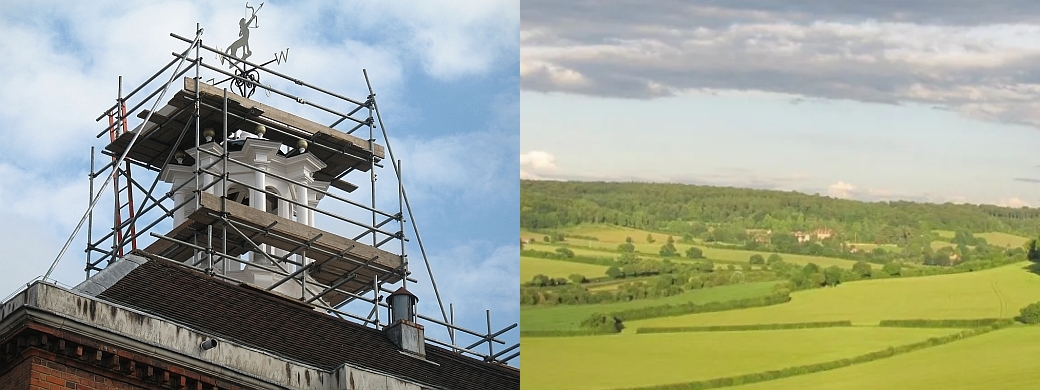

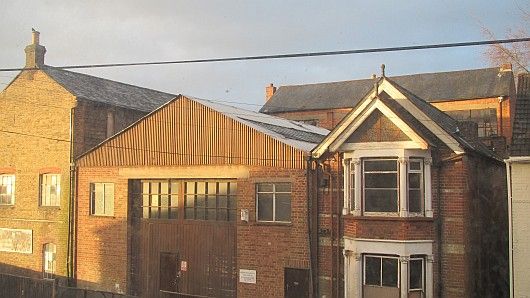
I’ve written several times about the factory across from our bedroom and how the morning sun progressively reaches down from the tips of its roof. When you wake and look out, it gives you an idea of what time it is, taking the season into account. On many nights and days too, I see the moon above it, waxing, waning, gibbous, crescent or full. An almanac may speak this way, but the view from my pillow says it without words, simply reflecting light, and being itself. Like any piece of architecture, like Stonehenge even, it stays where it is, a monument to its builders, silent about what it may have seen within and without its walls. If I am to die in my own bed—best way to go—the last thing seen by these eyes may be rosy-fingered dawn advancing over that self-same frontage.
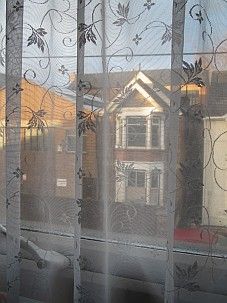
Yet everything is ephemeral, including our adopted symbols of changelessness. Some months ago the factory closed down. I miss the noisy young workers who played Radio 1 at top volume and street football in their lunch hour; the book-keeper who liked to chat, often with sad personal tales to tell; the sawdust, the whining of machinery, the offcuts of timber always available to neighbours who asked. One day, the last machines were moved out, the floors were swept for the last time. Then the buildings were put up for sale “with potential for residential development”. After being solidly built in the last years of Queen Victoria’s reign, they were now perhaps to be demolished in favour of some flimsy and hideous block of flats thrown up, like others in the neighbourhood. Who cares? The elderly may cry rack and ruin, but the young see only progress, and an affordable place to live.
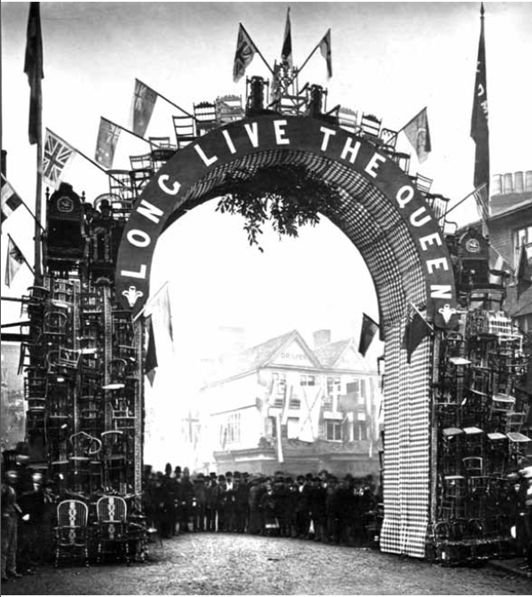 Then I was surprised to discover that this neighbourhood, site of the cheapest housing for miles around, has been designated an “historic factory district”, a proud monument to what once made this town renowned across all England and doubtless the Empire: furniture-making. When Queen Victoria visited in 1877, a triumphal arch was erected in her honour, built from chairs. (The tradition of such arches continues. A new one is to appear in a few weeks. I think it’s a project organized by students of the local university.) We are to become a conservation area, a living museum, including our house, I suppose. This and many other rows in the neighbourhood would have originally been built for workers in furniture and allied trades.
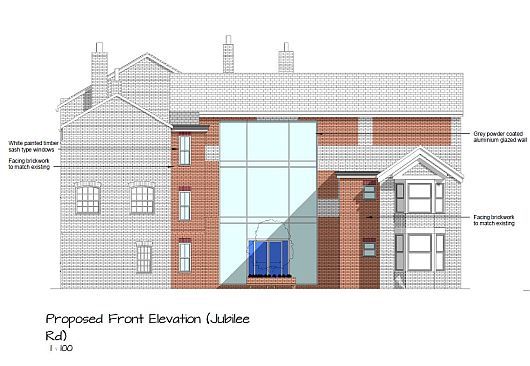 According to the architect’s drawings, a narrower version of the original courtyard will be restored, with cobblestones, benches and two Himalayan birch trees.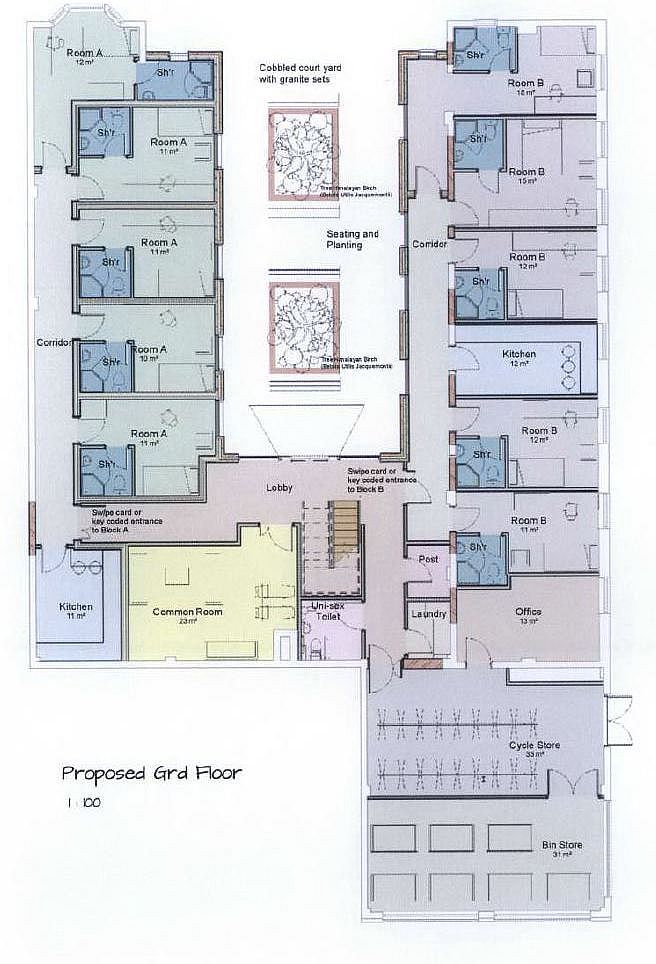
Of the neighbours I’ve spoken to, not one is in favour. To them, the students will grab scarce parking places and be rowdy at night. The building work will cause obstruction and spread dust everywhere. I keep my views to myself. I’m already content to park up to half a mile away, sometimes leaving the car unused for days. When the day comes to stop driving, I’ll hand over the keys without a struggle, perhaps to my younger daughter who lives nearby. I owe her anyhow. Fifteen years ago, I promised her a new Super Beetle, till she thought it no longer cool and changed her fantasy to an Audi TT. I thought I might have the money by the time she was grown-up, but alas! I broke my promise, though it was never a serious one, and now she drives an elderly Renault Clio, bought with her own hard-earned money.
I’ve never been materialistic. To be honest, I’ve always thought of opulence as somehow in bad taste and inelegant. K says it’s because I have to be different at all costs, for the sake of contrariness. I’m sure she’s right. I see it in the children too, especially my elder son. He seems to have enough wilful eccentricity to sabotage an entire civilization, if he set his sights on it. If? Or when; perhaps already.
Following this train of thought wherever it wants to go, I find myself arguing with St Matthew’s Gospel, not for the first time. A couple of verses have been bouncing unbidden in my head:
Lay not up for yourselves treasures upon earth, where moth and rust doth corrupt, and where thieves break through and steal: but lay up for yourselves treasures in heaven, where neither moth nor rust …
So what are “treasures in heaven”, apart from a comforting promise to those enslaved in this life, which might be any of us, at least metaphorically?
For where your treasure is, there will your heart be also.
I don’t know what that is supposed to mean. I’d simply say that your treasure is your heaven. Enjoy it while you can. Don’t wreck your moment of heaven by fearing the moth & thieves at your back. I confess to naïveté, believing in innate goodness and natural morality, without need of religion: or should I say, in spite of religion.
The things I cherish are those which cannot be possessed, such as blue sky and clouds, the blackbird’s song, true love, memories, Public Footpaths, Nature, sunshine, health, life. they cannot be bought. All are endangered, all will go. My efforts to keep them won’t avail and cannot prevail. There used to be a chorus of blackbirds round here before dawn, competing from rival chimneypots. This year there’s only one and I don’t know why.
I recall a post I wrote in August 2006. Here’s an excerpt:
This little excursion made me feel the poignancy and pathos of life, as if today was my last on earth, and I were reviewing the content of my days: their beauty, imperfection, yearning and joy. No more yearning now, because I have it all, except for the curse of material wealth. Like Diogenes, I have renounced all to gain all. It reminds me of Douglas Adams’ The Long Dark Tea-time of the Soul, where Dirk Gently asks a tramp, “Have you lost something?” “Have I lost something?” he said in querulous astonishment. “Have I lost something? . . . The sky? . . . The ground?”
Or another in September 2008, quoting a blogger called King Biscuit Man, relating the story of Diogenes and the Emperor Alexander, where the great conqueror offers him a boon, anything he cares to ask, and Diogenes replies:
I want only one thing Alexander. You stand in front of me, and you’re hiding the sun, so, don’t take from me the thing that you can not give me!
Well, it is a good advice, not to lay up for ourselves treasures on earth; but not for the reasons stated. Everything is threatened, not just our personal hoard of private property. Everything will go, but that’s no reason not to love it. That which I cannot possess—the sky, with all below and above it—is my treasure, and a symbol of eternity. Having already tried to trash verses from St Matthew, I’ve been directing my contrary nature to the words of Ellie, when she says “Spirit is the real; matter is the illusion.”. I was familiar enough with the assertion. It had been a cliché of the spiritual path I followed for thirty years. There was a time when Maya, the Sanskrit word usually rendered as “illusion”, would fall readily from our lips in casual conversation. Wikipedia has a good article on it, especially the section “In Advaita Vedanta”.
I don’t question the idea of Illusion, though its meaning is always shaped by context. I suppose it was her use of the word “spirit” that gave me the difficulty. By what criterion may we say that spirit, when divorced from matter, is real? With modern knowledge, can we conceive of that divorce? Can we point to a single instance of spirit separate from matter? Only in our imaginations, which require living matter to exist.
In the end, having chewed it over thus, I accept Ellie’s aphorism as provocative in a worthwhile way. For in the blackbird’s song, the kindly sky, the dawn light across the sun-dial factory, I see symbols of eternity, even as the things themselves are threatened and cannot last forever. All our symbolic treasures, our images of heaven, are so because they speak to eternity dwelling within us. That is spirit, and no illusion.
I see my sun-dial factory as infused with Spirit, though my neighbours may only see forms of matter which actively threaten their lives. “If we open ourselves to the spirit, we receive,”says Ellie. In daytime fantasy and night-time dream, I often revisit my old university campus, magically becoming a student again, not to attend lectures, but hang out, like a ghost haunting the scene of some unresolved disaster. (I did not use my time well, so I relive it in spirit, I mean in the world of imagination.) Now we have a new university in the town. Some students have already found lodgings in this street. Without any practical scheme in mind, only openness to spirit, I give thanks at this prospect of a university—some tangible part of it—lapping at my doorstep like an overflowing river of learning, scholarship and student adventure; and the refurbishment of my sun-dial.
7 thoughts on “The Sun-dial factory”
ellie
It is easy for me to think of the material world as illusion because I have learned that it is make up of quarks, quanta, electromagnetic waves, excited electrons and particles which exist for
Vincent
I grant you that in some respects scientific advances have nudged us towards revising long-held ideas, when we see that they are no longer tenable.But I don’t think that because of quarks etc it’s necessary to revise the meaning of “illusion”, which I take as referring to our senses being deceived. I don’t have a problem with the paradox of a relatively invisible realm being considered more real than the everyday realm visible to the senses. When Blake as a child reported seeing angels in the trees, I could understand him if he were to say that the angels were more real than the trees.What I was querying was the separation implicit in your statement that spirit is real and matter an illusion; a separation which you appear to reiterate in the idea of a parallel universe. It’s a traditional idea of course, that makes reincarnation, transmigration of souls, any form of afterlife possible.But—and this is simply personal preference, not dogmatism about the universe—I lean towards a kind of pantheism or animism, wherein spirit is a property of matter, just as colour and shape are properties of objects. In the abstract you can have colourless shapes and shapeless colours, but in real life you cannot have one without the other.
Vincent
When I said “in real life”, I meant of course, in the world of the senses.
ellie
Don’t our senses create for us an ‘illusion’ so that we can interact with matter. Five avenues are provided by our bodies which select portions of input from which our minds construct a world and occupy it with people, nature, emotions, ideas.Blake tries to disengage us from over reliance on our senses. Contemporary technology can teach the same recognition of the limitation of sensation. There is a great expansion in our ability of receive data from the time/space matrix but it is all transmuted to sensory data for us to process through our minds. So we recognize that senses are receivers, but they don’t determine the variety and quantity of information which is available.To me the spiritual world is not other than the world we know as material, but access to it is not provided by the senses nor can what we call ‘reason’ fathom it. You could say that the mind/body detects it. The reason that it is valuable to expose oneself to metaphor, myth, art, and beauty is because they can open one to a total, undivided image that can become integrated and transformative. But if you ask the question, ‘Transformed to what?’, you short-curcuit the process and probably have to begin again.
Vincent
Yes, I agree with all that.
ZACL
So, you are going to be at the heart of a living museum, that’s very interesting. Youth is to be introduced into it. I can understand partly why the neighbours have concerns, and it won’t just be about the alternative use for the old factory. As a conserved/preserved community, you will have to keep your present frontages as they are, though, depending on the grading you are allotted, you could be allowed to modernise and age internally.
Vincent
Actually in real life, ZACL, there has been no indication whatever that our dwelling houses are to be listed. We would have been told. Planning regulations are slack for private dwellings. I say “in real life” because this blog, which never names the town in question, preserves poetic licence to alter details to suit – in principle. No, for some reason it’s just the older factories which are listed, so they either stay as gaunt ruins with every window broken & old mattresses in their precincts, or they are eventually put to other uses, which can take years till a purchaser comes along with acceptable plans.The old school has been turned into a community centre, which is fine. It’s a beautiful building and the grounds are regularly tended. But adjacent is the old school playground, which combines the function of unofficial rubbish dump, shortcut to town centre (which I wrote about on 15/07/12) and teenagers’ venue for cricket & football. They’ve padlocked the gate to try and stop dumping, so no shortcut now but enterprising kids can still worm through the magic fence for gathering & games. The place remains undeveloped because the planners want the purchaser to build dwellings one side whilst maintaining a tidy playspace on the other. It is expensive to keep anything tidy round here. Dumping is almost the norm.
 a wayfarer’s notes