
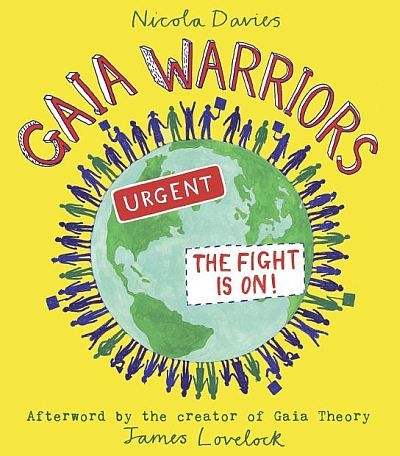
Nicola Davies’ book about climate change has hardly set the world on fire. Since its publication in 2009, it has attracted two reader reviews on Amazon: one in UK, one in US. It’s a lavishly-produced paperback, large format, bold use of colours and fonts; but I don’t think it’s selling too well now. You can buy it new for an English penny, or 96 cents US. It’s designed to appeal to an audience of children without insulting their intelligence, which puts it at just the right level for me to understand. It piles on scientific detail till the reader cries “enough”, and then piles on more. To sugar the pill, it’s jokey and vernacular in tone:
. . . we also know that levels of greenhouse gases went up and down like a monkey on a ladder long before humans were around to influence them. . . . This mega system was given the name Gaia by James Lovelock more than 30 years ago. Gaia was a pretty wacky idea back then . . .
The information the author supplies is so comprehensive as to pass for a school textbook, were it not for the fancy colours, fonts & jokiness. But as I write these words I reflect that it probably is a school textbook, and it’s I who am out of date by sixty years and more. Some of the textbooks I had to use were tattered remnants from earlier generations of schoolboys. Anyhow and by any standards you cannot accuse Gaia Warriors of being dull. Its seriousness is lightened with entertainment on many levels, not least with thought-provoking quotes:
“Humans never change unless we have to. And finally, we have to.” (Severn Cullis-Suzuki. Severn is a young Canadian who has been sticking up for our planet since she spoke to the 1992 UN Earth Summit in Rio de Janeiro when she was 12.)
“Unless we have to”: true and also thought-provoking. At what precise point do we find ourselves obliged to change? Scientists and activists like Suzuki assure us the “have-to” date has already passed. Here in southern England we’ve had two months of daily rain, leaving floods of Biblical proportions. People have been rescued from their homes in inflatable boats. There has been little else on the news till this week, but the waters subside only slowly, and, we’re told, may come back:
“Keep hold of your sandbags” is the advice from Bucks County Council this week, as residents are urged to stay prepared despite receding flood levels in the last few days.
The floods affected Marlow on the river Thames, a mere seven miles from here, yet here we remain unaffected. Such is the nature of self-interest that Suzuki’s awareness of “have to change” hasn’t hit those of us who’ve stayed dry. Insurance policies may still refer to an “act of God”, a phrase drained of meaning in secular England. For those whose carpets and furniture have been ruined, whose insurance will cost more and property will be worth less it feels natural to blame the Government. So it must pay compensation for a string of “failures”: inadequate drainage, inaccurate weather warnings, tardy arrival in rescue boats. Perhaps influenced by the general election looming next year, politicians play along with this sense of dependency, express empathy, appear on the scene to be photographed in knee-deep water, declare that no expense will be spared.
 One local politician, a town councillor eighteen miles away, blames God and the Government equally:
A UKIP councillor has blamed the recent storms and heavy floods across Britain on the Government’s decision to legalise gay marriage.
The United Kingdom Independence Party, which campaigns for Britain to be out of Europe, has expelled him from their ranks, not for opposition to gay marriage, but for dragging in religion. Apparently the councillor had “accused the prime minister of acting arrogantly against the Gospel”. Voters don’t like wacky ideas. They see divine retribution as even wackier than Gaia.
What sacrifices are humanity prepared to make to avert ecological catastrophe? Few and reluctant.
What attracted me to Gaia Warriors was not its scientific information, nor its adventurous suggestions for turning young people into activists. I’ve always shunned activism, shuddered at marches, demonstrations and most forms of “consciousness-raising”. What drew me was the Afterword by James Lovelock, father of the Gaia concept, or perhaps, as he’s now in his nineties, great-grandfather. His short essay upstages and overrides arguments made by the main author. He asserts what she denies, denies what she asserts, though gently enough for an inattentive reader to miss.
Davies:
Climate change is happening, but we’re not doomed. We can’t stop it, but we could slow it down and we could prepare for its effects.
Lovelock:
Unconsciously we set in motion the conditions for this war two centuries ago when we began to take more from the Earth than we could ever pay back. It was not simply by using fossil fuel for energy but also by taking the natural forests and turning them into farmland. These two acts, which made food and medicine abundant, enabled our numbers to grow until we took more from Gaia than she could give. Now we are like the victim of a loan shark, with debts larger than our means to repay them.
Gaia, the Earth system, regulates the planet so it always remains habitable, but to do so she needs the natural forest ecosystems intact. What we humans have done by taking them for ourselves alone is to make the Earth uninhabitable. I think it unlikely that anything we do will alter the course of this change.
Davies:
The good news about this battle is that it isn’t going to involve guns, blood and killing; the weapons you’ll need to help fight it are ideas, energy and determination. The even better news is that there are already lots of people out there fighting, and actually enjoying being part of such an exciting and challenging struggle. Who knows, if you join them, we might just save the world.
Lovelock:
. . . despite pretending otherwise, humans are war-loving animals, the words “Gaia” and “warriors” do indeed go together.
Warriors do not march to have a friendly discussion, or even an argument. Warriors march to battle and usually intend to win and make sure that their beliefs prevail. . . . In this, the 21st century, warriors may be faced with an older and simpler form of conflict: that of fighting for survival.
Nobody – not the cleverest scientist nor even a committee made up of Nobel Prize winners from each of the sciences – can with certainty predict the world of 2030 and tell us how to live peacefully there. Nor can they tell us how to restore the Earth to the lush and habitable state it was in sixty years ago. There are no sure answers, and Gaia, the Earth system, is moving faster than we can respond, still less oppose its motion.
Survival is our only option and, before long, some people will find that their part of the Earth is less harmed by climate change than others. Naturally those whose land becomes desert or is flooded and can no longer provide food and water will move to where there is plenty. Because of our natures, war between these haves and have-nots is inevitable. There will not be food and water enough for both. Sometimes the invaders will win and other times the defenders; what matters is that there are survivors so that there continue to be humans on the Earth.
Lovelock does acknowledge “Gaia Warriors”, in the sense that Davies intends the term, when he says
The ultimate survivors will probably include some powerfully effective Gaia warriors, and we will have evolved another step towards a new and perhaps more intelligent species of humans.
As the excerpts above express plainly, Lovelock places no faith in the remedies proposed by that minority of well-meaning dreamers, those we call eco-warriors. Politicians pay lip-service to their aims, knowing, if they are intelligent, that wind farms, turning off lights and recycling plastic bags are mere window-dressing. Reality will hit us in the face as and when it does. Then humanity will react, on the age-old principle by which we are here: survival of the fittest.
He holds out hope, but it won’t bloom in our lifetimes, or those of our grandchildren:
Let us look forward to the time when our descendants have evolved to become Gaia’s brain—clear in thought and clear in vision—and Gaia’s T cells,her warriors, the true defenders serving the first intelligent planet in our galaxy.
 One reviewer says this:
The afterword by James Lovelock seems rather gloomy and heavy-handed considering the age of the intended readers. That said, I believe it could also provide a critical introduction for children to a concept that is going to hold such a pivotal and relevant place in their adulthood.
(Grace ter Haar, in The Ecologist)
I’ve lived with these ideas of James Lovelock for several years, and don’t find them gloomy now. I find little or no hope in eco-activism. I place more hope in a reformed morality and spiritual vision after the follies and toxic beliefs of the world’s religions have been consigned to extinction, along with the follies and toxic beliefs of blind materialism.
Let Lovelock have the last word:
Some people see Gaia as the mother of everything alive, all-powerful, with a religious significance as part of God’s creation; others as the name of a scientific theory about the Earth system. I see her as something that includes both of these ideas . . .
 a wayfarer’s notes
This Nicola Davis book has one more reader than I do. I'm gonna have to catch up!
As for textbooks, I went to a private religious school where the textbooks were already about a good thirty years out of date, so I really can't speak to the current state of textbooks any more than you can. Maybe I should poke around in my daughter's book bag.
My experience with college textbooks pretty much went like this: you looked on the syllabus. You saw the book you needed for that class. You went to the book store and paid outrageously for it. And then the professor never mentioned it again for the rest of the quarter. The end.
LikeLike
“…the “have-to” date has already passed.”
I think this is probably true — in the broader sense, such as “We have to do such and such before it's too late.” But I'm not sure that it's true in the sense of impelling complacent people to act, which I'm assuming is what the “unless we have to” statement is referring to.
For example, if you go to a town and get up in front of everyone and tell them, “You have to stop doing [whatever] or your levees are going to collapse and flood your town”, the situation may be every bit as dire as you're making it out to be, but the complacent will still have the luxury of ignoring you — that is UNTIL the water is actually seeping through their doors. Then they'll actually “have to” do something in that second, crucially necessary, sense.
It's almost a tragic play on words here. As long as someone still needs to get up and say, “We have to do something”, it hasn't reached the point where people are going realize that they “have to” do anything. You can tell people all day long that the shit is headed for the fan, but they're not going to start wiping until after it hits.
LikeLike
This comment has been removed by the author.
LikeLike
I liked your third comment – the one you deleted – as much as the others, if not more. I hope you will reinstate it. In the meantime I would like to quote from it:
“This Lovelock guy even goes so far as to try to saddle me with farming guilt!”
I find myself instantly wanting to defend Lovelock, an impulse which proves that he's a hero of mine. Yes he mentions how the human race has been taking from the Earth more than we can ever pay back, but he prefaces this by saying that the process started two hundred years ago.
If we're going to feel guilty about the sins of our forefathers, we are certainly taking on burdens that we can never pay back.
See for example a headline from three days ago: “Jamaicans lead Caribbean calls for Britain to pay slavery reparations”
LikeLike
I just wish that I could have found something in your script with which I could disagree, But I find myself in total agreement. That human beings will not change unless they have to (and even then it's of the screaming and struggling variety) is almost a universal law. And scientific laws do not change to suit mankind's whims and fancies. Is it not a great pity that a species which prides itself on 'freedom of choice' cannot/will not exercise that choice over matters as fundamental as the environment? And it will take more than simply vast numbers to effect change, because there will always be a sizeable minority who will consider themselves above all this. If they are comfortable, they will find all sorts of reasons for denial. It is one of the fundamental characteristics of living creatures, all the way down to the simplest organisms, that they will only move (however one chooses to define movement) in order to relieve discomfort. That presupposes they have left themselves enough time and room. As long as there are people who feel comfortable enough in their current state, no effective change will voluntarily be embraced.
LikeLike
I agree with you that it’s “a great pity” that humanity is what it is. Do you urge greater dissatisfaction with the status quo? Do you blame those who feel comfort within it? Perhaps you are like me, finding no virtue in blame or guilt.
Dissatisfaction arises in Nature, especially human nature. It caused the plundering of earth’s resources & pollution of its atmosphere. Dissatisfaction, or the urge to improve things, got us where we are today. Environmentalists are the new preachers just as Jeremiah and the other prophets were in the Old Testament.
I’m all for Bryan’s third comment, the one “removed by the author”, which starts:
“On the other hand, there’s a part of me that deeply resents the way these environmentalists try to saddle people with this vague guilt merely for existing and living their lives.”
The environmentalists want to assuage their guilt-feeling by being saviours, and thus achieve the sense of comfort which they attack in others. Unfortunately for their case, the die is cast already, as even Nicola Davies admits.
We shall have to relearn skills almost forgotten in this generation of Promethean defiance, which believes everything is fixable in short order. They are the skills of last resort: acceptance, humility, serenity, thanksgiving for the blessings which remain, trust in Providence.
LikeLike
I feel neither dissatisfaction nor a desire to blame; there is no future in that approach. I cannot even say that I deeply resent the way these environmentalists try to saddle people with this vague sense of guilt etc. Firstly, I don't resent it, assuming they are trying to do that. Secondly, and this arises from the first point, if they are trying to dump, that's not my problem, it's theirs.
It does seem to me, and I do believe that as a species we indulge in a shocking waste of resources, driven by greed, that a more positive approach would be to begin to organise some forums where our possible long term futures might be discussed. Out of that we might arrive at some consensus as to what we might do now, rather than make piecemeal decisions supported by protest groups, which may be self-defeating. I think I'd keep politicians (or similar type wanabees) out of the process.
Of course we might fail in any case, but surely it is better to appeal to something higher in ourselves rather than get involved in sterile blame games. In the end I suspect nothing of any significance will be decided, no matter what 'faces' are applied to bit part solutions. We will gradually sink into a worsening situation until enough people say, “That's enough!”
LikeLike
It seems you have more access to that deleted comment than I do. I'll have to leave the “re-instating” to you.
I didn't necessarily have second thoughts about what I said. I just questioned the need to say it, and I wondered if maybe it would come across the wrong way. I won't deny that we're headed for some sort of environmental crisis. I don't know. I just have a problem with the environmentalists approach.
First of all, this Gaia hypothesis is sometimes used to give the planet itself an aura of sanctity apart from its inhabitants. But what do we really mean when we talk about saving the planet? As far as the planet itself is concerned, it's completely indifferent to whether it's a molten wasteland or whether it stays lush and green. It's is WE who are concerned with maintaining the planet's ability to support life, and we are concerned with maintaining it for US. The environmentalists seem like they're trying to obscure this fact and drive a wedge in this relationship, so that they can set us up as the perennial villain in the scenario. Sure the world would be a nice place to live without us here, but to whom would being a “nice place to live” be of value to then?
You could say that that's NOT what they're saying, but when the complaint isn't smog or industrial pollution but rather the existence of agriculture, then how else is one to take it!? There are, what, six billion people on this planet? Without agriculture there would be mass extinction. We're supposed to endure that to “save the planet”? Save it for whom? That seems like a whole lot of babies thrown out with a whole lot of bathwater. And if we're not supposed to do that, then what? We're just supposed to live with the chronic guilt of what we're doing to “the planet” to keep ourselves alive? How is that going to solve anything?
LikeLike
I'm reminded here of another blogger who wrote a spectacular review of the ending of the updated Battlestar Galactica series in which she was appalled by its implicit message that we “made a mistake coming down from the trees.”
At rock bottom, that's what these discussions always seem to come back to. I'm all for warning people that it's ill-advised to foul your own nest and that a day of reckoning will come if we refuse to heed that warning, but when environmentalism starts to become a platform for spitting in the face of humanity qua humanity, that's when I start to tune out. We are a clever, tool-making, primate. It's too late in the game to forego the cleverness or the tool-making, nor is there anything to be gained from shaking our heads in shame or disapproval that we possess the qualities or lamenting about what a burden that makes us for our poor mother Earth. All this talk ablut how we shouldn't have done this, or how we never should have been that, what does it accomplish? You can't slam the brakes on evolution, nor should you. We are HERE now, and we are who we are, and we have to work WITHIN that paradigm to find our solutions.
I for one am PROUD of our technological accomplishments. I don't have any shame or regrets or them. I just think that going FORWARD we need to be more responsible about how we do things. We need to think more long term, and be more mindful of the damage and potential damage that we do, and find more sustainable rather than exhaustible means of living.
LikeLike
Also, these environmentalists spend so much time bemoaning people's complacency rather than trying to look for the source of that complacency. After all, people aren't ALWAYS complacent about things. But yet, there does seem to be a definite resistance towards the subject. I remember this thing my daughter sent me a while back. It said something like, “Imagine how upset people would be about trees being cut down in they gave off wi-fi signals? But they don't give off wi-fi signals … just the air we breathe.”
And I think part of this indifference is because the problem often IS presented in such and unappetizing form with so much guilt and castigation attached to it. It almost feels like church!! If you tell people that humanity is the problem, don't be shocked when they're not eager to find a solution.
LikeLike
Okay. One more. I promise. I feel like I need to break what I'm saying down into a more succinct and perhaps more recognizable form.
First off, I said above that people sometimes “use” the Gaia Hypothesis a certain. By that I'm trying to give Mr. Lovelock the benefit of the doubt that he might not have intended the concept to have taken on the life that it has.
At any rate, there are people who talk about this Gaia Hypothesis in the sense of the planet being a living entity unto itself. It's not. It's merely a massive chunk of rock which can support life. That life, taken as a whole can be regarded AS THOUGH it were a single unified entity for the sake of conjecture, but it's important not to regard this entity in fact as something that exists independently of the lifeforms which are “in the network” so to speak. By disregarding this crucial distinction, people often set the discussion up in terms of people making selfless sacrifices “for the sake of the planet.” Nothing could be more deliberately designed to alienate people from feeling that they have a personal stake in the matter. And then they sit around and whine about how people don't care! It becomes not about saving the planet for you or your children or your great great grandchildren, but rather about saving the planet for … “The Planet.” You and your great great grandchildren are just grist for the mill, sacrifices waiting to be laid at the alter of Gaia. It's as though there were something dirty or un-PC in acknowledging that humans even figure into the equation, as though that would detract from the grand nobility of it all. There's a distinctly religious overtone to it. At the very least, they've done a fine job of extrapolating the religious strategy of completely expunging passion and self-interest and personal appeal, while simultaneously demanding unlimited devotion — just because.
LikeLike
Bryan, I've just seen your latest four comments. I'll be delighted to read them and discuss further, but first I would like to publish a response prepared offline to Tom's latest above. I know if I read yours first I'd have second & third thoughts ….
So here is that response to Tom.
Greed is an instinct within man shaped by natural selection, though not yet adapted to current needs. Ants and bees have selfless social behaviour, but attempts to persuade man to imitate them give us North Korea. Man like other animals has instincts to perpetuate close family genes, thus explaining altruism, say Dawkins et al. But never yet to save the planet.
The United Nations hasn’t yet worked as intended, nor have more focused conferences, protocols and accords. In the case of climate change, there are insights into what’s gone wrong but no united vision about what to do, because nobody knows.
If someone were, as you say to “begin to organise some forums where our possible long term futures might be discussed”, I think they would need to have a clear vision on how human motivation may be co-ordinated, as well as a plan of action which participants might support without a self-sacrifice more drastic to their minds than the catastrophe they are trying to avoid for future generations.
In a sudden leap of lateral thinking, I land on a recent programme in the BBC radio series “In Our Time”, in which Melvyn Bragg chairs a discussion of academics, usually on some historical topic. Last week it was “Chivalry, the moral code observed by knights of the Middle Ages”. It’s a fascinatingly well-documented example of altruistic behaviour whose development took place within a hundred years or so. It’s relevant to our discussion because it produced a breed of men who responded to the Pope’s call for the First Crusade.
It wasn’t altruistic enough to eliminate greed, however. You might say it was a systematic way to organize it. For example, knights took prisoners, instead of slaughtering their defeated opponents. But then, financial matters had become well-organized enough for ransom to be demanded and paid. Knights behaved with chivalry only to enemy knights, not to peasants, who couldn’t have supplied ransom money. So a sceptic might say that medieval knights were about as chivalric as Somali priates, as so well portrayed in the film Captain Phillips.
But there are interesting parallels. Knights flocked to the First Crusade because the Pope promised them Heaven for killing Saracens to liberate Jerusalem, much as suicide bombers are promised Heaven today. And when Jerusalem was liberated from Islam, the Crusaders broke their contract and didn’t hand it back to the Byzantine Empire as previously agreed.
Such is human nature, I’m afraid.
LikeLike
I skimmed through your comments quickly, Bryan, & find almost complete agreement. It's true that there is something mystical about the Gaia concept, but I do urge you to read Lovelock's Afterword in its entirety. I did give the link but here it is again: http://www.ian.mulder.clara.net/blog/Afterword.pdf.
Here's another quote from it, a challenging one:
“Other organisms, more important than we are, started as disastrous mistakes whose unrestrained growth did massive planet-wide damage. Tiny green bacteria heedlessly polluted the air over 2 billion years ago with a poisonous, destructive gas—oxygen. Pollution far more deadly than anything we have done so far.”
When Lovelock suggests that tiny green bacteria are more important than we are, what does he mean? I suppose he means that they produce oxygen, without which we and most other life-forms could not exist. Whereas if the whole human race were wiped out, there would be extinctions, presumably, such as domestic animals and crops, but wild nature would be grateful, so to speak.
So Lovelock does taunt his reader with the relative unimportance of human life to the planet. Perhaps he's carried away with his own Gaia concept. Or perhaps it is part of a more cunning rhetoric to emphasize our interdependence, a difficult concept for us to grasp. For instance, a few years ago, we men in the street thought of bees as being useful for honey and nothing else. Now we understand that they are essential to the lifecycle of many food crops, by pollinating them.
I notice in myself a tendency to defend Lovelock against all comers, just as I did, to a lesser extent, with Gray and his Straw Dogs. Forgive me, such is the weakness of all flesh.
LikeLike
“When Lovelock suggests that tiny green bacteria are more important than we are, what does he mean?”
Yes. This is at the very crux of what I'm saying. To say that something is important begs the question, important to whom? Oddly enough, this is one area where I fall completely on the side of subjectivity. The idea of something having value is entirely contingent on it being of value to someone, or at least some living thing. I can't really comprehend any meaning of the concept outside of that. Like I was saying above, as far as the planet itself is concerned, it's a matter of completely indifference whether it's habitable, barren, or blown into a billion tiny pieces. It's matter, and without measuring it against the standard of life who's to say one form is greater than another? It's this idea of this “importance” or greater purpose that goes above and beyond us that makes the whole thing seem so … messianic. (Not to mention it also puts the bitter, the disgruntled, and the disdainful in a perfect position to scoff at the human race wholesale and talk about us as if we're all some insignificant blight in the grander scheme of things.)
Now I'm off to follow your link. I won't promise that it won't piss me off.
LikeLike
And again, when he talks about “poisonous gas” it begs the questions once more: Poisonous to whom? By what standard? In what way? Is he saying it was poisonous to the lifeforms that existed at the time? You'll have to forgive my rustiness in the field of biology, but I'm not sure I've heard of ANY lifeforms that can exist without oxygen, let alone be poisoned by it. Am I wrong? If not, in what sense can it be declared “poisonous”? Is he just trying to be mischievous?
Anyway, read the afterword. At the very least, it seems pretty dire for a children's book. But then you've covered that already.
LikeLike
The point about the ecosystem is that it provides not just for itself but for the whole and for what is to follow. When you use your own body as an example of a system, you recognize that each molecule, each cell, each organ contributes to the whole. Each 'gives up' its own independence for something beyond its comprehension. The earth, the solar system, the universe, too, are manifestations of life or spirit to which they give body.
Without metaphor we can think only of the mundane and miss the mystical which clothes the meaning.
LikeLike
Ellie's comment, the fiery dart that flies to the heart of the matter.
LikeLike
Probably going to be out of tune with Vincent and Bryan here. I see every evidence that younger people have a growing sense of responsibility to the environment and a growing repulsion to instances of its being crudely exploited. In due course, these things impact political decisions and even the free market. The claim that it is too late to do any good presumes a knowledge of the natural world that, I believe, we are far from possessing. I see a beautiful world that is eminently worth caring for.
Interesting discussion anyway. I'm not very knowledgeable of Lovelock but I think he does see the world as a living organism of a sort. Also, not that it's particularly relevant, but yes there certainly are plenty of organisms, albeit small ones, for whom oxyen is a toxin. These days they live in relic locations such as undersea volcanoes. But it is widely supposed that early life on earth was predominantly of this type, since in those days there was no oxygen to breathe – not until the activity of green plants built up a reservoir. .
LikeLike
This comment has been removed by the author.
LikeLike
Has anyone read “The Sixth Extinction: An Unnatural History” by Elizabeth Kolbert? Just came out—I haven't read it yet, but it appears very well researched and is getting great reviews. Another asteroid is hitting Earth, and it's us.
LikeLike
An amended version of the comment deleted above. And also, thanks to Michael for pointing out about the organisms who find oxygen toxic, since I forgot to mention it earlier. Like I said, biology isn't my strong suit.
@Ellie: Yes, I get how the idea is useful as a metaphor. I think I even said as much above. But I think the problem comes in when the metaphor is taken too literally and treated as a moral imperative of subservience to “The Planet.” That's where it begins to border on religion.
For instance, the metaphor of the body that you mentioned. That's a wonderful illustration for understanding the Gaia concept, for reducing it down to a scope that's mentally manageable. It's an illuminating idea and I have no problem with it as an idea. However, it's application begins to break down when you consider that the individual cells in, say, my fingernails don't have hopes, dreams, desires, and wills of their own. If they did, I would begin to feel that there was something grotesque in clipping them off to preserve the appearance of my body as a whole. Likewise, I'm not comfortable with the idea that I have all the value of a flaky skin cell in the grand scheme of thing. Yes, such ideas can be useful in reminding people that they're part of something larger, but it can also often be used to cheapen the value of the individual or even human life in general. It can be dangerous to start thinking of people as mere cells in a system. It can lead to exploitation or worse. To use another metaphor, we shouldn't lose sight of the trees for the sake of the forest.
LikeLike
If I might come back just once more on this issue (and Vincent, I hope I am not using your space inappropriately), the point made in B.M.W.'s latest comment appears to ignore one half of what Ellie said. Of course Ellie can speak better for herself than I can, but she does mention the word 'mystical'. I do not believe that one can fully understand the universe without considering the mystical, psycho-spiritual half of the equation of Life, alongside its physical manifestations, any more than one can understand the cosmos without complex numbers, to paraphrase something written by Sir Roger Penrose. (Of course complex numbers consist of two parts, the Real and the Imaginary.) It seems to me that this holistic approach is precisely what lies at the heart of the Gaia hypotheis.
LikeLike
I like your amended version, Bryan for it strengthens this excellent discussion & shows a way to draw the opposing ends together, at some point.
The moral imperative of subservience to The Planet is already a religion to many who think that’s what religion is: moral imperatives underpinned by unsubstantiated beliefs. Mankind hungers for religion, it seems. We may reject it but our nature abhors the consequent vacuum.
I may dissent from those beliefs as much as you do. Yet I’ve been drawn vaguely to an idea of religion as far back as memory goes: long before I could express or rationalize it. Now I would say it comes from a source of universal awareness, so fugitive and inchoate that it needs to be clothed in concepts (and metaphors) before it can be shared. To reuse your own expression, I’m just a tree but sometimes I feel the forest’s beating heart more urgently than my own. As my personal needs lessen (consequence of age and settled form of life), so fancy lifts me above the narrow cell of ego-consciousness towards cosmic consciousness. This is the fresh air which breathes life into religion’s sails. The rest of religion is dross and at worst can be vile oppression.
You are right to mention that ideas can “cheapen the value of the individual or even human life in general”. Not just ideas of Gaia, I’d say but any ideas at all that impinge on the way we live our lives. Slavery, the Industrial Revolution, Communism, consumerism, Islamism, are examples springing instantly to mind of exploitative systems which think of people as mere cells in a system.
Do the cells in our bodies have a will of their own? In a sense, yes. Cancer cells are those with a will to survive and multiply beyond their designated lifespan. White blood cells are the soldiers in our bloodstream, dedicated to our defence by identifying and killing infectious invaders. These cells go wrong and may kill us if they start getting wrong ideas in their nuclei. I won’t pursue the point. I too am pretty ignorant of biology.
In the case of Gaia, it’s not that we must be subservient to it, but we are components within it. The tree is not subordinate to the forest, but part of it. Each glories in the other. An individual whose awareness does not go beyond its own interest cheapens itself. Gaia gives us concrete realization of ideas expressed in mythical form in the book of Genesis. Lovelock is telling us to prepare ourselves for the Flood.
LikeLike
Just after posting my comment above I saw yours, Tom. Lacking your gift for succinctness, I was trying to make the same point.
LikeLike
Commenting on Elizabeth's Kolbert's book Al Gore made this remark:
“But in the modern era, three factors have combined to radically disrupt the relationship between civilization and the earth’s ecosystem: the unparalleled surge in human population that has quadrupled our numbers in less than a hundred years; the development of powerful new technologies that magnify the per capita impact of all seven billion of us, soon to be nine billion or more; and the emergence of a hegemonic ideology that exalts short-term thinking and ignores the true long-term cost and consequences of the choices we’re making in industry, energy policy, agriculture, forestry and politics.”
http://www.marknykanen.com/al-gore-on-elizabeth-gilberts-the-sixth-extinction/
I think that we are paying far too little attention to the fact of human population explosion.
We're choosing the strategy of producing multitudes of expendable individuals who can't survive on limited and diminishing resources. The logical inconsistency is that we promote constant expansion, production and consumption, and care little about protecting, nurturing and educating the generations which will follow us.
LikeLike
Thanks Brian S & Ellie for pointing out Elizabeth Kolbert. I discovered that this new book is not available in the library here, but an earlier book is: Field Notes from a Catastrophe: a front-line report on Climate Change (2007). I was instantly able to borrow it using their e-book download service.
Its cover seduced me at once, looking exactly like the floods round here, & therefore more relevant to my own little world than the flight of frogs in Panama.
Yes, Ellie, you hit the nail on the head with your last sentence. Every day here, politicians and everyone express an obsession with constant expansion, production and consumption, to the exclusion of almost everything. Insofar as most news media are financed by advertising which is financed entirely by consumption, I can only be grateful for the BBC, which in principle is not subject to that form of indenture. But still it reflects what's there in the world, & is therefore not encouraging.
In face of all the one-sided propaganda supporting this apparent dash to oblivion, one needs a daily cleansing; a kind of sauna of the spirit to slough off the dirt that inevitably clings to the skin. Not to replace one kind of propaganda with another: that is too wearisome in the circumstances; but to listen to a simple voice that speaks of nothing but life and its exuberance.
I get a taste of this in the dark hour before dawn, when in certain seasons a lone blackbird stands on a chimney-top somewhere, and the liquid notes of its song come through the open bedroom window,
LikeLike
I meant “plight of frogs” not “flight of frogs”.
LikeLike
Did you ever publish your manuscript? What is the status? I have been away.
LikeLike
Welcome back. I wondered what had become of you. I did briefly publish a kind of anthology as a Kindle e-book, in October or November. It was called “The Embrace of Gaia”, coincidentally. Then I withdrew it after a week or two. I sent Brian Spaeth a printed version, which has become an instant “collector's item” in that no other copy exists except on my computer.
When I realized that I'd never settle on a particular edition, it became apparent that if published at all it would probably be posthumously.
To which end there is an ongoing vacancy for a literary executor. Though you have not applied, I have put you on the shortlist. I am very fussy, by the way, very critical. But the beauty of this post is that no one will take it up until I am dead, and then they will have a free rein. And may get paid from my estate, if the executors of same see fit, and if any revenue should accrue.
Having said which, I ought to append an assurance of being currently in good health, and determined to do my damnedest (is that correct spelling? it seems odd) to outlive all persons on my shortlist. I am not sure what “damnedest” means in practical terms, but in my usage, let me assure you, it falls short of sending a hitman after them to shorten the odds. In any case I don't know where you live.
LikeLike
A point that I don't think has been raised here is that the planet experiences catastrophic Earth-changes on a regular basis—all on its own—with or without our help. And by “regular”, I refer to time-spans that can encompass millennia. It is an unstable place—there is no solid, dependable place to put our feet, really, in the long term. Continents rise and fall—oceans dry up—only to flood once again. The list of ancient cities and civilizations that have come and gone as a result of Earth changes is a long one. There are ruins of ancient cities that bear water marks indicating that they were once partially submerged, but are now in the middle of deserts. The Native Americans that I know talk very often of impending Earth changes—a big one may be heading our way soon. And these cataclysms don't even necessarily have to originate on our own planet, as the asteroid that (allegedly) killed off the dinosaurs demonstrates. The last great cataclysm may have been around 5000 BC—the great flood mentioned in the bible and other ancient texts—but of course, we don't know for certain, because they burnt all the books! (Alexandria and more than a few other great libraries). These book-burning parties are almost as great a menace as the tectonic plates themselves. The knowledge that has been lost…
But having said all this—I still think we ought to re-cycle!
LikeLike
Yikes! I sought you out on Amazon, and only found:
this
Two things bothered me. Firstly, there was no “Ian” attached to the author’s name. More importantly, the subject matter did not suggest that I had reached my destination.
After that I gave up the search and decided to just ask you. The decision was as disastrous as it was bitter. I learned that I am the target of your survival, which may not sound bad until one fully analyzes it, with all its morbid connotations.
Anyway, I am honored to be on the short list. It is a post for which I am both unqualified and undeserving. I am not sure what psychological aberration is satisfied by such an unworkable idea, but I feel there is one. Why should a fellow want to be overestimated? Except for the skills and the time needed, I have most of the requisite attributes. I have a barely used pen, two discounted eyes, and fickle enthusiasm that flits from one thing to another with little notice.
I have recently embraced kindle. I find that I can read it in bed, without waking my wife or daughter. I intended to download your magnum opus, and if the gods permitted, even to read it. The gods did not permit.
LikeLike
Right, Brian, and that gives a more poignant sense of not-to-be-taken-for-granted blessedness to that which we have. The moment something is snatched away, or the threat of snatching away looms, its value goes up an hundredfold in our eyes.
Which funnily enough reminds me of an anecdote about the book-burnings in Alexandria. Unfortunately the anecdote itself has almost gone from my memory, just a few ashes remain, and I've tried in vain to coax Google into bringing it forth from its capacious maw. Someone was burning the books and attempting to sell what remained at absurdly high prices, such that no one would buy, even though they protested at the burning itself. So the man burnt more books, and kept doubling the price of those that remained. Finally, when only a few were left, someone came forward and paid more than had been asked for the hundreds and thousands before.
If this is not happening yet with our countryside, our wildlife, our blue skies, the blessing (and curse) of water, it will.
It happens in a human life just the same. In youth our breaths are not numbered, we squander them, pollute our lungs with this and that, having little notion of the greatness of the gift of fresh air.
I'm reading “Coda”, the final volume in the quartet of “Smoking Diaries”, by Simon Gray, playwright, ob. 2008. It's worthy of a post.
LikeLike
Yes, John, I do confess to being the author of “this” – that thing you pointed out tentatively and with a shudder. Was commissioned to do so, someone landed me in it.
A psychological aberration? I briefly wondered “yours or mine?” before reaching the obvious conclusion. Not over-estimated, merely miscast. I think Emerson may have had something to do with it, or Twain.
Now that I visualize you in bed reading your Kindle, without waking wife, I see myself in you, with my Kindle, doing the same, in quest of something piquant and tantalizing, a magnum opus, the thing I have not yet completed, which consists of numerous flawed and overlapping drafts. Withdrawing all bogus threats against your person, I feel the strong urge to send you an opus, but fear to do so, fearful of your bored response to its longueurs, fearful to look at it myself. The gods will permit. Indeed it is their nemesis upon you.
Tell you what. Give me the email address of your kindle, by email if you wish to preserve its privacy, and I will send you an old and abandoned, yet faithful and complete, copy of “A Wayfarer's Notes”, complete with links & certain illustrations & certain attempts at classification and indexing.
In fact, as I write this, I am uploading same to a website, and again, if you request it by email, I can send you the link to download to your computer, and thence transfer to your Kindle.
The gods have relented.
LikeLike
It's a mobi file, 10.6mb.
LikeLike
??????????????
LikeLike
Your comments are always welcome, Bryan. Indeed, there are more questions than answers.
LikeLike
Hi Again, just thought t pop in.
Wot's the problem? Ah, Gaia.
OK, fact. Human beings are living on this planet, fact.
If there is some sort of fantasy “Sky God”, have yet to discover 'IT', “HIM”, or “THEM”.
At this point of time on this planet it seems that the “Roman church” Imperium has, in fact, been quite successful for the past 1500 (give or take a few hundred) years.
Ah, nostalgia. There was a time; many, many years ago, when females were important people in the community..
LikeLike
It does, also, fascinate me that most of the 'philosophical' discussions belong to the “northern” hemisphere.
Mediterranean origins.
LikeLike