
 “Most of the literature and history of psycho-spirituality has been couched in religious language”, says Tom, whose blog “Gwynt” is an exploration of his inner world via Pathworking. If one is going to write about one’s experience, one needs a language. I think Tom uses the term “psycho-spirituality” to distance his own language from that of ancient scripture and the writings of mystics—which he nevertheless accepts as laying out the territory to be explored. For we should be able to distance ourselves. Present experience deserves present-day language, forged in today’s world. And yet we have this legacy of religious language to describe certain aspects of experience, such as intimations of immortality, visions of angels in the trees.
But trailing clouds of glory do we come
From God, who is our home:
Heaven lies about us in our infancy!
(William Wordsworth, from Intimations of Immortality)
A tree filled with angels, bright angelic wings bespangling every bough with stars.
(William Blake, aged 8, from his notebook.)
And there’s the Bible, in the sonorous and poetic translation published in the reign of King James I of England. Since those times, we’ve absorbed modern science, beginning around the time of Newton. We’ve had time to take on the writings of Darwin and Freud; not, I would say, superseding the previously accepted authority of the Bible, but augmenting our literature. I hope to return to this theme in another post.
There was a time when religion ruled men’s minds, gave morality, order and ritual to their lives, provided answers to all the big questions. It has so shrunk in scope that atheists, the latest in a centuries-old tradition of reform movements, propose to sweep it away altogether. They claim that science and other rational, evidence-based structures of knowledge will serve all our needs; and we will be the better for it. The long-sought Utopia will come a step nearer. I’m sympathetic to their aims, except that their critique of religion always seems to have a blind spot. They are unable to perceive it as guardian of spirituality. Spirit is that which has no material substance, and in that sense cannot speak for itself. You cannot point to it or separate it from matter. Unless you have acquaintance with it, you can have nothing true to say about it. And even if you do have such acquaintance, it’s still arguable as to whether anything you can say will be true or helpful to others, in pointing them to it. Spirit is nondescript, in the sense of lacking description. But it can be felt. It is the basis of belief in the One God, or the many gods. To deny spirit is unscientific. You can be anti-religion, but as the psalmist says, only “the fool hath said in his heart, there is no God”.
Whereof one cannot speak, thereof one must be silent.
This is how Ludwig Wittgenstein ends his Tractatus, a meditation on reality, logic and language, which muses on what is, and what can be said about it. He envisages a “picture theory” of language in which true statements are those which validly correspond to facts. On such strict criteria one can well understand Wittgenstein’s stance. In these quoted words he was not exclusively referring to spiritual matters, but clearly he was including them, as shown in this excerpt from a few paragraphs earlier.
There are, indeed, things that cannot be put into words. They make themselves manifest. They are what is mystical.
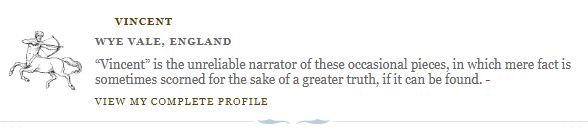
I suspect that very few people in the history of human speech have been as meticulous in this matter as Wittgenstein. We struggle to express, we find words to say, regardless of whether they make sense or can be relied upon as truth. I’m no supporter of modern atheism but I approve its implicit project of a radical reform movement, at least in one point. Like them, I don’t trust the word of any prophet, evangelist, philosopher or sage in anything whatsoever. I don’t claim to speak truth myself. Indeed my Blogger profile, alongside, describes Vincent as an “unreliable narrator”. So what hope or gain is there in writing at all, or in reading what’s written?
Let Tom have the last word:
I long ago discovered that, for example, a passage in a book really only had meaning if I had previously experienced what that passage was discussing.
13 thoughts on “Whereof one cannot speak . . .”
Tom
Thank you very much Vincent for the link. I have been complimented.
Bryan M. White
I glanced at this post earlier and I was so thrown by the new profile pic off to the side that I needed to go away and regroup my thoughts for a while ; But seriously, the problem with casting religion as the “guardian of spirituality” is that it is so often such a prescriptive and dogmatic guardian. It’s true that abandoning religion entirely would leave a sort of void in people’s lives, and that’s something that many atheists don’t seem to appreciate, but I don’t know that religion has always served as the best thing to fill that void — at least not as many people often practice it. Seems like something a bit more … flexible is called for.
Bryan M. White
I guess what I’m driving at is this: I can understand why people say that religion provides for people’s spiritual needs and that if it were dethroned in favor of science that many it would leave us cold and mechanistic. I get what people are TRYING to say when they say that. But ultimately what does it amount to? Do I HAVE to believe in Noah and the talking snakes and all that jazz to be spiritually? Religion is providing one fairy tale, one size fits all, with a rigidly defined narrative and they take it pretty damn seriously. In terms of nourishing a hunger of the magnitude that we’re discussing here, religion is offering cardboard crackers and Kool-aid (sometimes literally if you’re a protestant) and there’s absolutely nothing else on the menu. I know you might insert something here about how it’s different in England, more tolerant, ect. But that’s not religion. It’s some custom that you have as a side with your tea. It’s part of your country’s strange tendency to cling to outdated vestiges from the past, like those ridiculous hats the palace guards where, or the fact that you’re still knighting people in the 21st century. You need to stop seeing that as a template for how religion works among people who actually take it seriously and literally.
You might remember my piece “The Human Variable” from our long defunct co-venture. There I argued that it’s a mistake to look at science as a SUBSTITUTE for religion. Rather, science clears religion out of the way, leaving you free to explore these things in your own way and on your own terms through the act of living itself. In other words, religion is the “Paint-By-Numbers” version of spirituality for people no artistic inclinations or ambition to imagine something greater. Me, I prefer a blank canvas open to all the possibilities of life. THAT’S what what these scientific atheists are offering, not a new kind of spiritual nourishment, but rather they’re just trying to break your addiction to the old nourishment and telling you that you can be free.
Bryan M. White
Didn’t mean to go on like that, and again, those remarks aren’t directed solely at you. As a personal matter you probably feel much the same way I do. I just find it a bit perplexing when people talk about religion like it serves some indispensable role of providing depth and meaning for people. In my mind, that sentiment starts to break down when you really stop to look at what religion is, what it does, and how it works. It’s like someone offering me a salad with beetles and cigarette butts mixed in with it and saying, “Well, you know, people do have to eat!” (Also sorry for all the typos. New phone.)
Vincent
I’ll explain about the photo. My younger son was here last weekend and decided to update my Facebook page. He did a witty job of it but I prevailed on him to remove various scurrilous inventions and fictional life-events. Under “professional skills” he wrote “selfies”, which inspired me to do one, which I decided to leave here until the first comment. So now it’s gone.
Vincent
Tom, I had said I’d write something inspired by your posts, about “demystifying mysticism”, and ended up with this, which might be the first of several instalments.
Vincent
Bryan, I do agree with the position you have set out so eloquently. You have described the current state of things, especially in the New World.But religion is in its death-throes, world-wide, fighting desperately for survival and often with extreme violence. It cannot impose itself any more. It cannot be rigid. These things you mention cannot last, they are of no account. The empire has fallen, the assets are being sold off, sometimes literally (as with thousands of old church buildings in the UK, no longer needed in a country where it’s mainly immigrants who go to church, mosque etc).We can talk about “my country’s strange tendency to cling to outdated vestiges from the past”. It’s a topic I love. But I’m much more influenced by knowledge of European history. The story of Christianity is the story of European civilization, good and bad.It’s hard to let things go. That’s what we see. From here, I cannot understand America’s reverence for its Constitution, & the implications on safety of life & limb (referring of course to gun control, lack of). I say this not to score points but to point out the universal clinging to outdated vestiges from the past.I propose that it’s not just because we are attached to these vestiges. We worry what would be put in their place once they are swept away. Better the devil you know.There is much more to say. Later.
Vincent
Further to my last: I said “the assets are being sold off”. Religion may seem like a monolith from where you’re standing, but that’s an effect of personal perspective (just as my own view is, of course).But imagine a great mansion being sold off, full of art collections, furniture, antiques, and so on. Religion has been, in Europe, the guardian of spiritual life for many, over centuries. It has left the legacy of cathedrals, Dante, Bach, Raphael, Milton, bedrock culture of the past. And in the East, Buddhism, Vedanta, Taoism, Confucianism etc. Religions, in general, no longer rule their territory. They can no longer dictate to captive congregations. Their assets are for anyone to pick and choose, if they find anything to their taste. Referring to the tolerant traditions of the Church of England, you say, “But that’s not religion. It’s some custom that you have as a side with your tea.” I know what you mean. When I was still young enough to argue with Christians, and would point out for example the practices of a given group to “people who actually take it seriously and literally”, they had a simple response, such as “Oh! Those Catholics, those Papists, they’re not Christians at all.”
So in a way you are arguing like them “That’s not religion.” It is, I suggest, next to impossible for any of us to say what is or is not religion, especially when we are building a case for or against any viewpoint.
Bryan M. White
Fair points, all of them. And you’re right, I shouldn’t have said that the C of E “isn’t religion.” I guess I was just trying to make the point that it’s a unique situation, peculiar to your national idiosyncrasies and not necessarily a guideline that can be applied elsewhere.It’s funny that you bring up America and the constitution in this connection, because I said much the same thing about our “experiment” to bring freedom to Iraq (“freedom” being a kind of catch-all that we like to throw around a lot in this country.) I said that our feelings on this subject and the circumstances that gave rise to the constitution grew somewhat organically out of certain historical conditions (i.e. the Revolutionary War, the whole mystique surrounding the “New World”), and that we couldn’t hope to just simply transplant them in another country and a completely different situation, that we couldn’t just “copy & paste” our government and set up “Freedom Franchises” around the globe.So I guess what I’m really trying to say is: When can we hope to see a new blog up composed entirely of selfies?
ellie
Bryan, I think you got to the point in your last sentence. We aren’t satisfied with seeing ourselves as only the superficial material image we see in the mirror or through the camera lens. If the trappings of religion don’t satisfy you, throw away the trappings. If you know that there is more to a human being than his atomic structure, affirm that seed, that light, that spark that you recognize without sensory evidence. Selfies shall pass as shall facebook and cathedrals. But there are some things that abide.
Vincent
It’s funny, I just woke up this morning thinking about my next piece to follow on from this one, which I’ll put up as soon as possible. I too thought Bryan had got to the point in his last sentence, but I saw a different point, almost opposite to Ellie’s, complementary to it.I had been in a hurry to withdraw the selfie and in a flash just now realized why: that I did not want others to see me more clearly and nakedly than I could see myself. I wanted to show them a construction and hide behind that.And so in the post I wrote above, I wanted to hide behind the eternal and impersonal, so to speak: quoting from others, being prompted by others to respond, postponing the question “Who am I?”I have often in these latter years affirmed that seed and that spark, tried to let the essence shape my trajectory, and in some sense try to dissolve and disappear in the process. The selfie, as I perceived it in the act of publishing and then withdrawing it, exposes the uniqueness of an individual which can never be erased until that time where his play is over, and he can no longer strut the stage. When he has gone, we realize that however insignificant the impact he made upon the All, there will never be another like him, with is unique sufferings and joys. the superficial image we see in the mirror or through the camera lens or in a portrait, say, by the late Lucian Freud, we see a small part of that. Anyhow for the record, here is the “selfie” that was briefly my profile picture.
B.F. Spaeth
Good to see you back here on a regular basis, Vincent. Interesting post, and many issues raised. As far as the selfie is concerned: (speaking for myself), I think that there is an extreme antipathy towards being turned into an object—being defined, grasped, understood, circumscribed. All these allow others to possess our self. It is always a rude shock when my lofty fortress of subjectivity is destroyed and I am turned into an object for others. But another thing is that I cannot stand to see images of myself, and I am always appalled and distressed at my appearance. It is only with the passage of time that I can look at an old photo of myself and say: “Oh, that’s not so bad—what was I so worried about?”. In the meantime, I see that you already have a new post!
Vincent
Yes, this self-consciousness is very common, and I can trace camera-shyness through the generations of my family, afflicting some and skipping others. For myself there seems to be an impending liberation, somewhat age-related. I’m hitting a paradox at present, touched on in my previous comment. I’m starting to find that the best counter to feelings of vulnerability of this nature – being aware of others seeing you as an object, when you have need of seeing yourself always as subject, and thus in control of your image – is to embrace this very vulnerability. Not by anything like self-abasement, but a bigger awareness, in which I begin to see my own self as an object, complete with its intact ego, from the ‘All’’s point of view. Which is not very far, I imagine, from the contemplation of death, in the sense of imagining the world happily without me having forgotten I ever existed.All such momentary exercises (they flash in and out of consciousness) have the effect of increasing gratitude for life itself, whether or not I have my own way.
 a wayfarer’s notes