

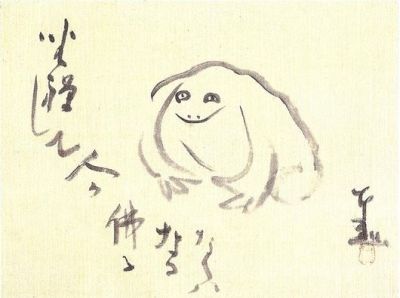
Limited by space, a frog in the well has no idea what is the ocean.
Limited by time, an insect in summer has no idea what is ice.
Limited by intellect, a man in life has no idea what is Consciousness.
— Chuang Tzu (369 BC-286 BC), tr Herbert A. Giles
In my reading, I’m like a bee in search of nectar. Sometimes the flower-scent wafts towards me; sometimes I’m attentive to the little dance of another bee returning to the hive, which is said to convey directions for fruitful places to look. In plain words, I regularly follow trails on the World-Wide Web, to see if anyone has written a book about the latest idea that arrives partially-formed in my head, perhaps in the night. If ever I discover in myself an original thought—unlikely—or one which no one has expressed better than I could, I may have to do something about it. I wouldn’t be sure whether to greet such an opportunity joyfully, or dread the burden it would carry of life-changing responsibility—like a young woman who suddenly discovers she is pregnant. In the woman’s case, instinct usually takes over; but a man, confronted by some incipient sign of vocation, might turn to drink and drugs to abort the risk of giving birth to destiny’s child within him. As for me, I’ve recently discovered how intellectually lazy I am: far too lazy to be a writer, or anything else. Age withers the ego’s yearning for fame or fortune. Luckily the id remains vigorous. Those who can, do; those who can’t, teach, says the old saying. I can’t even teach, so I’ll be content with tossing a few seeds randomly; or, more humbly, a few crumbs.
One germ of an idea first came to me on 15th September. There’s nothing to mark it in my notebook, but several entries in “browser history”, looking to see who’d had a similar thought. I’d been asking myself why three big religions have caused so much trouble in the world. I’m not saying they’ve not been the cause of good too, but that’s hard to measure and you can always say that trouble and good both come from people rather than institutions, which merely orchestrate, and hand out the heavy weaponry, whether it be guns or bibles. So my answer began like this.
They are big because they have survived, with effective mechanisms for attaching themselves to worldly power. To survive, you must be fertile to propagate a new generation, and adaptive to a changing world. You can see where this is going: a parallel with Darwin’s natural selection among the species. So I looked up “evolution of religion” and downloaded a Kindle book by Jesse Bering: The God Instinct: The Psychology of Souls, Destiny and the Meaning of Life. That’s the title for British readers. In the US, it’s The Belief Instinct: . . . , which seems to be quite a different thing, but after careful comparisons I can assure you it’s the same book. I can’t remember why but I never thought to write about it here. I would have to read it all over again to give you an idea of what it said.

On the same day, I discovered Robert Wright, via his website http://www.evolutionofgod.net/. His book The Evolution of God wasn’t available cheap so I ordered it from the library. His topic is the “three Abrahamic religions” and he covers it mainly by reference to the Old and New Testaments, the Koran and the scholarly-historical interpretations they have spawned. You might say it’s a fair approach, but I couldn’t help feeling I’d eavesdropped on someone else’s conversation. Wright was brought up as a Southern Baptist, and the little I know of this American group of Christians has been obtained by the same means. What I mean by eavesdropping is hearing answers to questions you never cared to ask, incomplete answers where you have to fill in the gaps yourself. There’s no point to pursue it further because “it’s none of my business”: any issues it may raise are not issues over here where I live. Round the corner, a Victorian Chapel has been taken over by Seventh-Day Adventists, who somehow convey the feeling that their worship too is none of my business, unlike the previous occupants who tried a little outreach with their posters and coffee-mornings for passers-by. Anyhow, Wright is now an agnostic, or as he prefers to put it, a secular humanist. I think he wants to tell the Southern Baptists, other Christians, atheists, Jews and Muslims how to understand one another, and be tolerant about where they find themselves today. (In his Introduction he acknowledges that his former pastor would think he’s sold out to Satan.)
His book starts off with a conventional structure: first there was just primitive religion—animism, shamanism. Then religious consciousness developed from polytheism through monolatry, whatever that is, to monotheism. Then he has a chapter about Philo of Alexandria who arouses little curiosity for this reader, then one entitled “Logos: the Divine Algorithm”: at least I ought to find out what he means by that. There’s one on what Jesus said, or should one say what the original evangelists decided to report. Finally there are several chapters about Islam, whose most memorable lines are those which show contradictory texts in the Koran (“Kill the polytheists” versus “there is no compulsion in religion”). I’ve barely skimmed the book, because his notion of God centres around human power and morality, thus confirming the idea I mentioned above, about how religions have evolved through the survival of the fittest. And I suppose he’s being true to the scriptures and historical times he takes as his base. But all the time, I was looking for something which turned out not to be there at all. He finishes with two chapters “God goes Global (or doesn’t)” and “Well, aren’t we special?”
Then he astonishes the reader with an Afterword entitled “By the Way, What Is God?” It’s not a rhetorical question. He really doesn’t know. His book is the long sermon of a frog in a well who’s never seen a horizon, never mind an ocean. He gets into the fruitless debate about whether “gods exist in people’s heads and, presumably, nowhere else” versus “a kind of god that’s real”. I should have read the subtitle more clearly: The Origins of Our Beliefs. I accept what Jesse Bering says, that there’s a belief instinct (which in my view is quite different from a God instinct, though he reveals his sense of their equivalence in his two titles for the same book). Yes there is a belief instinct, and I believe things too, for it’s too much effort to cleanse one’s mind of all beliefs and be a comprehensive sceptic. I don’t care what anyone believes, except for the harm that may result from ideas like “jihad” or “God’s chosen people”. I respect people and shrug politely at their beliefs, for we’re all human and believing is what we do. I think it’s absurd to waste time on discussing whether beliefs are true. If you want truth, go to philosophy, including natural philosophy, now known as science. Truth is costly. “Credo quia impossibile est!” to misquote Tertullian, or as the White Queen says, “Why, sometimes I’ve believed as many as six impossible things before breakfast.”

But if you are going to write a book about God, there’s surely something you ought to mention, even if it’s merely an afterthought. There is a god instinct, for there are certain kinds of experiences which we desire to have, which occur naturally and inexplicably; experiences which can’t be shared unless you can find a way to express them, invoking the idea of some power beyond conscious control. (Which, for convenience, we may call God.) Robert Wright seems to have felt the need for some afterthought on these lines, because after his Afterword, he has an Appendix, which ends with a section “Varieties of Religious Experience”. And at the very end of this section he says:
None of this is meant to deny the possibility of valid religious experience . . . But defenders of religion would be ill advised to stake its validity on the claim, as Otto suggested in The Idea of the Holy, that at the dawn of religious history, lies some mystical or revelatory experience that defies naturalistic explanation. . . . Because the more we learn about . . . human nature, the easier it is to explain the origin of religion without invoking such a thing.
Jesse BeringAt this point I got annoyed with Wright for wasting my time. “What do you mean, the dawn of religious history?! Every single day, in the life of illiterate peasants as well as learned monks and nuns, you and me, offers mystical and revelatory experiences that defy naturalistic explanation. It may be easier to explain the origin of religion without invoking such a thing, but even I, lazy as I’ve confessed myself to be, feel a duty to declare the truth of my own day-to-day experience. Not to explain the three Abrahamic religions—that’s a once-fertile field, now tilled to death. You’ve heard of winners’ history— “history is written by the winners”. Darwinian theory, as it may apply to the noösphere, is adequate to explain domination, reproductive power and adaptability. What needs to be explained is what people find endlessly attractive about their spontaneous outpouring of supplication and praise; their worship of the ineffable. First comes the urge, then the belief to make sense of it. Organized religion merely preys on what’s there already, like selling fresh air to those who were born to breathe free of charge.
Actually I’m grateful to Wright, for belittling the very thing that I want to praise, and provoking me to put in print my own explanation of God, and “spiritual paths” in general.
To be continued . . .
* I first learned about Sengai from an exhibition in the Musée de l’Homme, Paris, in 1961.
 a wayfarer’s notes
Well you're certainly not a lazy reader (even if you do confess to skimming.)
Your statement about the major religions becoming what that are as a matter of survival, reminds me of many conversations that I've had with my mother who is Christian but staunchly anti-Catholic. I've tried to explain to her that Christianity as she understands it took on the trappings of Catholicism – the Eucharist, confession, ect. – during the Middle Ages out of necessity. I've tried to explain to her that Christianity in the forms that she endorses – Baptist, Fundamentalist, ect. – probably wouldn't have survived the Middle Ages and wouldn't have worked with their way of life and mentality and understanding of the world at the time, and thus Christianity itself wouldn't have probably survived. The point being that she shouldn't look at Catholicism as some evil enemy, but rather a natural and necessary part of Christianity's development.
I'm sure you can understand why she and I KEEP having these conversations.
LikeLiked by 1 person
In fact, my mother tends to believe that Christianity began with the Apostle Paul and the early disciples. Then Catholicism came along later as an evil corruption of Christianity. Meanwhile, Paul's church continued on as a kind of pure strain of the religion, enduring as a small underground movement (opposed to the Catholics of course) throughout the Dark Ages and the Reformation and so on, until it was delivered inviolate at her doorstep in the 20th century.
I'm not sure where she ever got a wild idea like this, or what kind of historical fact that she thinks it's based in, but I suppose she finds it to be an edifying little fantasy.
LikeLiked by 1 person
Upsight: A sudden, usually unlooked-for moment of clear understanding. —the dictionary, 4th edition, A.R. 3000
From Neal Stephenson's novel Anathem.
Stephenson describes this manner of acquiring knowledge in some detail, and so drives Anathem into very deep philosophy, while keeping the story moving along. When Erasmas and the others finally arrive at the meeting of minds, the full theory becomes clear. The theors accept the multiverse theory and use it to come to terms with one of Arbre's main social problems. For centuries Arbre's thinkers were torn between two views of knowledge. One is that people can get 'upsights,' flashes of (e.g.) mathematical knowledge that seemingly come from another domain. This is the doctrine of Platonism in today's philosophy of mathematics. The theors decide that an upsight is the reception by a conscious brain of information from another cosmos.
From: http://www.zone-sf.com/wordworks/anathem1.html
LikeLiked by 1 person
We attempted to discuss something like this in a philosophy group. The books on show were the usual suspects. There were sections on Why [whichever deity]almost does or does not exist. Whichever it was, depended on the individual author's written stance. It weakens any argument when that adverb has to be put in place.
In our group was a retired minister of the church, who made surprising philosophical and personal statements about belief, which were more agnostic than faith-full. Maybe he meant to do it when he did, but just on the verge of leaving was a bit mean, as we could not pursue the threads of discussion with him.
'Preying on what is already there,' seems to be a tidy phrase for the myriad of complexities in sensibility, thought and mind. It is a view I would be comfortable with.
LikeLiked by 1 person
Bryan, I've been starting to see religion on the basis of costs and benefits. It sounds a bit like what an accountant would do! But I think it solves mysteries. To maintain one's faith as a Baptist – or any other denomination – requires a great deal of effort in today's world, to defend it from criticism and justify staying loyal to the flock.
It stands to reason that there is a benefit in staying loyal – or if you prefer an immeasurable cost in abandoning a lifetime's certainties.
So the believer finds the least troublesome way to defend her position. Sticking to the idea that Catholics are heretics is a lot easier than attending evening class to learn history & theology.
The idea that her own son knows better than her can be ruled out straight away. It seems like only yesterday that she watched him learning to walk.
LikeLike
Upsight eh, Charles? I only just learned the other day what upcycling is. & from Paula's House of Toast (see link below) we have a welcome use of 'levity' as the opposite of 'gravity'. Things are beginning to look up.
If I wasn't reading all these philosophical books, I might have time to read massive novels like Anathem. A cross between anthem and anathema? The reviews say that nothing happens at all for the first 60 pages or so. Excellent!
LikeLike
The Church of England in particular has always been the refuge of last resort for agnostic clergy, ZACL, as I understand it. The first to 'out' himself was John Robinson, Bishop of Woolwich, with his Honest to God published in 1963.
Some are more timid, waiting till they retire before revealing their doubts, so as to avoid harassment from their parishioners. I can well imagine your minister being reluctant to expose himself for questioning by the class!
LikeLike
Good work Vincent, you've raised the issue quite starkly, I'm looking forward to the continuation.
BTW, I'm confused about which are the “three big religions” that you begin by mentioning? Are they what are sometimes called the missionary religions , i.e. Buddhism, Christianity and Islam? Or are they the three Abrahamic religions you mention later on? (But Judaism must have quite a small following compared to some other world religions.)
LikeLiked by 1 person
Thanks for pointing out a misleading phrase there, Michael. It should not be the three big religions, for as you point out, Judaism isn't very big in the world. Yes, they are the three Abrahamic religions, but the label is Wright's, not mine.
LikeLike
And while I was at it, I did some other edits too, not to demand that anyone reads the whole thing again, but worthwhile edits all the same.
LikeLike
Well, if you're going to long way around the bush to tell me that my mother believes what she wants to believe, I could have saved you the trip 😉
LikeLiked by 1 person
If you're going to offer to save me a trip, and translate my finely-wrought exegesis into a bland reductionist sound-bite, I shall have to tell you that I prefer the scenic route, and thanks for the offer of a lift but I'd sooner walk—for religious reasons. 😉
I don’t mean to belittle the profundity of your point though. Your mother, your mother’s son even – we all believe what we want to believe. And you have helped me understand belief, in its weak and strong senses.
Weak sense: “I believe X” = “I understand X to be true.”
Strong sense: “I believe Y” = “I want Y to be true. To hell with open-mindedness.”
LikeLike
Wow that post is wonderful as always and packed with information. I guess I will have to return to it to digest it,
As regards teaching, I have already discovered that you would have been a great teacher of English language as well as literature/prose and mentioned that before, and still would be if you choose to. I will get to the content soon perhaps.
LikeLiked by 1 person
Very interesting. And not surprisingly.
I believe in God. It's a gift. God is there, He is everywhere, and He is not silent. But not everybody hears His voice. Or maybe He doesn't speak to everybody?
I'm fed up with all those imperfect churches. God is in everyone of them. But they betray His message, out of greed, fears and love of power. Being imperfect myself (I do what I shouldn't do, and do not do what I should), I forgive the churches. Not the leaders too well.
Have you read Teilhard de Chardin?
LikeLiked by 1 person
Claude i agree with most of what you have written, a little nuance here and there aside, and it seems to me that almost I wrote that.
LikeLiked by 1 person
Comment from Blake:
SONGS 54
The Voice of the Ancient Bard.
Youth of delight come hither:
And see the opening morn,
Image of truth new born.
Doubt is fled & clouds of reason.
Dark disputes & artful teazing.
Folly is an endless maze,
Tangled roots perplex her ways,
How many have fallen there!
They stumble all night over bones of the dead,
And feel they know not what but care
And wish to lead others, when they should be led.
LikeLiked by 1 person
Ashok and Vincent: Usually Believers in Someone or Something seem to need company and form congregations to celebrate their faith. The God I believe in does not require this of me. I simply face life's challenges in His company. And I seldom speak about this.
But a text, as profound as this one, pushed me to state, that there is a universal and personal God. Whether anyone agrees or not, He is part of my life. Remembering the unbearable loneliness of my long ago years without that certitude, I'm very, very happy for anyone who agrees.
LikeLiked by 1 person
Vincent – I'm looking forward to read what you're planning to write on a “Presence, based on experience alone”.
I could not claim this. We lived in a world which has been structured by what has been written in the Bible. I have read and studied the book extensively. And many of its pages are filled with wisdom. My life and experience of God has been strongly influenced by this.
That the message it conveys has been corrupted by churches became obvious to me. I refused to accept their different interpretations and doctrines. And I rejected the little gods they offered. In my distress and loneliness, I cried to the Spirit of God, “If you're there, if you're there, I beg you, answer me…” And He did. He always does. He inspires me and gives me the understanding necessary to live my life moment by moment, not only through certain pages of this book (not the ones I choose, but the ones He sends me to). He also speaks to my heart, soul and reason through His creation, with the words I need to hear for joy and comfort. And, when the inevitable life pain is at the door, I never cry alone. Dearly, beloved God! If it's an illusion, it's more real than what I see, touch, taste and hear.
LikeLiked by 1 person
I don't believe that God has created us in His own image; rather, i believe the contrary is true that we have created God in our own image.
Nevertheless, what is the need to know if there is God or not, or for that matter what is God?
I once visited a butcher, Rehman. He had lot many assistant to him (he was kind of trainer for this job) but he insisted on butchering the goat himself. I asked him, Rehman uncle, why do you have to kill the animals yourself? Anyone can do it for you, you have so many of them here and I have seen they slit throats of goats in other places.
His reply was something that still one of the best gift that life gave me. I consider it a reply from God himself.
“I know,” he said. “But if they slit the throat, the goat will feel more pain. It will die in much agony. Everyday my endeavour is that the next goat should get lesser pain than the previous one. I can't help but to kill the hapless animals, this is my job. But I can help in being efficient and humane.”
As Osho said, there is nothing called God, but there is certainly a quality called Godliness.
Vincent, that is Godliness to me. That's enough to prove that deep within us, there is a God. Name Him anything, but he sits just inside us.
Rehman showed me Godliness when i was very young. Enough proof for my little intellect.
LikeLiked by 1 person
Thanks for this, ghetu. I assure you that I have no interest in debating any question as to the existence of God. I liked your story about Rehman, the one I published here in June as “Everything Knows“.
So, nothing about proof in my next, nothing about godliness either, but still a journey of exploration which I hope will be worthwhile for a few readers as well as the writer.
LikeLike
ghetufool, I loved your story of the butcher, a story of true compassion, as also the conclusion that God sits inside us, as inside everybody else and everything else in the universe.
LikeLiked by 1 person
One thought I've entertained for a long time is that God/Consciousness/Intelligence is immanent in creation. Our pre-industrial ancestors were wise enough to honor nature and the cosmos.
Ashok is right that God is inside us.
LikeLiked by 1 person
[…] https://rochereau.uk/2012/11/01/the-view-from-nowhere/ https://strangeparadox.blogspot.com/ https://rochereau.uk/2012/11/19/the-evolution-of-god/ https://rochereau.uk/2012/12/02/presence-the-numinous-in-everyday-life/ […]
LikeLike