
 Said CIngram, in a discussion of his recent post, Misunderstanding Evolution:
I would be interested to hear your diatribe on teleology, if you still have the urge to produce one.
Did I still have the urge? I wasn’t sure. I eventually responded:
Yes, I feel that whatever dire accusations are fired by either side in this contentious topic, Darwin is invariably innocent.
As for my threatened diatribe, it may take a while. This goes into strange territory. I feel a blog post coming.
Most of the territory in question is extremely well-trodden, by much more distinguished minds than mine. Only fools rush in where angels fear to tread. For a change, I must study and think before I speak. First, to the dictionary!
Teleology: The doctrine or study of ends or final causes, esp. as related to the evidences of design or purpose in nature; also transf. such design as exhibited in natural objects or phenomena.
This careful definition provides no hint of the raging conflict unleashed by the publication of Darwin’s systematic observations and explanatory theories. They were seen as an unprovoked attack on the Christian cosmogony. Darwin in later life was agnostic, but had no wish to upset the Church, of which he remained an active member. See http://en.wikipedia.org/wiki/Religious_views_of_Charles_Darwin for more. But the Church rallied its defence forces, and felt itself forced to counter-attack. See http://en.wikipedia.org/wiki/Reaction_to_Darwin%27s_theory.
Here’s another definition, which does give a clue to the source of the controversy, and a possible solution too:
1881 G. J. Romanes in Nature 27 Oct. “Teleology in this larger sense, or the doctrine that behind all the facts open to scientific enquiry . . . there is ‘Mind and Will’ as the ultimate cause of all things . . . does not fall within the scope of scientific method.”
In his definition, George Romanes declares that scientific method does not take into account the possibility that Mind and Will may be the ultimate cause of all things. By following the link, we find that Romanes, like Darwin, started off as a Christian but like Darwin became an agnostic. It seems to me this was by choice and not necessity.
I’m steadfast on a single crucial point in this argument. Millions of things may fall outside the scope of scientific method, but that does not make them false, for scientific method is a doctrine like any other. It’s a doctrine limiting the ways in which Truth can be apprehended. It’s the way they do things in that highly-cultivated garden called Science. Fair enough, but it’s not the case that beyond the walls of that garden is a desert where no Truth grows. Scientists have not established supremacy over you and me, so that they can tell us whether our thoughts and feelings have truth-value or not; or that we are too ignorant to criticise their ideas or actions. 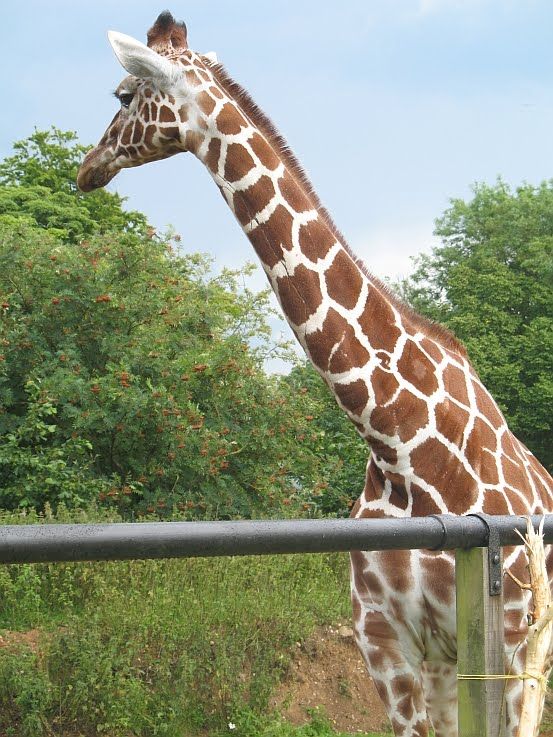 I don’t challenge their claims as a profession (1) to have helped improve material conditions for the human species (2) to have exposed many superstitions as baseless and baneful. But scientific method is a discipline which applies only to scientists in the performance of their professional duties. A judge at a dinner-party won’t object to gossip for its being hearsay: won’t arrive at the table in his wig and gown. Being a judge is merely his job. Scientists could have the same attitude.
I accept Darwin’s theory and subsequent elaborations, so far as they go, but when I wonder why the giraffe has a long neck, I have no hesitation in concluding that its ancestors wanted to browse the higher branches of trees. Wanting is not enough, of course. As an old English proverb says, “If wishes were horses, beggars would ride”—meaning everyone knows that wishing by itself is not enough. Nevertheless, as another proverb reassures us, “Where there’s a will, there’s a way.” Man yearns to fly? He invents the aircraft; by trial and error, as it happens, just as in Evolution.
But the moment you say “trial and error” you invoke teleology. Unless you have a purpose you cannot make an error. Any outcome will do. As another proverb says, “If you don’t care where you are, you ain’t lost”. Yet the article on trial and error linked above contains this:
Biological evolution is also a form of trial and error. Random mutations and sexual genetic variations can be viewed as trials and poor reproductive fitness, or lack of improved fitness, as the error. Thus after a long time ‘knowledge’ of well-adapted genomes accumulates simply by virtue of them being able to reproduce.
So this is what we have learned to expect: that evolution works by randomness, which incidentally and without any hint of purpose leads to the survival of the fittest, and by some magic mysterious mechanism produces distinct species.
Of one thing we can be quite certain: that the human animal is driven by specific purposes, which predominate over innate instinct. Every purpose, we may say, is shaped by desire, driven by a combination of emotion and imagination, with intellect serving both, and helping create coherent action out of the clash of impulses that we feel. This is true as I write this article, try to make it lucid, bring it to a desired and already-imagined conclusion.
I see no reason to deny this motive force, desire, to the giraffe; or for that matter, to the slug. In a Wikipedia article on “Four Causes”, we find this:
Final cause, or telos, is defined as the purpose, end, aim, or goal of something. Aristotle, who defined the term, explicitly argued that a telos can be present without any form of deliberation, consciousness or intelligence in general.
For example, the telos of a seed is to become an adult plant.
I’m not a philosopher any more than I’m a scientist. But I think that everything in Nature is motivated by desire. For I am a representative part of nature: I experience myself directly, from the inside. This is my scientific method. And when my body ceases to have any desire to perform actions in this life, then it disintegrates into its component materials, which are still not dead because the desire remains in each molecule and atom to re-form and combine; to contribute to new life. For life is desire. Everything is alive, everything desires.

Comments
Vincent
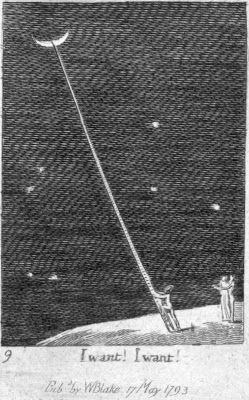
Illustrations: (1) I want! I want! From The Gates of Paradise, William Blake, reproduction borrowed and edited from Larry & Ellie’s blog on Blake(2) A snapshot I took last year at Whipsnade Zoo.(3) An illustration by William Blake for Dante’s Inferno: “Whirlwind of Lovers”.
Bryan M. White
Ah, but hearsay IS an important thing to consider when dealing with gossip – perhaps even THE thing to consider – even for us poor saps outside of the legal profession. The judge might not be as strict and vigilant about it as he would be in a courtroom because he’s relaxing with friends and not looking to take the matter all too seriously, but that doesn’t mean that it would be irrelevant to someone who was really intent on getting to the heart and truth of the matter. Likewise, a scientist would also probably let his hair down outside the lab. He wouldn’t go around whipping out the scientific method at the slightest provocation, but only because not everything in life requires such a strict standard of verification. But that doesn’t necessarily mean that the scientific method is invalidated outside the lab, or that he’s operating in a different domain under completely different, alien, rules. It just means that sometimes and you can get by with a quick measurement with your thumb without having to resort to the micrometer.
Bryan M. White
That last sentence should read:” It just means that sometimes you can get by with a quick measurement with your thumb without having to resort to the micrometer.”I don’t know how that “and” got in there, but I figured I should point out the mistake since it makes the sentence contradict everything I said before it. A lot of damage for one little word, eh?
Vincent
Thanks, Bryan. I never noticed that superfluous ‘and’ till you pointed it out.Yes, my metaphors don’t stand up to your analysis, that’s true. Analogies are clumsy instruments which shouldn’t be used to add weight to one’s case. I employ them because imagery is more vivid than abstraction—at the cost of being less precise.
darev2005
I gently disagree with your statement that you aren’t a philosopher, my friend. Everyone is a philosopher to some degree and you are better at it than most. An interesting diversion. First looking up “Teleology” before I noticed your definitions. Then reading about Darwin and the reception of his book with the church.I wonder, would he be amused or mortified to know that the debate still rages on just as hot today?
susan
I always enjoy reading your posts even though I don’t always feel able to contribute much to the background discussions. Your pointed insights about your own experiences are always a treasure because they are so honest and humane.I hesitate to mention something I read lately because it may be somewhat too pop for your taste, but since it was an alternate and well argued (only somewhat well researched) take on human evolution, I thought I’d tell you about it and let you make up your own mind. Some weeks ago I came across a reference to a book called ‘Left in the Dark’ by Tony Wright and Graham Gynn. The authors make a very rational argument that our inheritance isn’t so much DNA bound as it is dependent on transcription of the chemicals we ingest and that our diet has had a powerful affect on our physical and mental health. I particularly enjoyed reading about how our left brain dominance has caused so much trouble in the world these past few hundred years which is something I think you’ve been looking at too, albeit from a different perspective. If you’re at all interested the book is available in pdf format and at 220 pages doesn’t take long to read. btw: I appreciate your choice of this particular Blake image.
ghetufool
There is a saying here, “people with strong desires live long.” the moment you stop desiring, you are dead mentally (which is not a bad thing, i guess) and it’s not long that you stop breathing too. our world is a land of desires, every breath that we take is a desire. may you desire more … i loved this piece, Vincent!
Larry Clayton
Very Blakean, Vincent; you show an understanding of Blake far beyond my puny and facile one.”But I think that everything in Nature is motivated by desire” : if you envision Nature as materialistic in a material/spiritual dichotomy, you perceive that in due course it passes away. The Buddhists seem to mean to do away with it as well as desire.But “everything that lives is holy” (end of Marriage of Heaven and Hell).
Vincent
Rev, I have reasons for saying I’m not a philosopher. But I have to admit they are philosophical reasons. So you could be right after all. I’m glad you looked up teleology for yourself, because I’ve noticed that the Oxford Dictionary of English (supplied free on Kindle Reader) provides two distinct definitions: one labelled [PHILOSOPHY] and one labelled [THEOLOGY]. To me that seems like “weasel words” and somehow morally wrong; as if denying that philosophy and theology are creatures of the same species who can speak the same language and out of miscegenation produce beautiful pickneys called Theophilus and Philothea.I think if Darwin were alive today he would wince every time his name was mentioned.
Vincent
Susan, you were astute in surmising that Left in the Dark would be too pop for my taste. The thing is that not being a scientist I nevertheless respect science and am sceptical about alternative science, when it adopts the language of science without the rigorous methodology. Sceptical but by no means hostile. So I’m on my guard from the title onwards (not accepting the folk-myth attributes of left and right brain, though acknowledging the lateralization of brain function, as cautiously summarized in Wikipedia)—unless the jargon is used metaphorically. So long as theorists do that, fine. Let them talk about quantum physics without knowing what it is, and say “I was born to be an actor–it’s in my DNA!”; just as we don’t mind someone saying “–it’s in my blood!” Harrumph, end of rant! I did read up about the book, and like very much the wide-ranging analysis of symptoms: the existence of a general malaise in human culture reflecting the same kind of shortfall in individuals. I also like the principle of looking for new solutions rather than relying on the old ones, such as the various religions and sects.But not being a scientist, I usually don’t read books which depend on it. I prefer the Book of Nature, whose most available specimen for examination is the limitless depths of one’s own inner experience; and actual literature, which exposes the depths of someone else’s inner experience. I’m certainly not dismissing that book or its authors. May go there. Thanks for the tip.The top Blake image has been in my head for years. I first encountered it on the cover of a book by Jacob Bronowski: “The Origins of Knowledge and Imagination”.
Vincent
Ghetu. I had to rescue your comment from within the Spam filter. I wondered why. You had mentioned desire 5 times – perhaps the Anti-spam is rather strait-laced. Or perhaps it was because you said “I loved this piece”. Spammers say things like that, though they haven’t read it. But no. I tested your comment by submitting it to another blog and it was accepted. I think the Anti-spam may be suspicious about you. I agree that being dead mentally is not a bad thing; but only if you are dead physically at the same time. As for the Buddhists, I used to think that Buddhism must be an expression of eternal Truth (along with the Upanishads, Bhagavad Gita etc). Now I simply accept they were expressions of their time, efforts to express a way to correct human understanding & behaviour. Following their doctrines could be harmful today. (I don’t speak from ignorance here.)
Vincent
I meant to say, Ghetu, that on the rare occasions when you say, “I love this piece” I think it must really be good: otherwise, not. I trust your judgement that much.
Vincent
Larry, I understand little of Blake, and look to you and Ellie for enlightenment. But what I do understand corresponds to what I’ve learned from experience especially over the last seven years. Please see my penultimate comment for a paragraph (misplaced, sorry!) responding to your point on Buddhism. I regret spending thirty years placing credence in a meditation which put more value on “turning your senses inwards” – e.g. by focusing on the breath – than in rejoicing in Nature, and one’s own part at the very centre of a concave world. Which—that wonderful image, straight from Blake, but pointed out on your blog—is, I think, where we met!
Vincent
I mean the mental image of a concave world.
ghetufool
technology doesn’t approve of my love for you, looks like! glad, you do!
CIngram
Throughout the writings of Darwin you get the impression that he forgets about any religious belief he may have, most of the time, so caught up is he in the nature of his observations and where they have taken him. Only occasionally does he remember to nod in the direction of God, more for his expected wider audience than for himself and his colleagues. He was unaware of the biological mechanisms by which the process he was describing came about- they weren’t identified for another 60 odd years- and because of that he is unable to state with confidence that the Lamarckian idea of the heritability of acquired characteristics was false. There was much that he didn’t understand about the meaning of his own observations and experiments, but one thing is very clear: he wasn’t looking for God, and he didn’t expect to find him in his work. This makes sense for any scientist (I used to be one). You have to assume that results are replicable and that things only change as a result of the continued application of those laws, and the will of people, whose limits are known. If you allow the possibility that an omnipotent and omniscient being may act arbitrarily to change any aspect of the observable world, there can be no science, or even knowledge, in any meaningful sense. So science deliberately excludes such a possibility from the premises and logic by which it proceeds. Thus, there may be things that science cannot find, because it is specifically not looking for them. And we know that there actually are things that exist beyond the scope of science. Morality, for example, even if it is finally determined to be no more than a complex interaction between our consciousness and our social instinct, and even if it were further established that these things are purely biological, it would be hard to say that science has explained, or discovered, morality. It exists outside science.“ The moment you say ‘trial and error’ you invoke teleology. Unless you have a purpose you cannot make an error.” This is more or less true, but the use of the phrase when discussing evolution is another example of the way that even experts tend to use the language of teleology at times. An ‘error’ in the evolutionary sense is the failure of certain genes to be passed on, or even the extinction of an entire species by its unfitness. There is no guiding hand in this, and no purpose. It’s just what is.
CIngram
It’s very satisfying to think of Miocene giraffes stretching constantly upward to reach the highest branches, and passing on their necks to their offspring, but it probably isn’t what happened. Ancestral giraffes found themselves in an environment where the only stuff worth eating, or the only stuff that other animals would let them eat, was at the top of the trees. There was an advantage to being a bit taller, and height is encoded in the genes. Minor, random variations were passed on more by the taller animals, who ate better, lived longer, and so had more females, and slowly the taller genes predominated and the species as a whole grew taller. You might say that the giraffe was constantly branching into subspecies, and the shorter they were the more quickly they died out. Only the tall survived. There were other species which didn’t experience enough variation for that to happen, and they died out completely. Neither they nor the giraffes had a telos. Adapt or die is not an instruction, it’s just an observation.When the Wright brothers invented a working plane they could identify error easily because it didn’t leave the ground, or it crashed on take-off. They had a telos to which to refer their progress. But when Marie Curie invented photography it was as a chance result of variations in the way in which she did something else. The ‘trials’ were irrelevant to the subject of photography, but the combination and interaction of them led to something robust enough to form an important part of the modern world, and so he memory survives. It might easily not have done. We can say (with Aristotle) that the telos was present in the process, but it wasn’t present in the mind of Madame Curie.
Sorry for the long ramble, but I felt I had to say something and it seemed to want to get longer and longer 😉
Thanks for the link, by the way.
Ellie Clayton
I think we suck the truth out of whatever approach we follow until we find it empty. Science, Buddhism or poetry may become an empty rind when we have assimilated the truth they contain. But we accept their nourishment as we pursue the journey. (And may well return to feast at their tables.)
Charles Bergeman
In addition to desire, I would add survival. A strong desire to survive could be stronger than any other desire in the conventional sense of the word. Survival instinct could be extended to include protection of the ego. That said, I believe it would be near impossible to apply scientific method routinely in your life. To be consciously aware of every step you take, every decision, every calculation. Intuition, based on knowledge of your surroundings, past experience, personal bias, are more likely to rule the day in anyone’s life. Even a scientist. This is the real world we live in. Scientific examination of our everyday lives may reveal surprises for those that live it. However, it won’t prepare them to confront life’s trials and tribulations using the scientific method. I also appreciate your observations regarding Buddhism. I have had a similar, although significantly abbreviated, encounter with meditation. However, I still find it useful in getting rid of the hiccups
Vincent
I think you are right, Charles, that survival is the strongest impulse and of course it is actual survival, rather than the desire for it, which in evolutionary theory explains the world we have.And as you say, in everyday life we are not constantly looking for explanations, but support for our own living–in which, for most humans, it is not survival which is threatened but other dreams and desires.
Vincent
Ellie, I had never thought of it like that. Now the image of sucking the juice from an orange will forever be associated for me with discarded beliefs.This idea of “returning to feast at their tables” is a most suggestive one. I find that the ones which I return to are those which I spurned or misjudged in the first place. And I might return not for my own nourishment, but to understand others better, who find that nourishment in those things which I spurned.
Vincent
CIngram, I appreciate the ramble & so will other readers. I agree with you that a Lamarckian theory about the giraffe’s neck would be unsatisfactory. Still it seems to me that by mechanisms yet unknown, nature has enough intelligence to know what direction it would like to go, and take steps accordingly. Not God playing with his toys, but something inbuilt. I was intrigued as to what editing lapse left your text conveying the the notion that Marie Curie accidentally invented photography.
Vincent
Ghetu, I have not approved of all your loves, but technology has not stood in our way on this one.
Bryan M. White
This all reminds me of that old thing about the mousetrap. You know, how a mousetrap has a handful of working parts, but you need all of them for the trap to work? Take one away and you don’t have mousetrap, just a useless piece of junk. Likewise, the eye and the ear are complex mechanisms. So if you suppose that different parts of the eye evolved gradually over time, then it’s hard to explain how they exerted selection pressure. They couldn’t bank on their future investment as parts of a working eye down the road. It’s not suppose to work like that. Of course, The Dawk* would say that the eye just evolved from simpler forms like photo-sensitive cells or that the parts piggybacked on other useful functions until they were part of the eye. That all sounds a little pat, but I guess I defer to his expertise in the field. Still, I can see how it feels like something more was driving the eye into existence, some principle, some “desire” as you say. It is hard to believe that we’re just the beneficiaries of such an credible string g of fortuitous accidents.
* Richard Dawkins
 a wayfarer’s notes