
I was inspired by a recent essay on Rebbecca Hill’s blog, entitled “Here is where I am”. I’ll give you the link later. What struck me specially was her saying so many personal things that applied to my own case—the situation she describes, the questions she asks. I recently asked myself those questions too, and found answers to them, enough to look at Rebb’s words and say “Here is where I was”. She’s given me permission to refer to her post, so I’ll start by quoting those parts which reflect my own case.
. . . as a writer, I am in a sort of limbo as to how exactly to label what I write. . . .
What do I write? I am a journal writer, but I realize that in addition to being a journal writer, because I like to process my surroundings and interactions with people, places, and things—I tend to write reflective pieces. I like the freedom of free writing, and when I allow myself, I like the stream of consciousness aspects that sneak into my writing. I write a lot about my . . . own life and observations, so in that regard I write memoir. I also enjoy writing personal essays, but I don’t know how many of my blogs can be called essays. . . .
I’ve written vignettes, but what do I do with them if I envision including them as part of a collection? What if I want to create a book that is part memoir, part reflection, part essay . . .
How do I include all of these pieces of me into one whole?
I do best when I write about the truth—about what I see and maybe sometimes I can tell it slant—I’m not sure yet. . . . What I gravitate towards is holding life up with the tips of my fingers and examining it—life’s beauties and the nooks and crannies in between—and also how I process life. Is this enough? If any of it touches just one person in some way, that’s enough.
I don’t think I could imagine myself not blogging. I’d like to imagine myself blogging into eternity.
Her thoughts were triggered by joining a writers’ group. That’s where we differ, I thought. A few weeks ago I went round to our new Arts Centre and chatted with its chief. He asked me if I’d like to start a writers’ group. How little he knows me, I thought. Lone wolves don’t even join groups, let alone run them. And as for starting one. . . ! But still I thought about it afterwards, played with the idea of being part of a local community of creative minds. How would I present myself, and what I’ve done to date? I toyed with starting a new blog, and actually launched it, but I could only fill it with extracts from this blog over the last six years relating to the neighbourhood; trying to show how it looks through my eyes, trying to attract artists and writers to this place I called “Somewhere near Green Street”. It felt a little like van Gogh inviting Gauguin and other artists to join him at the Yellow House in Arles. I realized soon enough that I cannot be part of a “scene”, cannot have alliances and loyalties. They make me false to myself. As Rebb says, “I like the freedom of free writing!”
And then today I saw a sign in the local library that someone is starting a Writers’ Group there. So I sent in my name, and received an emailed response: The first meeting will largely be getting to know each other, and seeing what everyone wants out of the group. Although, if you have any work you want to bring for people to get a sense of your style, you’re more than welcome to. What would I bring? Not this post! Since we are meeting in a library, how about Gilgamesh: book for our time? No. Perhaps Reading, and other extreme sports?
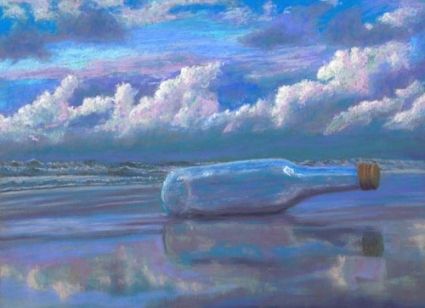
This, though, would not answer the question which Rebb asked herself: “how exactly to label what I write?” So here’s my own answer: “letters to the Universe”. It’s no good saying I am a blogger. That’s as uninformative as saying “What do I write? Paperbacks.” A letter to the Universe is a kind of message in a bottle, entrusted to the oceans of space and time. It’s the very symbol of literature. But what Rebb and I mean is something more intimate and personal. For the personal is the universal. We are all pieces of the same rock, and language helps join the pieces back again into a whole, but only if I am me and you are you. We must preserve our individual shapes, and speak only of what we know, each our own truth, with the inner eye’s aid.
“Very well,” says someone in the writer’s group, as I inwardly rehearse that first meeting. “I hear what you’re saying—I think—but I still don’t understand. Is this some new genre? If you could point to a role model, that would help.”
All right, here we go:
1. Michel de Montaigne (1533-1592). He wrote not for fame or fortune but to please himself, and in so doing invented the essay form in literature.
2. Fernando Pessoa (1888-1935). “Nothing had ever obliged him to do anything. He had spent his childhood alone. He never joined any group. He never pursued a course of study. He never belonged to a crowd. The circumstances of his life were marked by that strange but rather common phenomenon – perhaps, in fact, it’s true for all lives – of being tailored to the image and likeness of his instincts, which tended towards inertia and withdrawal.” (Richard Zenith, his translator). Manuscripts for his projected Book of Disquiet were found in a wooden chest in his Lisbon apartment after his death.
3. Anne Frank (1929-1945). After her death in a Nazi concentration camp her Diary was found in the apartment where she had hidden with her family in Amsterdam during the wartime occupation of Holland.
I wouldn’t have thought of her, but her cousin Buddy Elias gave an interview on the radio last Monday. He had known her when they were both children. When the diaries were discovered and published he never thought they would sell out the 1500 copies in the first edition.
He continues: Otto [Anne’s father, who survived the war] always said ‘I didn’t know my daughter till I read her diary.’ And it was the same with me . . . the deep thoughts, the humanistic thinking. For me she was a playful, lovely young girl. But these wonderful thoughts—absolutely new. I still get letters from people who tell me ‘Anne Frank’s diary has changed my life.’
So much for role models—they are purely aspirational. But they emphasise my point, that only without compromise and self-censorship, unfettered by allegiances—owing nothing to publishers, agents or even writing groups—can I (borrowing Rebb’s words again) write about the truth—about what I see and maybe sometimes I can tell it slant—I’m not sure yet. . . . What I gravitate towards is holding life up with the tips of my fingers and examining it—life’s beauties and the nooks and crannies in between.
Or in my own words, pondering the question “What is this enigma called life?”
 a wayfarer’s notes