
It’s increasingly difficult to write anything, I mean write coherently. It’s probably not the first sign of dementia, more likely that “When we try to pick out anything by itself, we find it hitched to everything else in the Universe.” (John Muir) That’s my new excuse for rambling hither and thither.
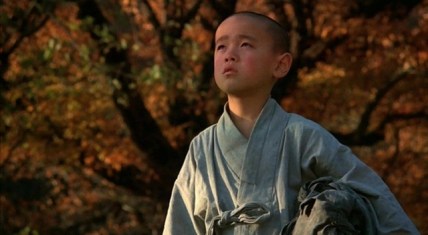
I wanted to write first about Why has Bodhi-dharma left for the East?, a Korean film illustrating—and profoundly embodying—Zen Buddhism. The question, for which it does not provide a direct answer, is posed as a koan: a problem to meditate upon, until the moment of enlightenment hits you like a bolt of lightning. if Zen is something you couldn’t care less about, I don’t know what you’ll think of the film. To me, Zen goes way back, almost imprinted in my soul. So like any other film, it’s one to be evaluated on its cinematographic merits; but mostly by whether it grabs you or not. Copies are rather rare. You may not find it possible to rent the DVD. I recommend ownership or nothing, for it’s not just another movie to tick off your list. It’s a place to visit and revisit. I’ve only watched it one and a half times, so far, which makes it too early to say whether it’s my favourite film of all time. Nevertheless, I would like to nominate it as one of the most successful films in the history of cinema. Let us remind ourselves what “success” means. It is to achieve your objective. It’s sloppy to use success as a synonym of popularity, or—much worse—a quality to be measured in terms of income or revenue. Sloppy is something that Bodhi-dharma never is. Its creator Bae Yong-kyun spent years making it, getting it perfect, and it shows.
Zen has been in my life as an undercurrent for more than fifty years. At 22 I was nearly ready to apply to a Zen monastery in Japan, but then … never mind! Everything may be hitched to everything else in the Universe, but that’s where judicious editing can take out the pruning-shears, leave vast tracts on the cutting-room floor, including the story of my life. I disqualify myself from predicting whether you will like the film or not. For me, it’s a counterfactual adventure: what could have happened to me if my life had taken a different turn. You may judge for yourself, from this 9-minute trailer.
You might say that the highest art (judged subjectively) is that which goes on conveying its intention—succeeding—extra-temporally. It does what it does by taking residence within us, beyond the reach of time; which sounds highfalutin, but I bet you know what I mean. Perhaps this is the very definition of the highest art: that which dwells constantly within us. I can see Bodhi-dharma achieving this status within me, through its very simplicity and purity; but mostly, as you can see from the trailer, its cinematic sensuousness that with no visible artifice places you within the scene, so that you may live it. And if you doubt the concept of Enlightenment, or believe in it fervently, you may find the film as gripping as a whodunnit, right up to the final credits.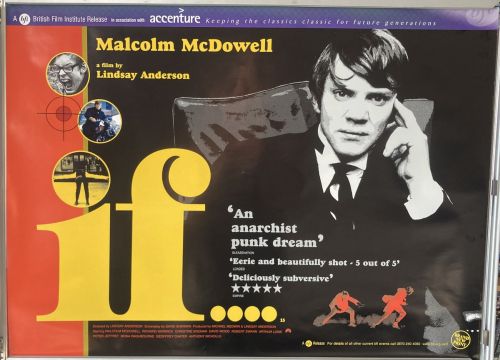
And there this piece might have ended, had I not asked myself the question “is it my favourite film of all time?” For in asking that question I challenge the status of the film I’ve previously given that honour: If…..
At this point, in order to fulfil the promise of my title “Art and Life”, I was about to expand on the merits of If…. and perhaps even contrast it with Bodhidharma, or perhaps (forgive me, dear reader) hitch my theme to anything or everything in the Universe. Perhaps fortunately at this point, the postman rang the doorbell, and delivered a book, a second-hand copy of Going Mad in Hollywood: and Life with Lindsay Anderson, a memoir in the form of a diary by David Sherwin, scriptwriter of If….. Lindsay Anderson was the film’s director.
So there will be an intermission, till my next.

PS: After drafting the above, I took a stroll in the sunshine—to the supermarket as it happens—and dictated further thoughts on Bodhi-Dharma, on If….—or any work of art, as appended below.
“I enter the film, and am totally embraced by it. Or the film enters me, diffusing into my bloodstream, as you might say. This is nothing like idolatry. For when the absorption has taken place, the essence and the sponge act on equal terms. There is Self, and there is Other, an infatuation which goes on forever. It’s devoid of idolatry: merely teamwork, symbiosis, synergy.
“Even when you pass somebody on the street, there’s a mysterious exchange of essence, an acknowledgement of two souls, even if the eyes don’t meet. It’s the same with all of Nature, all of life. Everything bleeds and touches everything else.
“John Muir spoke as a naturalist. Everything bleeds into everything else, like watercolour, when you apply it to wet paper.”
There were 40 comments :
 a wayfarer’s notes
Bryan White said…
As for the movie, I’m still trying to get my hands on the Tree of Life. I’ll have to check out that 9 minute trailer, when I have a few more minutes to spare.
John Myste said…
Your definition of success is that it does what the creator intended.
Another definition of artistic success would be that the work resonates far beyond what the creator ever imagined. As art, and not purely a communication science, its success would not be bound by the creator’s vision.
Just another perspective.
Vincent said…
Actually I was not intending to define artistic success. I was complaining about sloppy usage of the word “success” in any context, not merely artistic.
I’ve now looked up the OED and see that I was wrong in trying to force this word to go in the direction I desired. The dictionary reminds me that the original meaning of the word is close to “what follows), or “outcome” as in the line of succession in a monarchy. All modern meanings of success derive from what used to be called “good success” (as opposed to “bad success” or “ill success”).
So taking your instance of the work’s ultimate resonance being out of control of the artist, which is, I should imagine, universally true, someone (a critic, I suppose) might judge what kind of success it is: a good, ill or indifferent one.
Vincent said…
I hope you will speak of the success of The Tree of Life and say whether it be good or ill.
Vincent said…
DaRev said…
The back of my mind, you see, is a real jerk.
Charles Bergeman said…
Alan Watts
ZACL said…
Unknown said…
I like what you say about popularity not being synonymous with success. And the John Muir quote is startling.
John Myste said…
Everyone should read Essay on Criticism because it is short enough to be easily digestible even if you don’t like it.
I don’t know if it would resonate with you, but it certainly does with me: not the whole thing, but one thing specifically, actually two.
One:
To paraphrase Pope liberally: the main thing is a point one could merely state, without all the pomp. All works of art, though technically flawed, are not necessarily artistically imperfect. No brush stroke is exact; no phrase is perfectly turned. Critics who seek out and not the flaws seem to fail to realize that all works of art are greater than the sums of their parts, else they are not art. Therefore, it is illogical to seek out or point out specific technical flaws, as if they were relevant at all. The whole thing, taken as an artistic entity, should be the point of the artist and must be the point of art, as art is defined as a whole thing, not a collection of pieces.
The artist may or may not take special care with a specific brush stroke, a specific word or a specific crevice in a graven image, depending on his medium, but those kinds of details should remain in the domain of the artist, to be planned or to be incidental, and the critic need not know the internal method the artist used. Look at the art only in context of the whole work, not its flaws or its supposed intentions, and you will see the art for what is really is, which is wholly subjective to the viewer, and completely hidden from the critic.
Again, this is a liberal paraphrasing. It is the way in which the essay speaks to me.
Two:
The very famous passage, which speaks to more than just literary criticism:
A little learning is a dangerous thing
Drink deep, or taste not the Pierian spring
There shallow draughts intoxicate the brain,
And drinking largely sobers us again.
Fired at first sight with what the muse imparts,
In fearless youth we tempt the heights of arts
While from the bounded level of our mind
Short views we take nor see the lengths behind
But more advanced behold with strange surprise,
New distant scenes of endless science rise!
So pleased at first the towering Alps we try,
Mount o’er the vales and seem to tread the sky,
The eternal snows appear already passed
And the first clouds and mountains seem the last.
But those attained we tremble to survey
The growing labors of the lengthened way
The increasing prospect tires our wandering eyes,
Hills peep o’er hills and Alps on Alps arise!
John Myste said…
You are probably familiar with it already, but it spoke of the arrogance of humans to claim that they are the creators of this wonder or that one and that they are victims of an unjust deity when things go wrong. A cancer patient suddenly turns his back on God because a just God would not have allowed him to get cancer. Again, I am paraphrasing and relating what I took from it.
If a human does not understand God, then he cannot judge Him. The idea is ludicrous. Yet, humans claim not to understand Him and yet they do judge Him. They make assertions about what is right and wrong and how things should be based on their personal opinions, reasoning, and assumptions, while at once claiming allegiance to the moral will of Another, even while they freely admit a total lack of comprehension about how God works. Pope considered the “problem of evil,” not to be a problem, but to be a puzzle easily solved: “human arrogance.”
I read this essay as a child, and a translation of Voltaire’s rebuttal (I think it was a translation), “The Lisbon Diaster”, or something like that; my memory fails me. I have not read Voltaire in over 20 years, but I have reread Pope. Anyway, if one were to read Essay on Man for the first time, then he may also want to read Voltaire.
A few passage from Essay on man that stayed with me from my childhood. The first, I am able to recite from memory, even today. It is in my philosophical toolbox, as Pope presented it. The second one, I remember, but must look up. It is also in my toolbox, but it sometimes gets covered with wrenches and levels and awls.
Heav’n from all creatures hides the book of Fate,
All but the page prescrib’d, their present state;
From brutes what men, from men what spirits know:
Or who could suffer Being here below?
The lamb thy riot dooms to bleed to-day,
Had he thy Reason, would he skip and play?
Pleas’d to the last, he crops the flow’ry food,
And licks the hand just rais’d to shed his blood.
Oh blindness to the future! kindly giv’n,
That each may fill the circle mark’d by Heav’n;
Who sees with equal eye, as God of all,
A hero perish, or a sparrow fall,
Atoms or systems into ruin hurl’d,
And now a bubble burst, and now a world.
And This:
Ask for what end the heav’nly bodies shine,
Earth for whose use? Pride answers, “Tis for mine:
For me kind Nature wakes her genial pow’r,
Suckles each herb, and spreads out ev’ry flow’r;
Annual for me, the grape, the rose renew
The juice nectareous, and the balmy dew;
For me, the mine a thousand treasures brings;
For me, health gushes from a thousand springs;
Seas roll to waft me, suns to light me rise;
My foot-stool earth, my canopy the skies.”
susan said…
I remember seeing this film for sale at a time when I was being especially averse to spending money (it wasn’t cheap). Now that I’ve read your recommendation I plan to see if I can find a copy at the somewhat eclectic video rental place we visit regularly. I’m reluctant to describe myself as a Buddhist but I have been practicing for a number of years using for instruction a number of books collected over a long period. Without a real teacher it’s difficult to plumb the depths or scale the heights.
I do own a documentary film called ‘Unmistaken Child’ that I’d suggest you might also like.
Vincent said…
Vincent said…
Vincent said…
Vincent said…
“You too can have weather – here’s how, in three easy steps!”
Vincent said…
Vincent said…
Is not this a function of art – to expose the otherwise unacknowledged “back of my mind”, and make something of it? You are almost tempting me into doing a blog-post treatment of If….
Vincent said…
Your Point One: it seems to me that Pope was inspired by some contemporaneous criticism fashionable in his time. Taken out of context and as summarised by you they could lead towards a form of idolatry, as in your earlier remark about a resonance beyond what the creator ever imagined. I don’t know that an artistic creator has to imagine any resonance. I think the artist simply does his or her best. As for criticism, I see no relevance today in criticising criticism; or rather it has no resonance for me. I may say something about a film, perhaps pointing to what I don’t like about The Tree of Life, or what I do like about Bodhidharma; but it won’t be “criticism” in the literary-academic sense: merely the notes of a wayfarer sharing thoughts which strike him vividly. Those who earn a living from criticism, whether academics, hack reviewers or some bastardised hybrid, must of course take their trade a good deal more seriously.
Your Point Two: yes, I could imagine getting excited about this passage, for example if I were at school aged 16 and asked to write an essay on the poem. It would be a wonderful discovery. But at that age, I was discovering something in Wordsworth, and writing several pages in my exercise book on lines such as:
A violet by a mossy stone,
Half hidden from the eye
Fair as a star, when only one
Is shining in the sky.
We glanced at Pope & Dryden, and saw how drily they glittered. I couldn’t help it. I found myself pre-tuned to the Romantics, and never bothered to challenge myself on that; except that in French poetry I learned to admire the Parnassian school as led and typified by Théophile Gautier. And now I find it too much effort to admire Pope personally. All the same, when you point him out, I do see what you are talking about, & admire him in passing.
Vincent said…
John Myste said…
I don’t think Pope was against criticism. I think he was against nitpicking criticism, as supported by his A Little Learning is a Dangerous Thing commentary, which has been adapted for other philosophical arguments after the fact. When it stands alone, outside its context, it makes a slightly different, but more meaningful statement
As for saying what you like about a film, I don’t think that is the form of criticism in question. The difference would be if you said what you don’t like about a great work of literary fiction is that one of the constumes seemed anachronistic. I am not aware of Pope being anti-criticism in the form of anti-art appreciation. In fact, I think the opposite was true. I think he was anti nitpicking.
Now that you speak of it, I can see how Pope would not appeal to you, though. His most famous works were mostly argumentative and somewhat in rebuttal to the works of other philosophies, as opposed to venturing into less charted territory, or saying much without taking a firm stance.
John Myste said…
Vincent said…
Vincent said…
Vincent said…
John Myste said…
Bryan White said…
I’ve written my own recent movie review on my new blogging effort (Yes, I’ve started a new blog, as the old ones seemed to have reached a kind of dead end.) Check it out if you like:
http://sunnystrangers.blogspot.com/2012/03/woman-in-black-popcorn-review.html
Charles Bergeman said…
Charles Bergeman said…
JustRex said…
DaRev said…
Davoh said…
Bryan White said…
John Myste said…
Vincent said…
Vincent said…
For reference, the tweak to achieve this fix was found here: http://www.mybloggertricks.com/2012/01/how-to-remove-blogger-threaded-comments.html”
Bryan White said…
John Myste said…
I would love to reply to this myself, but the reply link appears to be missing.
DaRev said…
Vincent said…
On an unrelated topic which somehow popped into my head, I’ve been trying to block the entrance to a rat’s nest in the backyard. I put down some wire netting covered with a heavy upturned plant pot. Came to check. A huge tail was visible, quivering, apparently belonging to a stuck rat. I lifted the plant pot and the tail’s owner fled. As a brother or at least a cousin to all living things, I’m trying to encourage this family to seek pastures new, without inflicting any cruel or unusual punishments upon them.
No resemblance to living commenters on this blog is implied by my tail I mean tale.