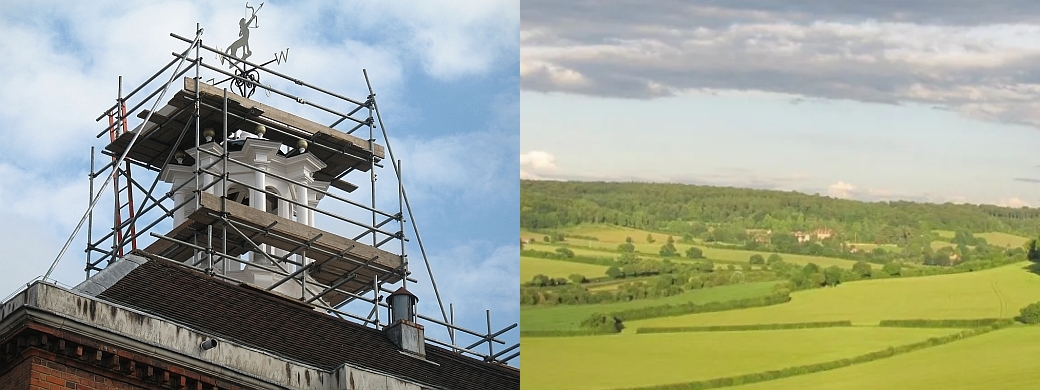


Things are happening in hedgerow and pasture; a spate of fresh worm-casts; larks twittering; occasional sardonic comments by crows. A suddenly-surprised cock pheasant flaps away from me, going airborne in its panic, plumage bejewelled and voice like a rusty klaxon. Last year’s sunflower-heads, haggard and desiccated, stand witness to the kindness of supplying winter provender for hungry young pheasants, so they can be shot by businessmen in September. That’s farming, part of the harmony in all that grows.
If I were a farmer I’d be wandering these meadows and arable fields, taking a keen interest in the renaissance of everything at this end-of-winter moment. But I’m merely an observer, with no vested interest, no trained eye, ear or nose. I see how the birds, thorn bushes, young nettles & all wildflowers in their turn awaken, look to expand their territory; sniffing the wind, temperature and humidity; noting the lengthening days & the brighter sky. Intelligence, in the whole being, not just the brain, determines when to continue in hibernal mode, when to let the sap or blood quicken for growth or mating. Tramping by, in mud-caked boots, I sense all this; using reason merely to unravel what I have sensed, and put it into coherent prose.
People think of “dumb animals”, but the perception is false. In the universe of all living things there is knowledge and wisdom, equally wondrous in every creature. It is contained in i) instinct, ii) acquired skill and iii) reason. There is good reason for extolling reason: it’s one of the defining attributes of the human ape, a gift which matures in each of us with a healthy brain. But it’s no more wondrous than the other two.
Instinct is knowledge and wisdom in its stored form, already present in the seed or ovum. No scientific insight can dim its glory. In us, instinctual nature has not been superseded. What the autonomous systems do in our bodies cannot be replicated by reason. These systems keep us alive in almost every varied circumstance, till things become too hostile for our continued singular existence; then we unravel and merge back to the All. Intellect is not the master of all it surveys. We (our conscious intellectual selves) are wholly dependent on hidden bodily mechanisms. We can’t control them and we cannot replace them with thought.
We acquire many skills in life. The baby takes its first steps, speaks its first words. These are observable milestones, but the skills go on becoming more complex. The underlying mechanisms might be understood and documented in books; but they cannot be learned from books, for their execution is beyond analysis, as in the “Centipede’s Dilemma”:
A centipede was happy—quite!
Until a toad in fun
Said, “Pray, which leg moves after which?”
This raised her doubts to such a pitch,
She fell exhausted in the ditch
Not knowing how to run.
As for reason, we’re fully aware of it, “we” meaning I writing and you reading. We won’t get far without it. I shall merely say that it differs from the other forms of intelligence (instinct and learned skills) in one characteristic only: its spontaneous inventiveness. For example in language communication, without the faculty of reason we could not make up new sentences to suit the occasion; or understand them. We’d be reduced to the formulaic, and learn a phrase-book. At any rate, reason is too big a topic for me to think of at this irreplaceable moment. I’ll just focus on our capacity for improvisation, whether in jazz, speech or dance; a kind of reasoning whose steps we cannot see, possibly the best kind; the mathematics of the ear that flowed from the pens of Bach and Mozart like a constant spring.
Some of the signs of human industry are a mystery in these rolling meadows; archaeological remains of the very recent past. I saw at the edge of a field, in the shade of an ancient hedgerow, some huge paving stones which seemed to hide something beneath, like the entrance to a cave or sewer, with a neat pile of about 50 bricks on one corner, as if to prevent the stone being lifted. I could not make sense of it.
There was a time when most phenomena could be ascribed to God because no other explanation was available, and this ascription had the advantage of uniting everything known or unknown. You could talk of Divine Providence, as I still do, without any prescribed worship. It’s true that today, there are more explanations, but they don’t diminish Providence: they fill out the rough outlines with more detail, a kind of fractal recursiveness. I’m confident that mysteries will always outrun explanations.
What I see in these fields, cultivated for two thousand years at least, is effort, by man and his near and distant relations. Impulse precedes effort. For the miracle of life there has to be potential energy. Most of it comes from the sun. Then there has to be purpose, at any rate, that’s what I lightly believe. If you say it was randomness I will not burn your books. Potential energy is there but purpose-driven impulse, I think, is what lets off the brakes so that potential energy turns into kinetic. Or to put it another way, Nature doesn’t fool around in mindless interaction for its own sake. Ask James Lovelock*; he’s spent his life gathering evidence. Not that nature is perfect. It makes mistakes. We have only to look at ourselves, or (to see them more obviously), at one another.
I seem to gain a kind of direct knowledge, tramping these fields: a peripatetic† philosophy open even to the illiterate, like a ploughman who walked these fields a few centuries ago, whose entire spoken eloquence derived from the Bible cadences he had heard.
I see that human separateness—from one another and from the rest of Nature—is an illusion; a necessary one, whose potential is built-in and whose actuality is gradually learned in early childhood. I call it the primary illusion, from which others derive along with philosophies and religions. I have no authority to say it’s an illusion, other than personal certainty derived from intuition whilst passing through landscapes, and confirmation from others§ who have travelled the same paths, viewed the same reality.
————————–
* For example by reading any of his Gaia books.
† Peripatetic: from classical Latin peripatēticus of or belonging to the peripatetic (Aristotelian) school of philosophy, philosopher of this school; from Hellenistic Greek περιπατητικός given to walking about, especially while teaching or disputing, especially with reference to Aristotle and his followers; from ancient Greek περιπατεῖν to walk about, to walk up and down while teaching … (Oxford English Dictionary)
————————–
Addendum November 2013 In the comments below I mentioned that the human genome could fit on a CD. I don’t know where I got that from. Two minutes of research produced informed estimates that it’s of a size to fit on a DVD—something like 3 gigabytes. Somewhere else I’ve written that the genome of an amoeba, one of the simplest organisms, I believe, is 100 times larger. Make of it what you like.
 a wayfarer’s notes
If there's a bustle in your hedgerow,
don't be alarmed now.
It's just a spring clean for the May Queen…
Instinct is a fascinating thing to me. It's seems like something almost supernatural, but I'm sure that's largely because I'm not initiated into the biological mysteries of how it works. Still, the idea that a bird is pre-installed with instructions to build a nest, or a beaver to build a damn, or even a dog to eat it's own feces so it doesn't leave its scent lingering for predators, is just mind-boggling.
E.B. White made an observation about instinct that really seems to sum up the essence of it. He observed a lamb being born. As soon as the lamb was dropped, the mother responding to her natural instincts, immediately turned and began licking the after-birth off the lamb's face, clearing it's nasal passages so that it could breathe. White said that mother of course didn't realize that she was doing this so that the lamb could breathe. She just had a sudden, inexplicable craving and urge to lick the after-birth off of it's face.
Also, I like what you've said about reason here; some common ground for once. And, of course, it goes without saying that you're right that our bodies run as machines are set to run in an automated factory and not at the discretion of our reason. This much is obvious. The interesting question that arises then is where the line is drawn between the mind and the body, the question that Freud and contemporaries struggled with (and people are struggling with today.) Still, regardless of where the line is drawn, I definitely agree that our reason operates on top of a foundation of physical impulses and drives, and it's hard to imagine where we would be left if those impulses and drives were removed, if say, the human race were superseded by sentient androids that never got tired, never got hungry or aroused. What would they do with their time?
LikeLike
I just checked and discovered that the human genome, or instructions to make a human being, can be stored in 750 megabytes. It would fit on a CD-ROM. The website I got it from helpfully pointed out that Windows XP is twice as big. The genome is a specification for making a human being, you might say. A specification so relatively simple must require a builder who works from the specification, you might say. The 750 megabyte music CD requires the human ear to make sense of it. Windows XP requires a computer to make sense of it.
I can't see how 'something' can make a human from such a spec. (And I don't know who that 'something' could possibly be. A kind of science-fiction idea presented itself to me. Suppose the 750mb is merely the unique key or password? Or, to use a different simile, suppose that what you get in a sequenced DNA is a radio set pre-tuned to a certain station? The content is then beamed in from some source.
Or perhaps the genome is like a smartphone that fits easily in your pocket. With that, you can receive a measureless amount of content.
I just think that the mysteries must surely go beyond biology; just as the content of the internet goes beyond how to solder transistors together, or how to etch circuit diagrams on a silicon chip.
The standard explanation of evolution as randomness plus survival of the fittest is a big conjuring trick, as in that video you linked to in a comment the other day. It doesn't begin to explain anything much. All it explains is step-by-step evolution. I don't mean to belittle that huge discovery, that thesis which has stood the test of time since Darwin.
It just doesn't tell us very much, same as genome theory doesn't.
LikeLike
PS it makes me rejoice when we agree on some of the matters we've disputed about for so long, so implacably. And in this rejoicing I acknowledge the importance of your fierce disagreements in the past, which fuel a process of rethinking, finding a new way to express intuitions which erupt unruly like molten lava.
LikeLike
“Or, to use a different simile, suppose that what you get in a sequenced DNA is a radio set pre-tuned to a certain station? The content is then beamed in from some source.”
Yes, this is interesting notion, especially when you consider, as I imply above, that instinct is in the body, rather than the mind, and therefore obviously encoded in the DNA. 750MB does seem like an awfully small amount on information to create something as complex as a human being.
This reminds me of a similar conundrum that has puzzled me. If the universe is nothing but inert matter and blind physical forces, and it arose on its own from that matter and those forces, then how has it given rise to consciousness? For instance, if we were to succeed in creating an artificial intelligence that was truly conscious, we would only be able to do so because we are conscious beings ourselves. We would be modeling it after ourselves. The AI would not exceed us on a metaphysical level. The precedent for consciousness is already set and the AI would be outgrowth of that, consciousness born from consciousness. So wouldn't the same be said for us? Wouldn't we also have to be an outgrowth of a preexisting consciousness?
There may be some flaws in my logic here, I admit. But I do think that the fact that you can put a bunch of matter and chemicals and code together and make a living aware entity called a human being is a mystery that no one has adequately explained.
LikeLike
I think I know what you mean about evolution too. There is always this nagging sense that there's a sort of…leap of faith required behind it all. Not faith in HOW it works, which is really so simple and elegant that a child could understand it once people get past their basic prejudices and fears about it. No, the faith seems to come in the very notion of the elegance itself. It all works so neatly, that one almost can't help but sense some spirit of benevolence and order behind it all. Perhaps this is only another layer of prejudice, a yearning that there's something looking out for us and that even a process that seems ingeniously self-regulating is still being guided by a steady hand. Or perhaps….
LikeLike
For instance, you mentioned giraffes a few posts back, I believe. Now, we can all pretty easily wrap our minds around the idea of wild horses living in an area with high growing vegetation, and the horses with the longer necks having an advantage over those with shorter one. In the cruel world of nature where they don't have programs like “No Child Left Behind” we can see how the shorter horses would die off in a few generations, leaving only the ones with longer necks.
But then, when we expand this idea, generation upon generation, where this competitive process eventually leads to grotesque horses with necks longer than their entire bodies, we have this sense that we're being rushed headlong into something that we haven't adequately had the chance to think through, as though we're signing a legal document that we haven't had time to read. Again, this could just be our human prejudices, the fact that we're not really equipped by the limits of our own experience to think in terms of the millions upon millions of years required for these things to work.
LikeLike
By the way, I really owe you an apology about the other day. We've had our differences before, but I don't know what the hell I was going on about this time. I was just shook up about those kids dying – everyone has been really shook up about it around here – and it was going round and round in my head all week and I think I just needed to take it out on someone. But of course, I was being ridiculous, and clearly the whole thing has nothing to do with you, and it was unfair to take it out on you, and I really am very sorry.
LikeLike
Bryan, I felt that it had nothing to do with me and told you so at the time! One only feels pain when the arrow strikes home.
But I can feel a little of what you must have been going through. Even a street accident involving strangers, viewed from a distance, haunts me for days, though that's obviously something entirely different.
LikeLike
I'm glad somebody brought up Led Zepplin. Otherwise I was going to have to.
750 megs doesn't seem like alot until you realize that that is… what? 750 million bits of information? More? And all of those 750 million pieces have to be in the exact right order (or a slight variation here and there in only select places) for the thing to work at all. One wrong bit in the improper place and it's all gone wrong. That's where the mysterious magic that we call “nature” steps in and puts things in order. If we can figure out how that happens, we'll be a step ahead.
LikeLike
It's difficult to say whether a string of 750 million 1s and 0s is a lot of information or not, really.
What i don't understand is this: information for the benefit of whom or what?
The information on a CD is for the benefit of a CD player, which understands that information enough to play music pleasing to your ear, perhaps Led Zeppelin.
Or perhaps it is for the benefit of your computer, because it won't work unless it has Windows XP or some other version.
So what is DNA for the benefit of? Apparently it is for the benefit of whatever organic chemicals that the fertilised ovum soaks up in order to become a fetus …
Then it's the information to turn mother's milk into a toddler; the information to turn a burger and fries from Macdonald's into an adult (or so Macdonald's would like us to believe).
There's a lot of things no one would believe at all. Except that we see them with our naked eyes.
LikeLike
um, ok, haven't read the whole post through; nor have read the subsequent 'comments' in detail – am just responding to the Title.
Am, as you know, in Australia – Southern Hemisphere (it does exist).. and am wondering about the concept of “seasons”. Obviously (or for those who don't know; or forget) the “seasons” in the Southern hemisphere are 'reversed'. In other words “our” summer is “your” winter.
(i could go on a bit about the local aboriginal concept here about the seven seasons – none of which align to the “romanised” version – but that is beyond the scope of this comment)
What, at the moment, is fascinating me .. is that – in my locality – never had what i would call a “summer”. Continuous overcast and rain (and no am not in a 'flood area', but regardless .. what is fascinating ME at the moment is that the daffodils think it is “spring” .. when in 'reality' the southern hemisphere is trending toward “autumn”.
LikeLike
I hadn't forgotten you, Davo, nor my brother Michael in New Zealand, when talking about spring. At least you do have a spring, so you know what I'm talking about. And your daffodils are ahead of ours because here they don't come out till April.
I've lived for a short while in Malaysia and Jamaica, where there are no seasons at all.
If you would care to do another comment, I'd love to know about the seven seasons of the Aborigines. I've been getting a better idea of the Dreamtime lately, and the relation in their cosmology of past, present, future and the dimensions of space, and songlines.
LikeLike
For a minute there I thought Davoh was being sarcastic in his mention of “comments”, and then I realized that be puts quotation marks around every fourth or fifth word for “some” reason 😀
LikeLike
I couldn't really say that the information is expressly for anyone's “benefit”.
(Raises an eyebrow at Bryan)
But if this clump of information here combines correctly with that clump of information there, then we get a human being. Or a bat or an olive tree or a salamander.
But if they don't combine correctly we get stuck with some defective nonviable mistake. Like Rush Limbaugh or Howard Stern.
LikeLike
I hope I am not deviating from your article, which was Emerson-esque poetry in its finest sense, but you reminded me a very similar discussion I was engaged in recently. It does dovetail into your discussion after a bit of meandering. Sometimes our boots must be muddied before we can blend in.
Ryan at Secular Ethics wrote a whole post in rebuttal to my concept of the Moral Sense. He argues that the Utilitarian search for happiness describes morality and other searches are not moral.
He argued this in response to my declaration that theologians, atheists, and secularists who are moral are moral all for the same reason: they seek morality. They seek morality before they know what it is, and long before they articulate a definition; and they beginning trying to define it long after their search has begun.
What makes them moral is a nod to a Moral Sense. The term “morality” is a label we made up after the fact to explain what was happening. Morality has no tangible reality unto itself. It is intransitive. We made it up to describe something that is intangible. Therefore, reason cannot reveal it and science cannot discover it.
It only exists to the extent that we defined it, and it is only a valid label to the degree that we acknowledge it as such as a group.
In as much as we are good, whatever that means, it is all for the same reason. The fear of God cannot explain goodness. “If you don’t believe in God, then why try to be good,” is a nonsensical question. I seek goodness, Mr. Theologian, for the same reason you do. I have a Moral Sense and I am committed to it, probably as a result of some form of natural selection in the past, and social conditioning more recently.
The theologian also subordinates himself to the Moral Sense. He does so long before he uses God to justify the action. The very act of seeking God’s Will is a nod to this sense.
You mention three forms of wisdom, reason, intuition (instinct), and skills (learning). It is true that many people discount two of them and call reason the whole of wisdom. Like the person who mistakes a Code of Ethics for the morality that calls him to construct it, the person who mistakes reason for wisdom tries to justify what he sees in himself and others with post hoc logic that attempts to promote him above nature.
He is not above nature, though. Repeated experiments have been done in the area of cognitive psychology where in a laboratory, using on the principles of cognitive dissonance and confirmation bias, the psychologist can make a whole group of people prefer one thing or over another, even when there is no relevant different between them. The human intellect is manipulated by the human psychological condition, and he cannot escape it. It is a part of his nature. He is a follower, not the leader he perceives himself to be.
Just as a flytrap consumes a fly because it is his nature, we come to believe the things we believe without evidence. We use our axioms, not the application of pure reason. We passively use the cognitive forces we deny in ourselves, combined with socialization and intuition and the tools in our toolbox, put there through learning this thing or that (If the only tool you have is a hammer, you tend to see every problem as a nail syndrome).
Reason is our justification, another cognitive principle, nothing more; but what we actually believe, most fundamentally, our epistemological ideas, our spiritual ideas, our intuitions, are all unprovable by reason. Therefore, if we deny any force other than reason as a valid means of forming an opinion, we inadvertently confess that our beliefs about most of anything that matters is foolish because forming certainty in the absence of necessary data is irrational. All philosophies or intangible ideas are started and finished with faith (the secularist calls his faith axioms). Reason is a good tool to throw into the mix.
LikeLike
To Quote myself from another post:
I had hoped to avoid answering the question of why one should be good, as it is a larger topic. Both religious people and non-religious people alike often have an intangible allegiance to “good,” whatever that is, the Moral Sense. Religious people define it as a commitment to God’s law. I define it as sense of equality and fairness, but I only do as out of compulsion [as to define good, immediately cheapens it]. I embraced Good long before I questioned what it is.
I believe that without exception an allegiance to the Moral Sense precedes any question about what it is we are actually worshiping, much as is the case for a Christian and his God. Our commitment to good is a process of discovery. It is the question that comes to us after the fact. “What happened?” Not: “What should happen?” Those of us who seek good often seek it before we have a concept of what it is we are seeking, and we often continue to seek it long after we have abandoned former ideas, such as the notion that God is the good we seek (or that nature is).
We embrace Good, then try to figure out what this thing is that we have wrapped our arms around so lovingly. Most people will not define it this way, as to do so indicates that we are less thinking, and more susceptible to the environment around us than we care to admit, and that’s just not Good!
LikeLike
I strongly concur with what you say, John, & admire the way you say it. Bryan used to accuse me of confusing reason with rationalisation, & I see his point but I think you have covered all sides of it here. It's rationalisation when we try to explain our search for the Good. I think it's rationalisation when we even talk of God, for God is a rationalisation of the human preference to behave in certain ways, as indeed is atheism.
I especially like this: “Therefore, if we deny any force other than reason as a valid means of forming an opinion, we inadvertently confess that our beliefs about most of anything that matters is foolish because forming certainty in the absence of necessary data is irrational.”
Evidence-based medicine has made enormous strides in the last fifty years (well within my own lifetime); and because of this seems to have become the paradigm for the rationalist/humanist/atheist axis. This is all very fine but if followed to its logical conclusion would lead us to have contempt for all previous millennia in human culture. I detect signs of this in some quarters, and it's a new dangerous kind of fundamentalism.
I would only raise a minor difference of opinion, with your sentence “I have a Moral Sense and I am committed to it, probably as a result of some form of natural selection in the past, and social conditioning more recently.” My italics. I like the word “probably” here, because it implies that not everything has to be explained by natural selection.
But may we take it a step further, and say that not everything has to be explained, period?
Every day I see evidence that scientists have taken over as the new role models for how the rest of us, who may have quite different careers, ought to look at reality. To be a scientist is a job. When you are back home with the spouse and children, taking time out, you don't have to think like a scientist at all.
There is in fact nothing new about the fashionable pressure to adopt whatever the scientists say as the proper way to see things in everyday life.
Robert Benchley writing in the Thirties was already satirizing it, for example in his piece, “Can We Believe Our Eyes?” from which I extract the sentence, “In fact, according to scientists, if your eyes tell you that a thing is so, it is a very good reason for believing the opposite.”
I've strayed from your excellent points, John, sorry.
LikeLike
I was ahead of myself when I was speculating about “benefit”, Rev, when talking about DNA, referring who or what is the recipient of the information it conveys in 750 megabytes.
If I had waited till the end of my own comment, and then edited accordingly I could have left it that DNA supplies information to nutrients it finds to hand. A fertilised ovum receives nutrients and teaches them its own lore, so that they become cells each imprinted with the same information.
LikeLike
Davo's use of quote marks is rather “infectious”. There was a time, particularly in the Eighteenth Century, when authors in the English language tended to capitalize almost every noun, e.g.
“I was born in the reign of Queen Anne, but the exact Date of my Birth I did not for many Years know, owing to the unfortunate occurrence of my having been abandon’d upon a Doorstep in tend’rest Infancy.” (from Fanny, a spoof autobiography of Fanny Hill by Erica Jong.)
It could become equally fashionable for every metaphorical use of a word or phrase to be encased in quotes. We could set the trend “in motion”, in this little “niche” of the “Blogosphere”.
LikeLike
I've always been a big fan of quotation marks and capitalization. I think I do it just to freak people out. Plus, it's the way my mind sees the world around me. There's a big difference between:
that thing and
“that” thing and
that Thing.
LikeLike
@Rev: I do the same with italics, especially in comments more for some reason. Sometimes putting a word in italics change the whole meaning.
“She doesn't really look that old.”
“She doesn't really look that old.”
Well, in that case, the sentence might be better off without the italics 😀
LikeLike
“Heh'
LikeLike