
Here’s another post rescued from the revisionistic cleansing of two years ago.
See also this previous post and also my own essay for the same competition hosted by Computer Weekly.

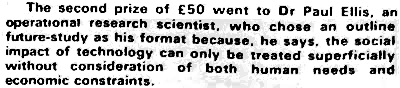
The one below, which won second prize, at first sounded as chilling to my mind as it did when I first read it in 1977. I saw Ellis’ ‘System’ as a centralized power whom all must serve, or perish, like Big Brother in Orwell’s 1984. I didn’t immediately grasp that the System is none other than the Internet, which we’ve absorbed and embraced for business, commerce, pleasure, social interaction and—well, more or less everything! And it’s not such a bugbear after all. I think I was thrown by the academic language, which my prejudice interpreted as somehow inhuman. Paul, please accept my apology!
Dr Ellis entered another competition 25 years later, for a paper on ‘The World and Business Computing in 2051’; in which he makes a number of references to the one he wrote in 1976, about which he says:
As we shall see in more detail, in a later section on method, there are circumstances in which it is possible to forecast major trends with reasonable confidence. As evidence of this, in the 1970s the author published a 20-year forecast on a related topic, which discussed what is today known as the internet, describing the rise of personal computing and much else of the character of today’s information technology and infrastructure. As a forecast its broad sweep stands the test of time surprisingly well, as does much of the detail.
I reproduce below that 20-year forecast, written in 1976.
PS I’m not one for forecasting these days, but do intend that normal blogging will resume in my next.

Extrapolating existing computer capabilities together with current economic trends suggests increasing social adaptation via diversification of lifestyles in decentralised and desynchronised emergent super-industrial economies.
Assume (1) a medium economic growth scenario with a decreasing cost ratio of (data entry storage, processing and communication) to (manpower, paper and transportation); (2) growth and global networking of databases expanding into the VDU/videophone terminals with limited vocabulary voice recognition input to a wide range of pre-defined formats.
 Socioeconomic context. The application of knowledge to men’s needs via technology has resulted in increased productivity. extensive social change and radical shifts of world-view —the industrial revolution.
In industrialised societies, economic growth becomes self-sustaining by creating products (e.g. the automobile) which satisfy former needs while creating new needs, higher aspirations, and changing values.
Successive shifts from agriculture to industrial production to service/informational work (now the major sector in the US economy) follows from the development of more powerful material and intellectual tools and a resulting growth of both the problems that can be tackled, and of the range of options available for their solutions.
This diversity of options branches decision trees multiplicatively, and decision making becomes more complex. Intuitive judgment must be augmented by information systems and OR techniques in competitive organisations, which often evaluate quite large decision trees—but the individual still has to prune his trees, using, primarily, habits, values and very restricted information.
The continuing growth to super-and post-industrial economies (a midcourse between Meadow’s and Kahn’s predictions) will require mass information, communication and decision capabilities leading to deeper perceptions of the way and state of the world and a continuing integration of the global economic system through common perceptions and aspirations, with international cooperation to aid developing countries to become productive.
Currently, most information to be processed is laboriously transcribed from people’s heads to paper, in fixed formats. Paper is transported, copied, stored and retrieved. The growing use of paper consumes forests, energy and labour while producing considerable pollution—paper use is becoming uneconomical for information recording.
The System. Hardware in the ’90s will include a variety of public utility and private processors, storage devices and terminal points linked by a developing global network like today’s telephone system. Terminal points will be almost as widely distributed by the ’90s as telephones are now, comprising TV/VDU/videophone devices with vocal, light pen and keyboard input, visual and vocal output. Book-sized mini-terminals with storage will ensure reducing paper use.

Under technological and economic pressures, the emerging attitude to information will be rapid, once-only input and switching about between databases, Most existing clerical/secretarial functions will dwindle. Software will be needed for speech analysis and synthesis, data tagging, reformatting, searching and retrieving with machine definitions of both vocabularies and input format for consistency of storage and ease of access. Database networking, security and operating system software will grow.
With falling processing costs, limited machine self-programming and analysis of systems, under vocal command, will become routine by the ’90s. Especially necessary will be a continuously operating “Filter/Hook” (F/H) facility, designed to capture into users’ temporary store (from the network) references to information of interest: e.g. research results, social functions and project offers.
Almost all new information will be stored in the global System, in a variety of functional forms. The design of generalised interactive databases to store, transfer and permit retrieval of the information will require extensive ontological analyses. Much of the information will be restricted to specified classes of users.
Most people will be both information sources and users. Storage of parts of existing libraries (to maintain cultural Continuity) will be desirable, though expensive. The choice of what to record more permanently and what to delete (one’s cultural heritage apart) may induce headaches in those responsible for keeping the System moving and heartaches in some bureaucrats.
Multi-entry user adaptive problem formulation and decision packages (the “books” of the future) will be a rapid growth area— not only research, design and OR [Operational Research – ed.] packages for large organisations, but also for an expanding range of personal, domestic and community decisions—eg relocation packages—to be interfaced with individual or organisational goals and history files.
The System’s routine capabilities will include telecommunications, electronic mail (with text formatting and editing) and fully automated financial and marketing transactions, thus reducing the volumes of data entry (via file interaction) and cutting organisational response times.
The primary characteristic of the System will be ease of handling diversity, eg. adaptive educational packages and advertising via F/H and personal file interaction, leading to increasingly specific routing of information.
Until artificial intelligence develops, some processing will be cheaper with human augmentation, e.g. in language translation (an alternative greatly preferable to “rationalising” languages.)
Social impact. Organisations are structured by information streams. Faster and more detailed information (on needs internal and external to organisations) leads via increasingly integrated modelling activities to more efficient and coherent organisations capable of more flexible responses, Less routine functioning will melt large hierarchical structures into smaller fluid problem-oriented groupings, orchestrated by highly sophisticated social and market research, thus allowing production to match consumer demands more closely.
An increasingly entrepreneurial management will evolve out of the existing management services style, oriented to self-actualisation rather than organisations, to ideas, values and people rather than many currently rather routine management activities which will increasingly be handled by the System.
Entering a super-industrialised economy in the 90s. the major employment sector will be System users working in a paper-free situation, freeing them to work at any terminal by file transfer into local or personal store. The decreasing ratio of communication to transport costs will thus reverse the industrialised trend to urbanisation/centralisation. People will increasingly work nearer (though not always at) home—gregariousness will ensure that people work at community terminal clusters, using the teleconferencing / videophone capability more frequently than face-to-face contact.
Since most routine information processing will proceed with little human intervention, System users could work on a highly flexi-time basis, freeing them to work when as well as where they choose, With decentralisation and desynchronisation, cities will start to devolve into little more than tourist/ leisure centres.
Although semi and unskilled work will not disappear, there will be poorer opportunities as work shifts from a production base to an information base. Manual work (in the broad sense) is generally less free to desynchronise. While shorter shifts and emigration to developing countries might help, there is a danger of an increasing resentment of the more flexible life-styles of System users by those less able or willing to operate the System.
The shift from trade apprenticeship could loosen the grip of trade unions, which will cease to be agents of beneficial social change (from the majority viewpoint).
The routine aspects of the earliest knowledge work—the professions—will also be performed by packages used by the customer, with professionals being consulted only for checking, polishing and perhaps implementing computer-aided solutions. This leaves the professional to concentrate on questions of judgment, detail, research into their subject or the development of improved packages—imagine using something like a Le Corbusier package to design your own home!
Teaching will move towards tutorial functions for the higher age-groups—reducing the numbers of full-time teachers while allowing others to become more productive by developing the previously mentioned widely distributable adaptive packages. Future education will swop fact acquisition for comprehension, relationship perception (including past to future and self- awareness), problem recognition/formulation and System use. The restricted machine vocabulary and vocal capabilities endanger language skills and, accepting Whorf’s hypothesis that language reflects world- view, the System may engender a mental dependence, preventing adequate intuitive “model-building” and lower judgmental development.
Education and re-education will continue throughout life, blurring the distinction between school and work and encourage earlier development of research skills, especially for socioeconomic problems.
Research will be System-supported in formulation, literature searching, data gathering, hypothesis testing and dissemination of results. Viewing the world through a deterministic System may introduce a deterministic bias into research styles!
Together with the trend to decentralise and desynchronise society, the greatest social impact of evolving software will be on the adaptation of individuals and society via a diversification of lifestyles. Consider bringing together one’s personal history files (including capabilities and susceptibilities) with need analyses, interests and values and interfacing them with the information network using a structured set of the aforementioned packages.
While this might generate recommendations for a random lifestyle or warn of inadvisable options, it might also indicate compatible choices of educational paths, habitat, work etc. Lifestyle research, planning and partial “optimisation” would lead to increased self-determination, achievement of goal trajectories and, paradoxically, a greater integration of society.
The numbers, sizes and durations of families will continue to drop, partly due to increasing independence and incompatibility of diversifying lifestyles. The freedom for couples to schedule their work time could, however, ensure a greater contact with children during the most formative and vital years.
Consider the impact on wider interpersonal relations of an indoor wall-sized, and possibly holographic, flat-screen visual terminal. While it could be partitioned for teleconferencing or programmed as a dynamic art gallery—most exciting is the prospect of interfacing widely separated living spaces giving the illusion of sharing, audio-visually at least, the “same” room. Its superiority to telephone and TV will radically alter the importance of tele-social contact with distant friends and relatives—regaining some of the lost extended family concept and reducing both loneliness and identify crises by the easy maintenance of one’s key social and kinship relationships.
Combined with the F/H facility set to social availability, one could rapidly locate or organise potential friends or groups in desired locations by interest, situation, personal history or goal matching. Detailed local scanning would allow a more meaningful participation in local affairs face-to-face as well as community planning and problem solving, drawing communities closer together while encouraging more democratic processes.
The increase in need satisfaction through lifestyle diversity/ “optimisation” and wider potential social contacts will reduce the current gap between social and techno-economic development by providing society with a plethora of feedback mechanisms operating within greater social variety, enhancing the flexibility and adaptability of relations between society and the individual.
Nevertheless, participation in society inevitably requires sacrifice of some freedoms to attain others. The cost of diversified lifestyles includes a reduction of privacy by the necessity to make available, via the F/H facility, more information about oneself—or to lose the opportunity of being “seen” by the System.
Voice recognition brings with it the dangers of increased surveillance and hence the need for security software and, perhaps, an “ethical moderator” in the System. Those, if any, controlling the network could wield terrifying powers to distort, falsify or censor one’s values, perception of the world and relations with people. Should the System be neutral or parental—if the latter, does it serve the whole or the parts?
System dependence creates vulnerability—to computer experts, to over-simplified solutions and to the illusion that the world “is” what the System conveys. Diversity may endanger consensus and actually reduce human communications leading to cultural schizophrenia.
While artificial intelligence might eventually solve some of the above problems, and others may be only the growing pains of a post-industrial economy, considerable thought must be given to which freedoms we need to maintain and the anticipation of required legislation.
Without radical unforeseen changes in technology, the foregoing could easily evolve, by apparently innocuous increments, under economic and political pressures. Its desirability is a question requiring consideration of the benefits to all, together with the welfare of each. Think deeply—you are the shapers of worlds!
Comments
Darev:
“Diversity may endanger consensus and actually reduce human communications leading to cultural schizophrenia.”
We can see examples of this happening all over the place. Everyone with access is communicating but it’s mostly reduced to meaningless drivel and this new “textspeak” crap.
We have this bright shiny thing that could reshape mankind and we are burying it in garbage.
And just to bring it right out in the open, that referenced sentence was about the only line in his article that I understood. And I may have even gotten it wrong.
John Myste:
It somehow seems depressing.
Vincent :
Sorry about this, Rev, but I’m glad you did find something worth picking out.
Yes, John, I felt that too. Even though so much was accurate in the piece, today’s reality is not the Big Brother society it somehow seems to evoke.
My own feeling – completely unfair given the competition theme of “software in the Nineties” – was that in any kind of futurology, including science fiction which it closely resembles, the whole thing needs to be informed by an underlying sense of human values, so that we can measure the technology not by how clever it is, but by whether it takes us closer to those values, or further away.
And if a future study showed us a pessimistic vision destructive of those values, it wouldn’t be depressing; for no future is inevitable, apart from the normal cycles of Nature: seasons, birth and death. Apocalypse can surely be averted. Fighting against the odds is never depressing.
 a wayfarer’s notes