
 I still haven’t given up on “the book of the blog”. When I do, this place can become “the blog of the book”, but don’t worry, it will be the same blog, going off in the same haphazard directions. In December last, I dashed off a Preface followed by a Preface Mark II”, both of which were enough to quell a reader’s interest stone dead from the first sentence on. Now I’ve had another go, but I’m not sure if it’s any better. You are invited to pass judgment, see below.
Over the last five years I’ve kept a journal, writing an entry roughly every four days. It hasn’t exactly been a private one, for it’s a blog, that strange word which some think ugly, formed from the syllables Web + log. There are on the Internet hundreds of millions of blogs, open to millions of readers. Some are like personal diaries. It is worth asking what drives the author to make the effort. I continue to ask myself this, and still get worthwhile answers. Gradually I’ve come to see blogging as a method of discovery. Without the discipline of written language, and of presenting something to my unseen audience, I wouldn’t know what I have to say. Precious experiences would hardly be noticed at the time, and soon forgotten afterwards; all for want of an album of literary snapshots.
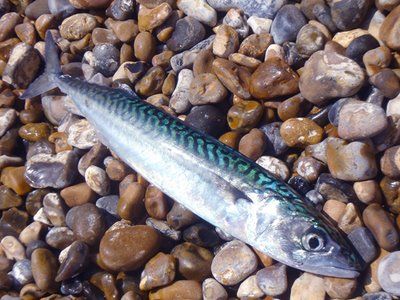
This much—that it would be an adventure of discovery—I knew from the start, as my first ever post reveals. The second post, written a few days later, brought to consciousness something that seemed like an idle flight of fancy at the time. In asking “Do fish have souls?” I tried to record what it felt like to discover the astonishing beauty of a mackerel, even when dead. As I slit its belly to prepare it for grilling, I saw that its bone-structure and organs were not so different from my own; that in a sense we are one family.
I was—am—overwhelmed by the wonder of it all: its beauty, the mystery of existence, an inexpressible feeling within me, always yet never the same. I know that there are explanations: in the theory of evolution; in recent discoveries of DNA and how brains work; in the lore of various myths and religions. But it’s quite different to make a personal discovery. The sense of wonder is nothing like any explanation. Keeping a public journal, trying to find words to share this sense of wonder, perhaps sometimes succeeding, has helped uncover extraordinary dimensions within the commonplace round of daily life.
Words can’t really convey the richness of experience, but that doesn’t stop us trying. Sometimes the spirit behind the words can jump the gap of separateness and touch what’s common, however clumsy the communication.
I was going to call it The Soul of an Animal, with a photo of young bulls on the front. But now I wonder whether to call it Do Fish Have Souls?
Comments
Bryan M. White
I don’t know. Sounds fishy to me. 🙂
John Myste
I vote for “Do Fish Have Souls” or “The Fish’s Soul,” since to propose a thing gives it dimension, such as black holes were a thing from the moment someone dreamed of them, even if only in our imagination. A good example of this is my son, Preston. I currently have no son, but I speak of Preston often.
This reminded me of an essay I wrote, maybe two years ago. I don’t know where it is. It was titled: “Why a Writer Writes.” At the time, I had no web presence of any kind. I had yet to post on Fair and Unbalanced and Mad Mike’s and I definitely had no blog. I am going to estimate that I started writing around the age of 12. In the essay I spoke of things such as the letters of Mark Twain and Victor Hugo. Many of them were addressed to a single person and I am sure the author thought would be read by no one else, and yet they were as literary and creative as some of their greatest published works. Writers write for the love of the written word and the exploration of their own thoughts.
That someone else may see their words, is rarely the motivation, and a distant secondary concern. Those who write primarily for others to see are professional writers. Those who write for themselves are artists. Emily Dickenson published 1782 of her 1800 poems posthumously. She wrote poetry because she was a writer and for no other reason. Most of my writing, the vast majority, has never been seen by another human being.
I discovered a very large part of who I am by reading it, sometimes as I was writing it, and sometimes years later. Moreover, I have learned, again and again, who I am not. When my wife recently asked what I get out of blogging, I explained to her that I think about more varied things in a few hours of blogging than I do in a week of daily living.
Writing and reading the writing’s of others is time dedicated to philosophical matters and it allows you time to sort through the half thoughts and fleeting inspirations that collect throughout the day. If you do not do it, much of the day is lost and how much will never return is unknowable.
To record ones thoughts is to remember oneself. When I happen upon who I was, I am often surprised and delighted, sometimes to rediscover myself and sometimes to realize that I have become someone else.
Ashok
Beautiful and meaningful writing to me Vincent.
Bryan M. White
Emily Dickenson published her poems posthumously? That’s quite a feat. :)Sorry John, I know what what you mean, but I couldn’t resist.
LadyBeth
Why do we do what we do? It’s always a good question. That last bit of this post is so poignant. The spirit of words… it is truly an amazing thing.
Vincent
Bryan, it was fishy in more ways than one. I was fishing for feedback, that’s for sure.
Vincent
John, thank you for your essay, not the one you wrote two years ago, but the one you appended above. You give me yearnings to know your writing, as well as your son Preston, though I must tread delicately there, fearful of the meaning of “currently”. If you speak of him often, I hope to hear or overhear some of it.
I share your feeling for unpublished works, realizing that several writers who have intrigued (and infuriated) me most did not publish in their lifetimes:
-
- Fernando Pessoa, who left manuscripts in a wooden chest from which Livro do Desassossego, “The Book of Disquiet” was compiled;
- Ludwig Wittgenstein, who published only one treatise, the other books being compiled from his notes;
- the English poet and Jesuit Gerard Manley Hopkins;
- the French palaeontologist and Jesuit Pierre Teilhard de Chardin;
- and others which I can’t currently bring to mind.
Vincent
Thanks Beth. Yes, “why do we do what we do?” is certainly a good question, especially when we reassure ourselves that questions are often complete in themselves. Attempting to answer them is likely to throw us into error. Leaving them unanswered preserves their purity and power.
Vincent
Thanks as always, Ashok.
 a wayfarer’s notes