

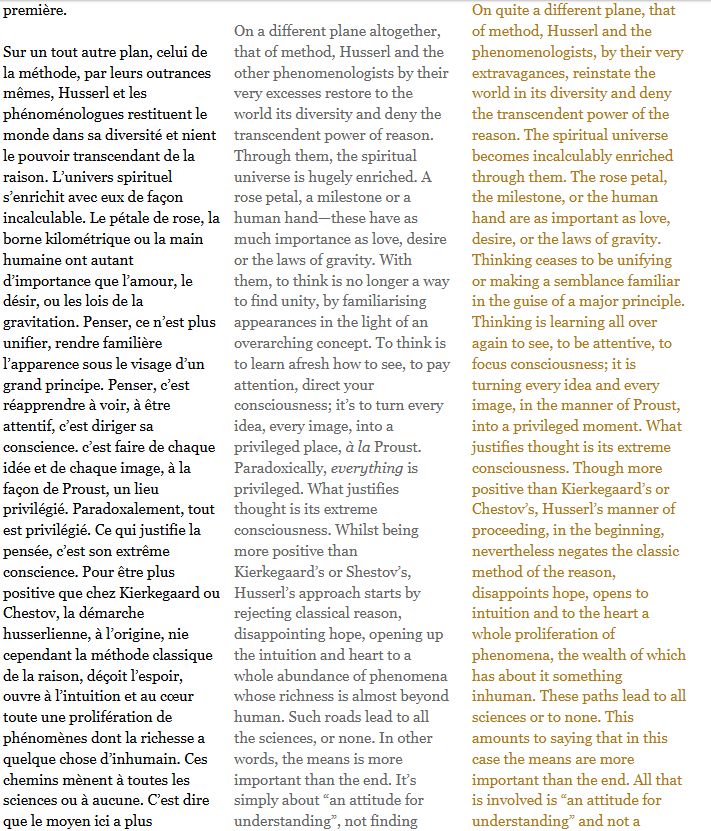
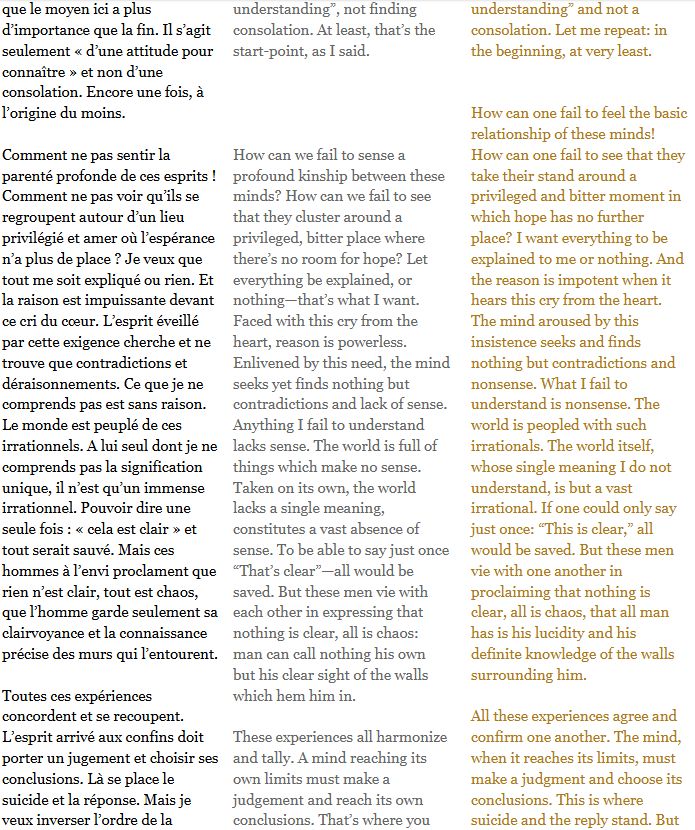
I’ve always been irritated by the stilted translation of Camus’ famous book by Justin O’Brien, and offered my own to the publisher, Penguin Books.They informed me that this translation was copyrighted as the only translation, so my efforts were a dead duck. I’d read French and Italian literature for my degree at the University of Birmingham, but my real interest was good English. Anyhow, it was fun to invent some new terms in contrast to O’Brien’s; one which attempts to speak directly to the reader, thus:
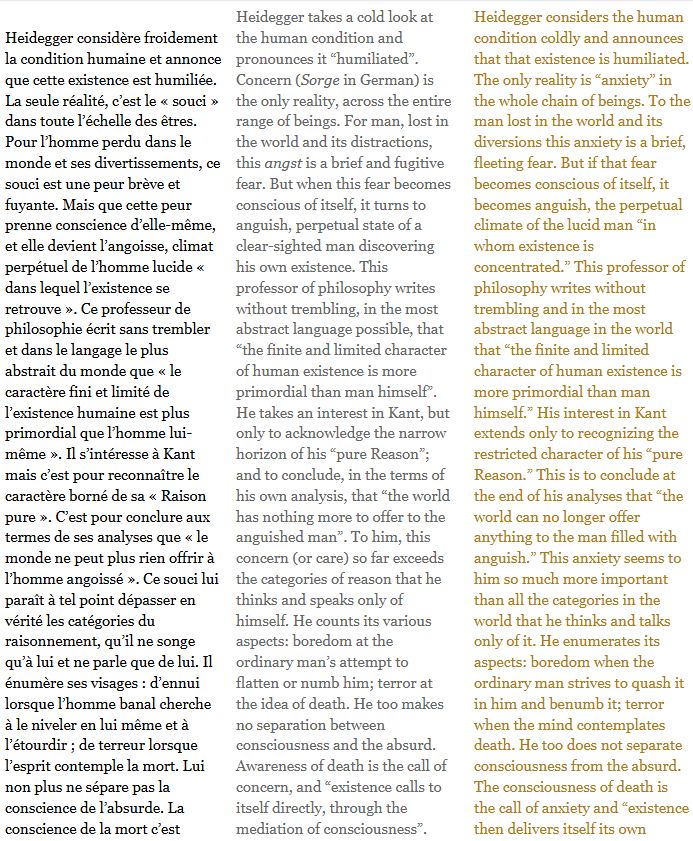
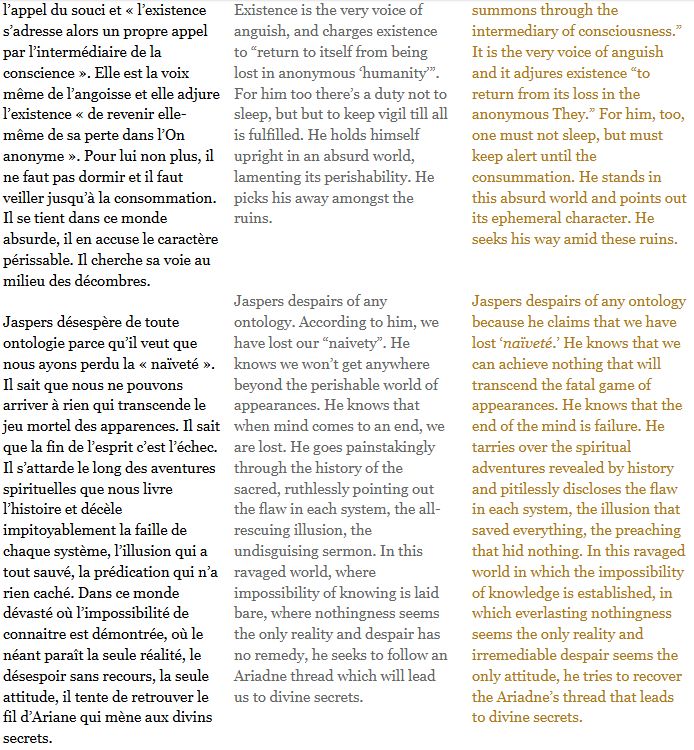
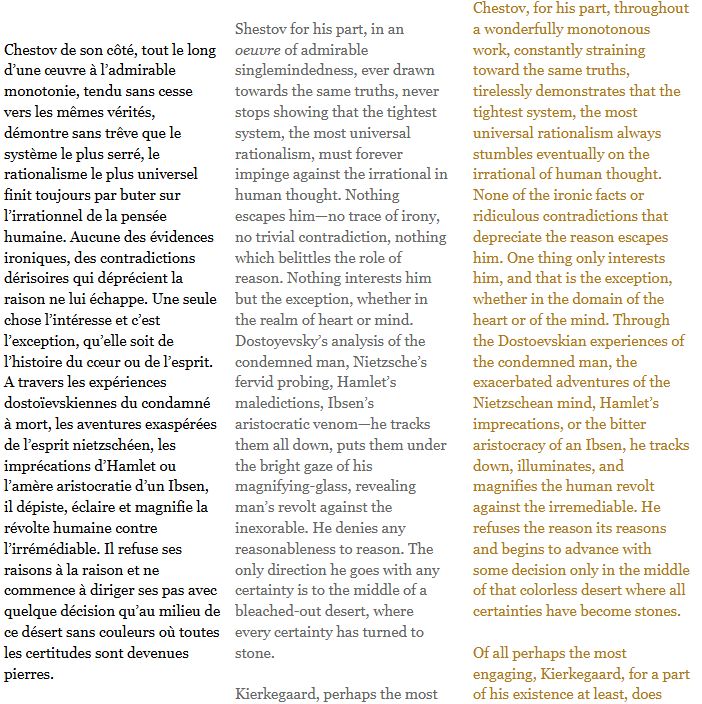
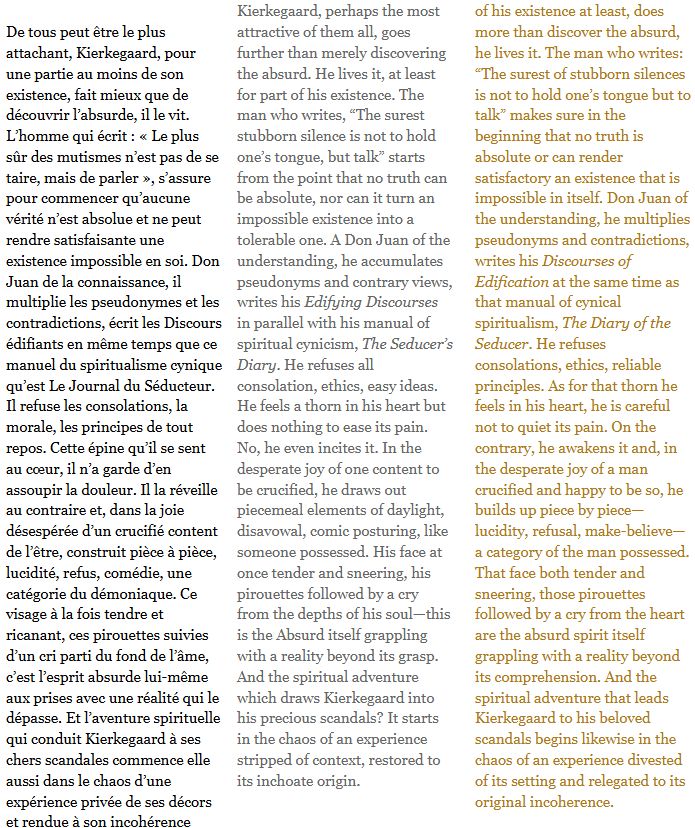
we find a kindred of minds, connected by the same quest in logic and ethics, divided only by their different approaches.
And then again later:
How can we fail to sense a profound kinship between these minds? How can we see that hey cluster around a privileged, bitter place where there’s no room for hope? Let everything be explained or nothing — that’s what I want. Faced with this cry from the heart, reason is powerless.
Reviewing this post many years later, I see that the O’Brien version is sometimes superior, but I’d chosen to be different just for the sake of it.

Le Mythe de Sisyphe: essai sur l’absurde
Albert Camus © 1942 Éditions Gallimard
Translation © 2011 Ian Vincent Mulder

JustRex
Good Lawd. It’s like two different, yet similar tomes. I would be hard pressed to pick one and say it’s ‘better’ or even ‘more digestible’. You could publish both in the same volume. One version right side up from front to middle. Then flip the book over and read the other from back to middle. That way nothing would be ‘lost in the translation’.Bryan White said…How did you get two columns like that? I suspected all along that you were some sort of ancient wizard.
Bryan White
I definitely prefer your translation. It has that nice flow I’ve come to admire in your writing. For instance:
“Heidegger considers the human condition coldly and announces that that existence is humiliated.”
vs.
“Heidegger takes a cool look at the human condition and pronounces it ‘humiliated’.”
There is a better economy of words and your version slips easier off the mental tongue. It’s not easy to accomplish both those goals at once. And yet, none of the tone or meaning appears to be lost either (although, as a small critique, I wonder if “cold” wouldn’t have served better than “cool”, but then I know nothing of the original text so I’m speculating in the dark. Maybe “cold” wouldn’t even have been grammatically correct in that context.)
At any rate, nicely done.
Vincent
I found a site which showed how to use html to create columns then copied and pasted, viz:
[style]
#columns {
width: 600px;
}
#columns .column {
position: relative;
width: 46%;
padding: 1%;
border: solid 0px #000;
}
#columns .left {
float: left;
}
#columns .right {
float: right;
}
[/style]
[div id=”columns”]
[div class=”left column”]
[strong]new English translation: blah blah[/strong]
[/div]
[div class=”right column”]
[strong]Justin O’Brien’s 1955 translation: blah blah[/strong]
[/div]
I had to change the < and > into [ and ] to have the comment accepted. So you would have to change back to make it work.
Vincent
Well spotted Bryan, “cold” would be more correct actually.
Rev, my whole reason for starting my own translation was that I found the existing English translation bafflingly indigestible. It sounded unlike English. And if one was going to publish a parallel text version, one would of course have to put the original French on one side and the English alongside.
There is an irreducible problem though and that is Camus’ French. O’Brien ducks out by translating literally, preserving the awkwardness and ambiguity of the original with little concession to any flowing English idiom.
If everyone were as hard pressed to pick one as you said, then I would be wasting my effort. And here I had an explanation prepared to back me up. I was going to get into the difference in connotation. “Cool” to me suggests breezy, casual, calm, and indifferent, while “cold” sounds harsher, sterner, more clinical, devoid of compassion or compromise. Considering Heidegger was pronouncing humanity “humiliated”, the latter option seemed more appropriate.
Of course, I didn’t need to say any of this, as you’ve already agreed with me, but I like to run my mouth anyway. It’s a weakness of mine.
Davoh
Oooer, reading your thoughts is becoming complicated.
never fear, will try to cope.
Hayden
Well, I find it simple to choose, and you are the clear winner.
Fascinates me that I don’t recall any difficulty or disagreeableness about the other translation when I originally read it, don’t remember anything except that it was an interesting work. Now, however, reading yours I find the other stilted and annoying. Perhaps, too, it’s my age – I’m less patient than I used to be.
…After further reading later in the day with more coffee in my system, I can see the differences. Someone… yes, Hayden said that the other translation was “stilted and annoying” and I heartily agree. Translating exactly word for word from one language to another just does not work worth a bean. Different sentence structures, different idioms. Yours does go down much smoother.
Vincent
Phew, Hayden, I was relieved when you said that. When I first put the thing in two columns, I had the same doubts that daRev initially expressed. After all, they do both say the same thing. But you may well be right: impatience comes with age. In our youth we accept things by reputation.
.
Le Mythe de Sisyphe: essai sur l’absurde
Albert Camus © 1942 Éditions Gallimard
Translation © 2011 Ian Vincent Mulder
 a wayfarer’s notes