

 It matters a lot which translation of a book you read. I confess to being super-fussy about these things. I hear a piano concerto or symphony, for example, and compare it unfavourably with one which impinged on my consciousness years ago, perhaps in my teens. (You’ll have to trust me on this. It’s the impinging, not the nostalgia, which counts in these evaluations.) That shows how much style is important as the messenger of content. In the same way, having recently noticed the difference between mp3 and higher-quality digital recordings, I’ve started to pursue the latter, with a purism that some might consider excessive. Not everyone is super-fussy, most of us don’t have the time or energy, but we can all benefit from those who do.
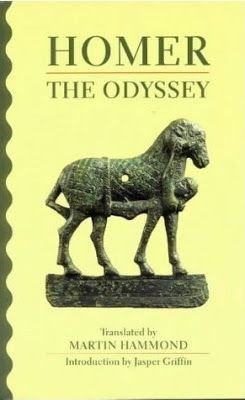
I have two versions of Homer’s Odyssey, both picked up in charity shops and left on my shelves largely unread. One buys such books because of the bargain price and the knowledge that they are classics. Making the effort to read them is another matter. It is very easy to get discouraged and lose interest when you doggedly start at the beginning. This is where the qualities of the translation tip the balance. Martin Hammond’s (published in 2000), fools me into thinking I’m reading the Odyssey fresh, in the original Greek: an experience so exciting it drives me to write this piece.
Let us compare it with EV Rieu’s version issued in 1946. As Wikipedia says, “Each night after supper, Rieu would sit with his wife and daughters in London and translate to them passages from the Odyssey.” What resulted was the first in the Penguin Classics series, with Rieu as their general editor.
His Odyssey may be considered “classic” in its own right, but that doesn’t make it good, something you don’t have to be an expert to define. Good is what makes the ordinary reader wants to read the whole thing, or be excited enough to spend a morning writing about it. You can judge for 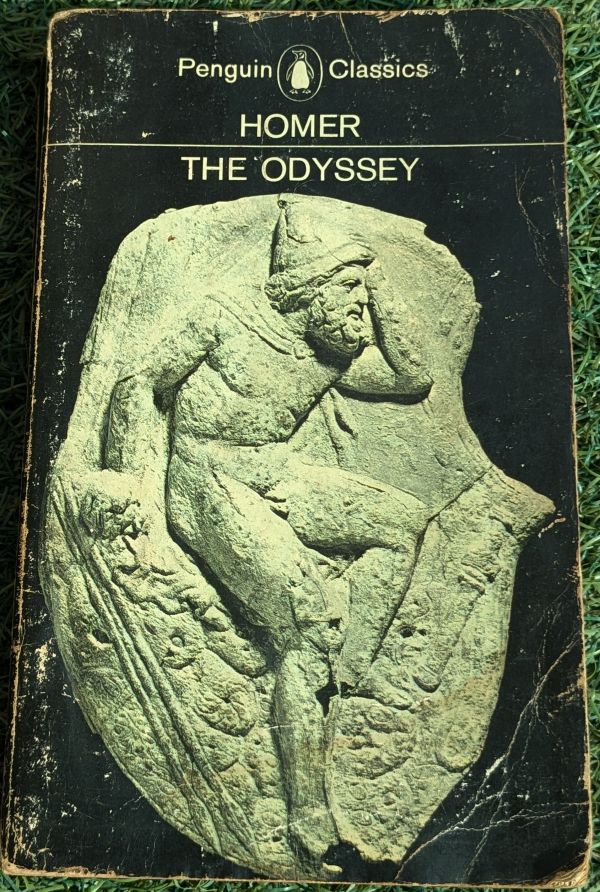 yourself from the following parallel extracts: Hammond first, then Rieu. I’ve colour-coded the text to make it easier to compare, and added a few corresponding notes at the end.
Hammond:
“So we sailed from there [the country of the Lotus-eaters] in distress of heart. And we came to the land of the Cyclopes, a violent lawless people, who do no sowing of crops or ploughing with their own hands, but simply trust in the immortal gods and crops of every sort grow there unsown and unploughed—wheat and barley and vines yielding wine from fine grapes—and the rain from Zeus gives them increase. These people have no assemblies for debate and no common laws, but they live on the tops of high mountains in hollow caves, where each man is the law for his own women and children, and they care nothing for others.
…
“When our ships beached we took down all the sails, and then jumped out ourselves where the surf breaks. And there we fell asleep and waited for the holy dawn.
“When early-born Dawn appeared with her rosy fingers, we went roaming all over the island, delighted with it.
….
When the sun set and darkness came on, we lay down to sleep where the surf breaks on the shore.
“When early-born Dawn appeared with her rosy fingers, I held a meeting with the men and spoke to them all: …”
Rieu
“So we left that country and sailed on sick at heart. And we came to the land of the Cyclopes, a fierce, uncivilized people who never lift a hand to plant or plough but put their trust in Providence. All the crops they require spring up unsown and untilled, wheat and barley and the vines whose generous clusters give them wine when ripened for them by the timely rains. The Cyclopes have no assemblies for the making of laws, nor any settled customs, but live in hollow caverns in the mountain heights, where each man is lawgiver to his children and his wives, and nobody cares a jot for his neighbours.
…
“It was not till our ships beached that we lowered sail. We then jumped out on the shore, fell asleep where we were and so waited for the blessed light of day.
“When the fresh Dawn came and with her crimson streamers lit the sky, we were delighted with what we saw of the island and set out to explore it.
….
The sun went down, night fell, and we slept on the sea-shore.
“With the first rosy light of Dawn, I assembled my company and gave them their orders….”
My notes:
References to the Greek gods
Rieu is just plain wrong to paraphrase the immortal gods as Providence! Unless we can let the text transport us to three thousand years ago, when there was no such thing as Providence—the word evokes a Christian idea—we are at a fatal disadvantage. We are not reading the Odyssey itself but a retelling, like Lamb’s Tales from Shakespeare, written for children.
where the surf breaks
Repetition of epithets is one of Homer’s characteristic poetic devices. Hammond preserves them, Rieu makes a point of varying them, as if Homer’s habit is an embarrassing atavism. (I don’t read Greek, but assume the repetitions from Hammond.)
And there we fell asleep and waited for the holy dawn
Hammond tells us how Homer’s Greeks felt about the dawn. Why else should I want to read the Odyssey, but to see through the eyes of his contemporaries! Rieu is more concerned with idiomatic English.
When the sun set and darkness came on, we lay down to sleep
Hammond’s version is transparent to Homer’s poetry, conveys the awe of sleeping in the open after the darkening of the sky, an awe not lessened by frequent repetition of the same event. Rieu is impelled by a need to be perfunctory in such matters, for a reader who says “Cut to the chase, EV!”, and likes the same thing said in a different way each time.
When early-born Dawn appeared with her rosy fingers
Hammond repeats word-for-word this most characteristic of Homer’s epithets, one which connects us directly to the animistic source of Greek religious awareness—the personification of phenomena in Nature. I speak here not as an academic. I may have the words wrong in their terms. For Rieu, this rosy-fingered dawn business seems to be tedious, has to be paraphrased anew each time: his Wikipedia entry makes special mention of it.
I held a meeting with the men and spoke to them all
—This sounds like the true voice of Odysseus, clear across three thousand years. “I assembled my company and gave them their orders.” —This sounds like Rieu, London Blitz survivor, trying to make Homer vivid for those accustomed to ration books, air-raid wardens, the sense of war being carried out on their behalf by heroes elsewhere …
I’ll grant that EV Rieu was a literary hero of his time. But we the readers have to look out for ourselves. Hammond is your man.
25 thoughts on “Homer’s Odyssey”
ghetufool
I’ll grant that EV Rieu was a literary hero of his time. But we the readers have to look out for ourselves. Hammond is your man.” I love the way you ended it.
Francis Hunt:
Traduttore, traditore [to translate is to betray], say the Italians – and there’s a lot of truth in it. As an English native speaker, who has lived in non-English speaking countries (first Italy and then Germany) for nearly thirty years now, it’s something I’m confronted with daily. Even as one faced with this phenomenon within a common time and huge amounts of shared western culture, I’m constantly confronted with the difficulty of completely translating all the nuances of one word into another language. How much more difficult is all of this when trying to convey the world of Homeric Greece to our contemporary world! ῥοδο-δάκτυλος Ἠώς [rosy fingered Dawn] is perhaps the best known of Homer’s epithets … and serves to illustrate a tiny aspect of some of the plethora of problems the translator is confronted with. The Odyssey and Iliad were both composed for oral recitation and, as such, make use of many such epithets as mnemonic aids (and also to help the flow of the dactylic hexameter in which the works are structured). Our world is very different and the translator is basically writing for readers in our age, with other literary forms and usages, who will be reading rather than listening to the result. So he’s faced with impossible choices. I’m not so sure I share your preference for Hammond. Rieu takes more liberties with the original, for the sake, possibly, of putting more modern “swing” into the story. This works for me but, in the end, it’s a very personal thing. De gustibus non est disputandum! I love your final observation about Rieu’s language being influenced by his experience of the Blitz — and I think that it’s an excellent observation of what I’m trying to say: The translator is always a person of his world, conveying how he understands the original to his world. I’m inclined to allow more “poetic licence” for the sake of producing a vivid, living product. But this is a point that has involved me — as someone who has done quite a bit of translating in his time — in heated debate with others working in this area who tend to place more emphasis on absolute fidelity.
DaRev 2005
Can anyone, even the most faithful translator, work on a text and not interpose their own idiom into it? Your mind is a road map of your time and place and it automatically changes things to fit inside your reality. The secret it would seem, is to remain as true to the feeling of the original while still making it pleasant and sensible for the modern day reader. I wonder what the Magna Carta or even the Declaration of Independence would look like today if someone were to translate them into modern English. Quite different, I imagine. I once saw a website that showed Japanese novelty T-shirts being sold. One stated “Accomplish your task”. When asked what that meant, the owner adopted a strange version of the American Redneck accent and shouted “Git ‘R Done!!!” It was one of his best selling shirts. They thought it was hilarious.
Gina
From what you’ve provided as comparisons, I find Hammond more interesting and pleasing to read. I’m not sure how I would feel *listening* to each. I’ve read a lot of translated works and always I feel a bit insecure as to whether I’ve chosen the best translation. Off-topic, I wanted to tell you that I took you up on your recommendation of the film “Together” and liked it immensely. It was funny with well-developed, likeable characters. Regarding the name change. Gina is my real name. Actually shortened from Virginia (after my great-grandmother) to Gina since birth. The first of my four names. 🙂
Keiko Amano
Vincent, I also can’t help but compare multiple translations for same book. So, this post is very interesting to me. I agree the points you made about the repetition of the phrase, and about rose fingers. Those details give me the feel of the ancient oral tradition. About “personification,” every time, I see or hear the words of body parts like hand, finger, toe, head, arm, foot, leg, and so on, it helps me see a picture more vividly. This must be global because it is true in my language, too. Also, I was even more interested when I found out E. V. Rieu was much older author than Martin Hammond. At first, I thought Martin Hammond was older than Rieu. I say that because in our language, I often prefer older translators because those older Japanese translators’ works I’ve read were more down to earth, concise, and beautiful old language. Modern Japanese authors can no longer use those languages spontaneously. But I know I can’t judge by age. The success of books must be complex. But, I can understand the great opportunity Martin Hammond felt when he read Rieu’s Homer.
Bryan M. White
Yes, a good translation does make a big difference. I must confess that I find Rieu’s version slightly easier to read, but this hardly makes up for the gross inaccuracies. The part about “providence” is especially unforgivable. That’s tantamount to transposing an entirely different perspective of beliefs onto the text. I can see Homer rolling over in his grave on that one. Nice analysis. It’s funny, I didn’t expect such lively interest in this topic!
Vincent
Francis, Traduttore, traditore is precisely how Hammond begins his Preface! Do you know ancient Greek yourself? I suppose you do, from your priestly studies. I wish I had learned it myself. Douglas R Hofstadter wrote a wonderful detailed book called Le Ton Beau de Marot: iIn praise of the music of language, which is all about translation, particularly verse, & how you can replicate tight structures; and how you must choose a path between faithfulness to the original, and bringing that original up to date with the culture of the reader. He avoids easy answers, preferring to spin his books out and get lost in details: but does mention that the translator (or interpreter) should aim for invisibility, letting the original shine through, fooling you that you are reading the original. I’m still pondering whether to continue my translation of Albert Camus’ The Myth of Sisyphus, a labour inspired by dissatisfaction with the very literal attempt by Justin O’Brien in 1955, still the only one available in English. My version is idiomatic and in my view a little daring. But when I read it back to myself after an interval, it just seems a lot more readable than O’Brien’s. But it’s just such hard work! I have published extracts already on this blog, Part 1 and Part 2
Vincent
Thanks Ghetu. I was thinking of the way literature is taught or criticised, which seems to have got a lot worse since I last encountered it (1963). Academic, reviewers & critics want to “make a meal of it” — expand their job big enough to make a good living at it, while readers just want a few pointers, so that they don’t waste their precious time. But then of course, there is no accounting for taste. Sometimes when I am choosing a DVD to rent in a hurry, I’ll look up the “Rotten Tomatoes” review site and merely look at the overall percentage of approval ratings. If it’s over 80%, it’s surely safe, you’d think, but that doesn’t take into account taste. I can’t get along with Almodóvar but am very fond of Fassbinder, for example.
Vincent
Rev, I agree with you there, but being up to date limits the shelf life of your rendering, unless you are a timeless master of your craft. “Git ‘R Done!” is masterful & timeless too, as Chaucer is timeless. There is a good example. If you are going to read Chaucer at all, you have to make the effort and read it in some form of the original, otherwise there is little point: Lamb’s Tales from Shakespeare all over again. So what they often do is provide copious footnotes. So in the Reeve’s Tale, this line on its own makes little sense:
So myrie a fit ne hadde she nat ful yoore.
But the footnote tells us it means “She hadn’t had such a merry bout for ages”
Vincent:
Glad you liked “Together”, Gina. I think I read somewhere how shocked they were by it in Spain! I’m getting used to “Gina” but still have to say “Susan”) to myself. One author which demands the best translation, in my view, is Dostoyevsky. I got on very well with Crime and Punishment but felt the translation was rather riskily modern. Now I am wallowing with The Idiot (David Magarshack) — I mean picking it up at such long intervals that I forget the plot and characters in the meantime. My son gave me a nice bound edition of The Brothers Karamazov in the Constance Garnett translation, quite an old one I think. Thing is I can’t afford to be too choosy!
Vincent:
Thanks Bryan. I can understand finding Rieu easier to read, but for me Hammond puts me in touch with a short foray in learning Greek when I was 11. I was at boarding school and the teacher taught me outside of class, for fun, but he had to retire from ill-health, and that was it. I fell in love with the language: the shapes of the letters, the sounds, the sense of some oceanic freedom and freshness compared to Latin. Later at another boarding school another teacher, an eccentric young man called Scott-Moncrieff, promised to teach me Greek too. I jumped at it. Then he said we would have to get up at 6am for the lessons. I was up for that too, till I realized he was trying to wriggle out of his promise.
Vincent:
Francis, if you learned Greek, do you have any book of grammar to recommend, that was fun to do?
Vincent: Keiko, I was most interested in your comments. Did you find out how much younger Hammond is? the Wikipedia article doesn’t provide his date of birth. I too often prefer older translations, but not because they are older. When you said “Modern Japanese authors can no longer use those languages spontaneously”. I thought it was a topic for a blog post, the kind you excel at. But it would be impossible, I suppose, to illustrate your point in English!
Francis: Alas, Vincent, my Greek is limited to a few semesters of Koine (New Testament) Greek during my theology studies – what remains today is the ability to read the alphabet and understand many common words, but nothing like the facility necessary to read it for pleasure, much less present myself as an expert.
keiko amano
I have the “Odyssey” in English but I’ve left it in Japan, so I can’t check the name of author right now. But I have “the Iliad and the Odyssey” by Alberto Manguel with me. It’s a history of the literature. The book was published in 2007, and I thought maybe it could be easier for me to read it since it was most currently published. I bought it in 2009 and read only a few pages. Because of your post, I checked this book, and in the acknowledgement section of this book, the author does not mention about Martin Hammond. I thought it odd because I was still thinking Hammond must be older than Rieu, so I checked their age and background in language. So, I still don’t know Martin Hammond’s age, therefore I don’t know how old he was when he interpreted “Odyssey,” but according to Wikipedia, E. V. Rieu was born in 1887 and died in 1972, and Martin Hammond interpreted (Wikipedia uses “translated” here, but I have problems with it because the original is the ancient Greek) the “Iliad” in 1987 and the “Odyssey” in 2000. So, I thought more or less they are one generation apart. I love comparing. I can stay in a bookstore or library all day for it. I wish you finish the translation of Camus’s book so that many people for generations can enjoy from either straight reading or comparing, arguing about it. I know it’s very very hard work. Just to translate one haiku, it is taking me weeks, but I’m still not satisfied with my translation. About your suggestion on new topic, I keep in mind. It is possible to some extent, and I love to write about it, but right now, I’m reworking on something. I can’t say just rewriting, editing, translating, interpreting, or novel, memoir, non-fiction, fiction, and so on because it is all mixed up. This morning, I was sure reworking on this current project, but again, I just had to look at your post and write this comment.
Vincent
Thanks for your support on the Camus, Keiko. My aim actually is to produce a translation which will enable the old one to be quietly forgotten, rather than encourage comparisons. I have in the last 24 hours submitted my initial proposal to a publisher. I’m a little puzzled when you say Hammond interpreted Homer, rather than translated him. He is very well qualified to undertake the translation from the original Greek! But we are in complete agreement about the hard work involved in translation. I’m certainly finding this when trying to render Camus into lucid flowing English. His French in Sisyphus gives me the distinct impression of having been written rapidly and with passion: not quite conversationally but in a tone where he relies upon the reader to know what kind of point he is trying to make. This creates a difficulty which I have to resolve in every sentence: what is he aiming at here? How can I guide the reader to follow the pointing finger in precisely the same direction as Camus intended? First I have to determine what that direction is! The existing English version doesn’t even engage with this problem, but translates literally, producing a clumsy English that leaves the reader with a great deal of work to do. Random example, from the existing translation: ”The perception of an angel or a god has no meaning for me. That geometrical spot where divine reason ratifies mine will always be incomprehensible to me.” I haven’t reached this point yet in my own version, and have no idea how I would render it from the original French. But you see that Camus is making an observation as part of a larger argument, whose aim needs to be understood, so that his thought may be clarified.
keiko amano
Vincent, Really? Do you think he translated directly from an ancient Greek text? For more than 3000 years tradition, there must be many translations already, so I assumed he has probably read most of them. To me, once I read many translations, my own translation wouldn’t be straight or pure translation anymore because other people’s ideas lodged in my head. Also, like Sanskrit, I thought that the ancient Greek sentences can be interpreted in many different ways, so unless the translator is a speaker of that language, he can’t tell exactly what it means. So, if I were in that similar situation, I would take advantage of all those existing translations, compare and interpret the text in the way I’d like. What do you think? In his book, did he write the name of the ancient document, the date, the place where it was found, and the kind of difficulties he encountered during his translation?
keiko Amano
Vincent, I just noticed your second comment. Thank you. I’ll reply tomorrow. But, more I thought about it, where we draw the line between translation and interpretation is unclear and probably each person has own measurement.
Vincent
I’m sorry, Keiko, I withdrew my rather abrupt comment in favour of a longer one which included my point that Hammond – I’m quite certain – translated from the original text. He studied Latin and Greek at Balliol College Oxford and went on to a career in some of the most prestigious English public schools (i.e. private schools!) as Head of Classics at Eton College, and then a series of headmasterships. In these old schools, Greek continues to be taught, at least to some pupils, who would learn to read Homer in his own language. As for the Homeric text, and how it survived over the millennia, that is another question. Wikipedia tells us this: ”We have little information about the early condition of the Homeric poems, but in the second century BCE, Alexandrian editors stabilized this text from which all modern texts descend.” In late antiquity, knowledge of Greek declined in Latin-speaking western Europe and, along with it, knowledge of Homer’s poems. It was not until the fifteenth century AD that Homer’s work began to be read once more in Italy. By contrast it was continually read and taught in the Greek-speaking Eastern Roman Empire where the majority of the classics also survived. The first printed edition appeared in 1488. ”It is just possible that some translations of Homer have depended on earlier translations as you suggest. But until recent years knowledge of ancient Greek was still the mark of a well-educated man, because it persisted as part of the school system I refer to above, to the point where it seemed like an anachronism to many. Here’s a list of the English translations of the Iliad and Odyssey. You’ll see from it that Hammond is two years younger than I.
keiko amano
Vincent, I saw the list of the English translations of the Iliad and Odyssey. It is just amazing. And thank you for all the information about the language and old documents and their dates. I am very interested in every detail you wrote. My heart and respect go to all the documents and translators. I get excited with language. I wish I could take a course in the ancient Greek just to see how it looks like. Also, I read the educational background of Martin Hammond in Wikipedia. I have no doubt that he is well qualified, and I’m impressed with his creativity. Not many have both abilities. So, the first printed edition appeared in 1488. According to Wikipedia, the early Homeric Greek did not have definite article! Latin, too. That’s interesting. If I take those languages, I don’t have to suffer with articles. But, it is also interesting that Classical Greek had article. I wonder who started it. This is so interesting. About your Camus translation, if I were you, I would self-publish it. Since the technology is here, why not? People I know all seem heading to that direction. If I finish my current project, I wish to do it. “The perception of an angel or a god has no meaning for me. That geometrical spot where divine reason ratifies mine will always be incomprehensible to me.” I have no idea Camus’s original French sentences are, but I like this because it made me think. Because you and Ashok quite often write about angel and god, I can imagine Camus was also growing up and surrounded by the people who spoke similar to the way you do. By the way, I appreciate those blogs and discussions. Without them, I am unable to have this imagination. I just don’t have much to add to those blogs. So, the first sentence I can understand. The narrator is quite removed from such perception. I also like the phrase, geometrical spot. It symbolizes perfect logic or reasoning. To me, this expression has a feel of Western culture. I can see it in many things such as in formal English or French gardens. So, I see an image of the narrator’s thinking. And I guess divine reason is truth, atman, or high spirituality. So, I thought an extreme conflict exists between reasoning and divine reason but this extreme conflict itself settles him which is puzzling. Suzuki Daisetsu called this Myo(妙 The left character means woman, and the right, few) in Japanese. I think the narrator reached certain realization. I think if something grabs our attention, then that makes us think. Good luck to the rest of your translation of Camus’s book.
Vincent
“If I were you, I would self-publish it.”—This shows how different we are, Keiko! I might self-publish something else but not this. I have no motivation to publish it at all but only a sense of duty—that someone should make a good job of it. I’ve little self-confidence in the matter, am easily discouraged & ready to abandon the whole thing. I would have to be begged (by someone very knowledgeable in this matter) to continue. Otherwise I shall abandon it with a sense of relief.
Hayden
I agree with you completely – the issue of translation is crucial. Don’t remember which translations I have and the classics are all still packed from my move, but I did a good bit of to-ing and fro-ing, checking one against another in the early 2000s. There was a translation of the Iliad that my ex and I used to take turns reading to each other once upon a time – I don’t remember which it was just know that every one I’ve looked at since has fallen short. The prose was wonderful…
Hayden
oh my, just read all of the comments and see you have submitted a proposal on Camus! how wonderful that would be, for us your readers, if you were actually to do this! I’m unqualified to judge the original untranslated, but know I very much enjoyed your version.
Vincent
Keiko, I must apologize for dismissing your self-publishing suggestion so lightly, and thank you instead, for planting the seed. This morning it just germinated! We will self-publish the Myth of Sisyphus as a Kindle book and contact all the professors of philosophy and other such academics by email, informing them that the first 100 sales of the Kindle version will be at the lowest price set by Amazon: $1, I think*. These are in essence review copies and the academics’ input is invited, to say what they think of the translation. After that the price goes up to the maximum – $10 say. What do you think?
Vincent
Thanks for the encouragement, Hayden. I’ve heard nothing re my proposal, to Bloomsbury Academic, but will try and do a bit of translation each day in the meantime. It nets out to 100 words per hour, 1 hour per day, but the momentum may build up.
*I later contacted the publisher and they said the Justin O’ Brien version has been copyrighted and no other is permitted by the executors of Albert Camus. I’m so glad. I don’t like the book anyway. Sour grapes, eh?
 a wayfarer’s notes
Another post in which the comments are longer (3822 words) and more learned than the main text (1185).
These days, comments are rare and generally brief. The world has changed, and so have I.
LikeLike