

When I take a bus ride, I journey to the past. Subconsciously, this is my intended destination, for I could have taken the car instead, and “saved time”. I have no reason to save time any more. Now is my invitation to spend it freely; to use if I wish to sift my past, like a prospector panning for gold in a flowing stream, that stream of which Heraclitus says you cannot step in twice and still expect it to be the same one. That’s a reason to keep coming back, paddling and gazing, scooping its sand for the glittering grains; or like Robinson Crusoe, to revisit the wreck and see what else can be redeemed from the general loss.
I’ve been reading Martin Amis’ memoir, Experience. The comparison of his childhood versus mine intensifies that sense of loss. Experience: he was rich in it, where my frustrated young self had to make do with yearning. If your father is a famous novelist, you get used to meeting top living authors without stirring from your own home. But there’s so much more: all added together his book fills me with a poignant, refreshing, agonising envy. All out of time, he takes me back into class, shows diagrams on the blackboard of my own potential; or recites an epic of gilded youth in some exotic tongue, from which I am to produce my own idiomatic translation; which will be my life. Well, I can only start now, no point to torture myself with what might have been. I could produce a translation of something, but I can’t relive my past, not literally—only literarily? Oh yes, I have learned to “be here now”! But where I am still flows from personal history. Yes, I have sloughed off earlier skins like a snake. But snakelike, I retain the same shape and coloration at each moulting. For all the civilising that civilisation has done on me, for all that instinct has been sublimated, the unconscious still keeps a perfect copy of the original, ensuring it underlies my every thought and action.
I was going to talk about a bus-ride. It provided an opportunity to scribble in my notebook, at any rate when it stopped for passengers or traffic lights. These buses judder and jolt with no inhibition, setting their fittings all a-chatter in a syncopated rhythm like loose dentures. Never mind, they serve as a Whole Body Vibration Therapy for the poor and dispossessed, especially those of us with free bus passes. Going through my mind was an orchestral hit from 1963, Vince Guaraldi’s “Cast your Fate to the Wind”, for I’d heard it on the radio before setting out. It was the summer before my free-gliding fate got fatefully snagged on a tree. I shall spare us both the details, dear reader.
I must have taken Pessoa’s Book of Disquiet on the bus with me, for I copied a fragment into my notebook: “Only the eyes we use for dreaming truly see.” Then I wrote, “Sitting on a bus puts me in an ideal state of passivity. I sit here trustingly like a child on an outing with its parents—no, something more than that— an outing with another child’s parents!” (Other parents were more to be trusted than mine, and I would have more readily surrendered to them.) Even at home, lying in bed, relaxed as it’s possible to be at the borders of wake and sleep, there’s a part of me that’s ready to twitch like the ear of a half-sleeping dog; for then I’m still in control, still subject to the dictatorship of will or dissatisfaction. I continued to scribble: “On this bus, I’ve chosen my destination. I have only to sit here tranquilly till it takes me there. I wonder how King Charles I felt that morning, the one when he was taken to his execution. He’d already cast his fate to the wind, with whose aid it got irretrievably snagged. Now he could just sit in that carriage, passive as a child in his mother’s arms, nothing at all left to do, only compose a short speech for the few listeners within earshot, before the axe fell.”
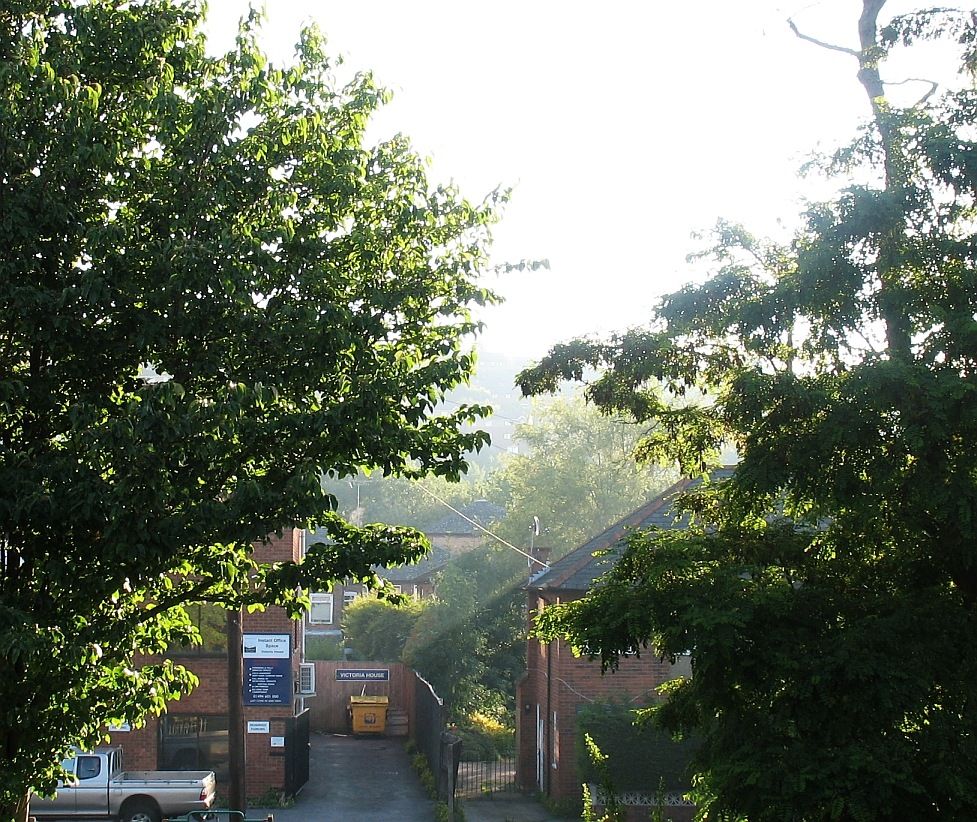
I got off the bus in Uxbridge, heading for the Grand Union Canal. It just seemed like a good idea on a day like this, to take that kind of a stroll. I discovered that to reach the towpath (where carthorses once used to pull the heavy-loaded barges between London and Birmingham) I had to sidle down an alley beside the Xerox building, where I’d worked on a contract in 1974. This was where the unconscious delivered me, on this sunny day! This was the very spot on the map, the spot marked “X” for Xerox, where my life took a major turn, in the summer of that year. There’s a score of ways I could explain that turn, but again for your sake and mine I’ll pass over the details. Suffice to say that point X marks the spot where an acute spiritual malady (let’s label it a) calcified into a chronic physical one (let’s call it b). Let’s assume that Nature knew what it was doing. Without asking permission, it bundled me roughly into a straitjacket of its own devising, to prevent me damaging myself further. I am grateful that it worked, but Nature takes time, as any tree bears witness (like this one outside my window, its leaves currently backlit by the morning sun). It’s especially so if you’re the kind of person who obstinately keeps on going when you know you’re lost. Then it levies a heavy tax on your available lifespan. In my case,
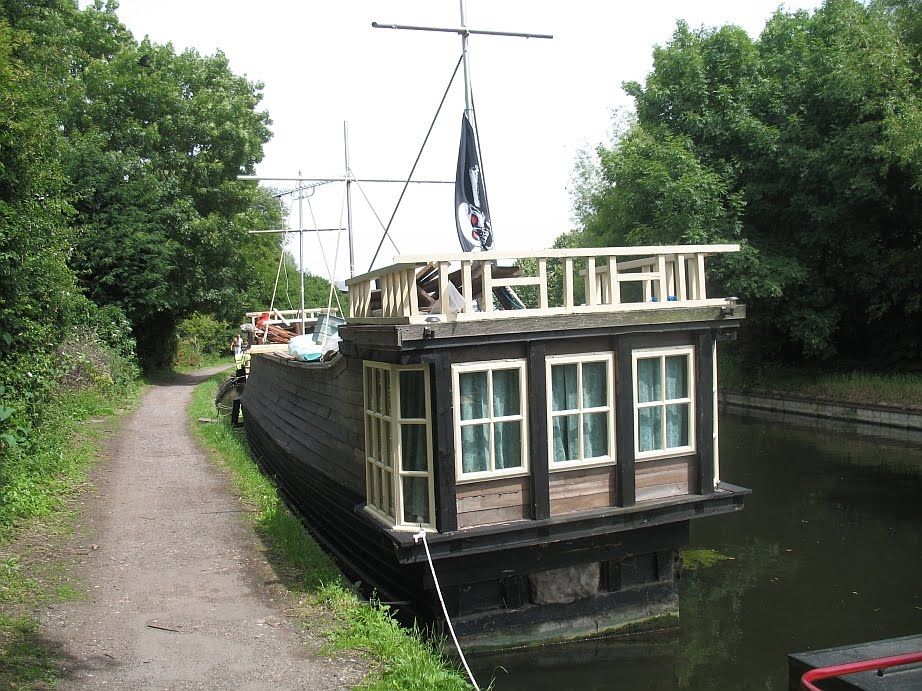
As I wandered down the towpath I encountered a barge, faked-up into the swagger of a pirate ship, complete with skull-and-crossbones flag. Barges are moored sometimes permanently along the canal sides. Once used for freight they’re now adapted as holiday homes, or even permanent residences: expressions of their owners’ dreams, or even their owner’s children’s dreams.
 “Only the eyes we use for dreaming truly see.” Like Pessoa I’m addicted to the dreaming of vicarious experience, provoked by my own past, or the Experience of my current alter ego, Martin Amis.
I wanted to finish with more from Pessoa, but won’t risk it again, not after my last post. My veneration for that author and his translator stands solid, but I admit Amis has the snazzier way of describing the unconscious mind. This time, I’ll let him do the job of paraphrasing the storms and wrecks of my adult life (the ones I have carefully failed to describe above).
“It was a bad plan, but it had worked. My respect for the unconscious mind continues to grow. My unconscious mind might not have thought of the plan either, but it worked round that, and made its preparations. Really, the conscious mind can afford to give itself a rest. The big jobs are done by the unconscious. The unconscious does it all.”
 a wayfarer’s notes
“the Experience of my current alter ego, Martin Amis”. My ego must have altered. I’d bought lots of novels by Amis but I recently ditched them out of disgust. The worst of all was a comedy called “Lionel Asbo”, which is hard to find online, and not mentioned on Wikipedia. ASBO means “Anti-social behaviour order”. If I recall correctly, Lionel has no conscience at all, and on one occasion has sex with his grandmother. There’s a repetitive phrase: “Who let the dogs in?” and we are led to believe that his pit-bull terriers have got in the flat and made off with a baby,
But his other novels push boundaries in many different ways. I remember recommending his Money to an online friend, but that was then. Here’s a review.
LikeLike