
To mark a double celebration, we took a few days off in Lisbon, a city of beauty and charm which I’ll try and convey in snapshots rather than words.
Click on any picture to enlarge it.
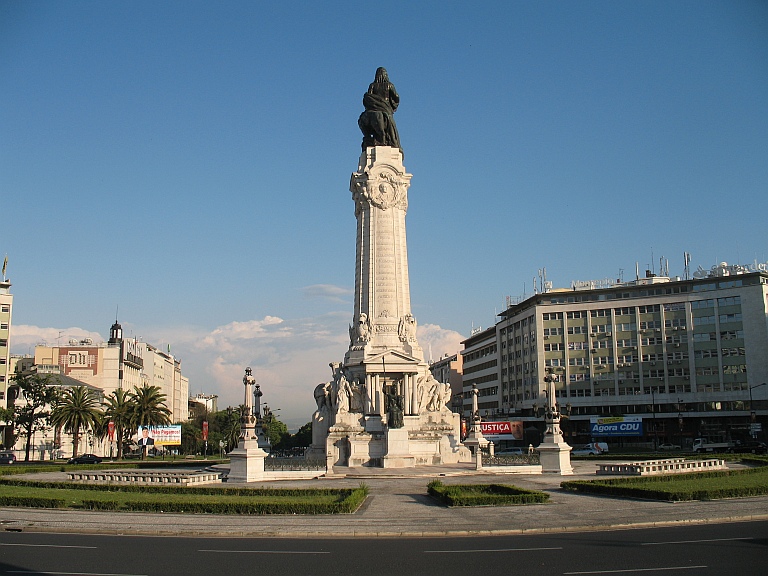
Our hotel was not far from the great Praça do Marquês Pombal, above. I didn’t discover who the Marquess of Pombal was till I could look him up in Wikipedia.

He was as important to Portugal as his monument implies. His bronze effigy gazes in perpetuity on the city whose rebuilding he supervised after the earthquake of 1755. Two noble presences, each with an impressive mane—Pombal and his attendant lion— gaze over the horizon to a Portugal he helped free from the influence of Jesuits and their Inquisition.
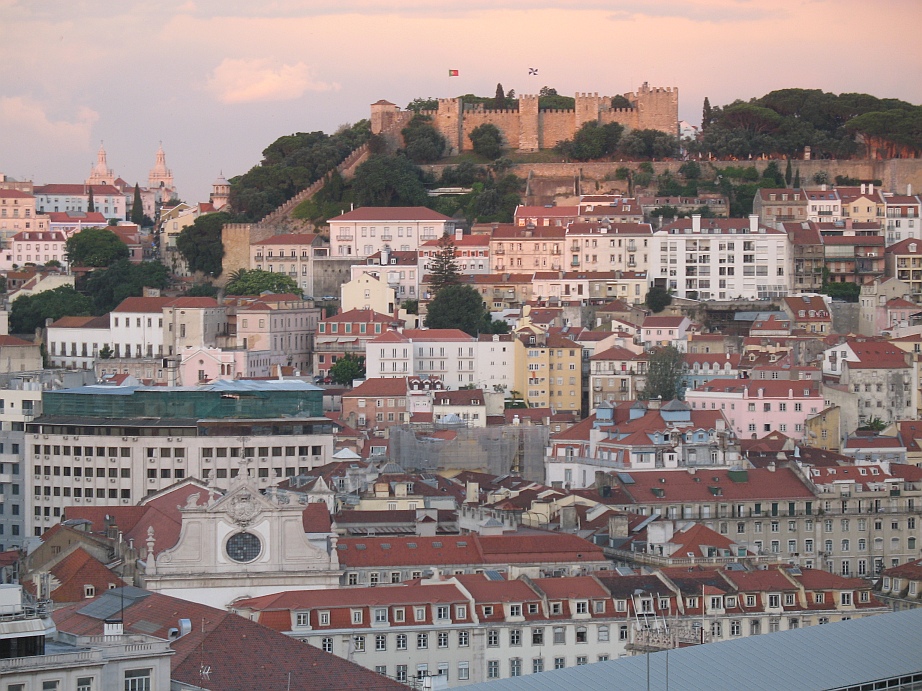
I suppose this castle survived the earthquake, but confess we made no study of history whilst there, and never stepped into a museum. There was too much to admire by just wandering around the streets.

For example the Santa Justa Lift (1902), Lisbon’s riposte to the Eiffel Tower. K had originally suggested a visit to Paris, but we were glad to come to this more beautiful city, about which we had known nothing, and discover it for ourselves.

We would have hated to see a bullfight, but this arena, glowing in the evening sun, was lovely from the outside.

There were so many beautiful buildings.
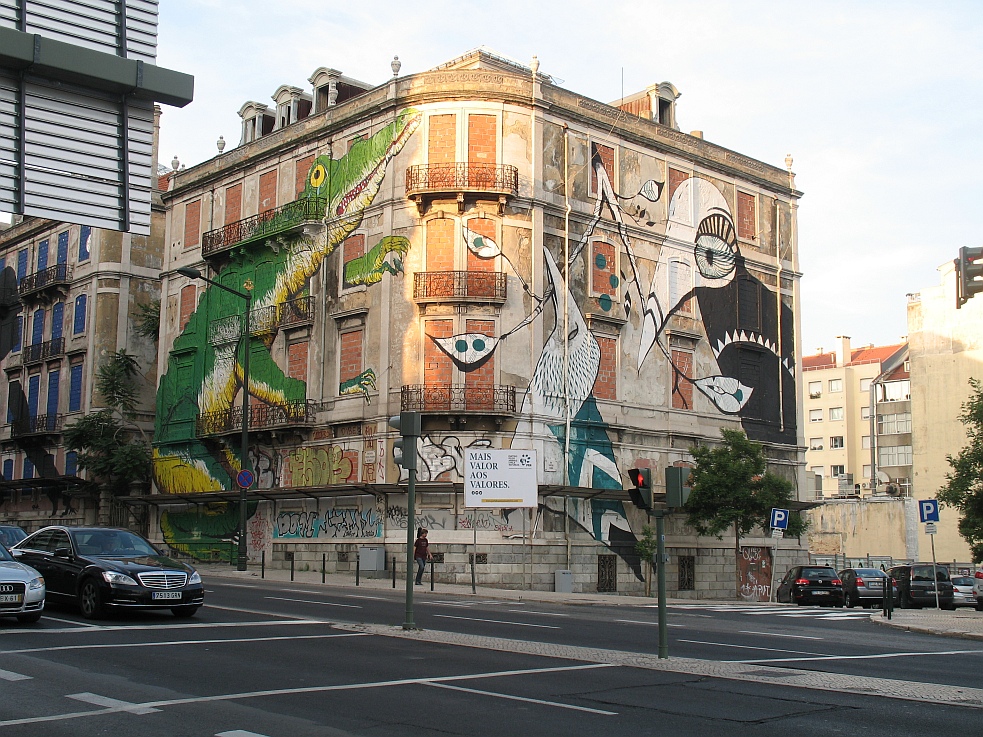
Uninhibited art is everywhere in Lisbon, like here, turning a derelict building into a statement. I don’t know what it’s trying to say, though.

I had heard of the trams and was keen to go on them. You can get a cheap 24-hour ticket, good for all types of public transport within the city, so you can hop on and off at will.

Trams can clank and scrape up steep inclines and tight bends, while sharing the cobbled streets with other vehicles. Our driver had to shout to some of them to clear our path, and we got past a jutting parked car with half an inch clearance. I recorded a soundtrack, but it hardly captures the quality of our old-fashioned journey. You had to be there. For major routes on level ground, they have modern trams. They are big, articulated and dull. When it comes to ‘new meets old’, I prefer the outrageous disrespect of graffiti on a transport heirloom, above. Commissioned artwork or lawless vandalism? I can’t decide. Same goes for the crocodile and bird on the building, above. And that is how it should be.
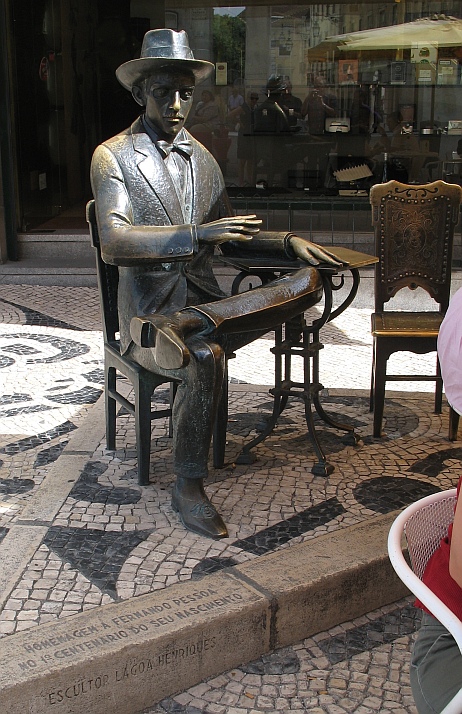

We found an international bookshop with some volumes by Fernando Pessoa in the window. I’ve written before about this famous Lisbon writer, my literary idol. I enquired about his statue, which I hoped to see whilst we were in the city. It was a few yards away. Hospitable even preserved in bronze, he keeps an empty chair, where one can sit beside him, and be photographed together.
 a wayfarer’s notes
Vincent,
I enjoyed the photos. Did you enjoy their food? Also, could you communicate without speaking English there? I thought perhaps you could communicate with people there since Portuguese is similar to French. But maybe most Portuguese speak English. Is that right?
LikeLike
Hi Keiko, yes we enjoyed the Portuguese food very much, though we ordered only simple meals. One day we had a Chinese buffet.
I can speak French & Italian (which is rather close to Portuguese in structure, though different in pronunciation and spelling); K is reasonably proficient in Spanish. But we didn’t attempt those languages. I had downloaded a Portuguese phrase book to my Kindle, and it helped a bit. In fact, we could have spoken English exclusively but wished to be polite and use Portuguese. The room number at our hotel was 102: cento e dois. It took several days before I pronounced it correctly! Something like sentoo ee doish.
A surprisingly large number of the people we spoke to didn’t have Portuguese as their original language, so it was a kindness all round to use English, the new European lingua franca!
LikeLike
cento e dois.
Hmm. I wonder if cento is 10, and e is yi which means “and” and dois is dos which is two in Spanish. But you don't say “ten and two” in English for 102, do you? We usually say either one hundred two, or one o two. Maybe, Luciana can teach us, I hope.
LikeLike
Not yi but y. I think my head is mixed up with Chinese pin yin.
LikeLike
cento = 100
LikeLike
Vincent,
I should have checked it, but thank you. It's a bit different but a coincident that sento (千と)in Japanese means “1000 and.” Sen (千) means 1000, and to (pronounce toh) means “and.”
LikeLike
wonderful photos, thanks for the vicarious journey!
LikeLike
Best wishes for your double celebration.
These pictures make me want to visit Lisbon.
Trams are great. We had a really good experience using trams in Istanbul.
Graffiti is universal, much of it is crap. Now and again you come across some gems that are better than visiting hanging frames in a formal art gallery. They live and and move with life.
LikeLike
Vincent, you visited Fernando Pessoa´s Lisbon! Great pictures!
“sentoo ee doish” is perfect. I actually pronounce it “doiss”, but I´m a Brazilian gaucho lady. 😉 I guess “doish” is just right for Lisbon.
Keiko, 100 = cem [sein], but if you add 1 or more it becomes “cento” :
100=cem
101=cento e um
102=cento e dois
and so on.
LikeLike
Lu,
That's interesting. So, it's like a conjugation and “to” and “e” are redundant. One of “to” in Japanese means other or outside. It sounds as though they are related, but it could be also a coincident.
LikeLike
ZACL,
About graffiti, I haven't confirmed the current status, but as far as I know China doesn't have the tradition.
LikeLike