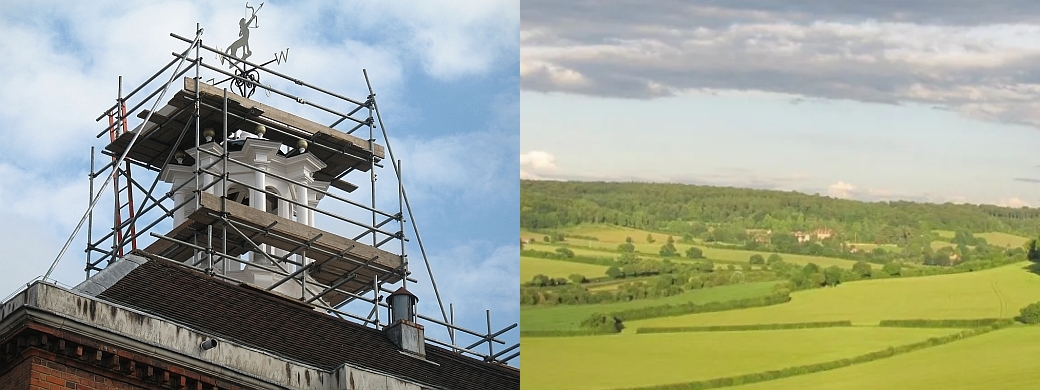

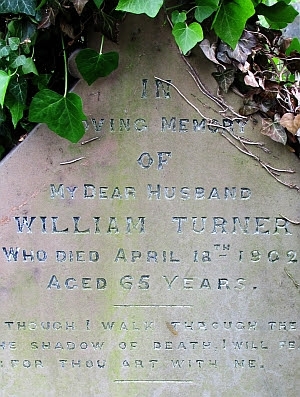
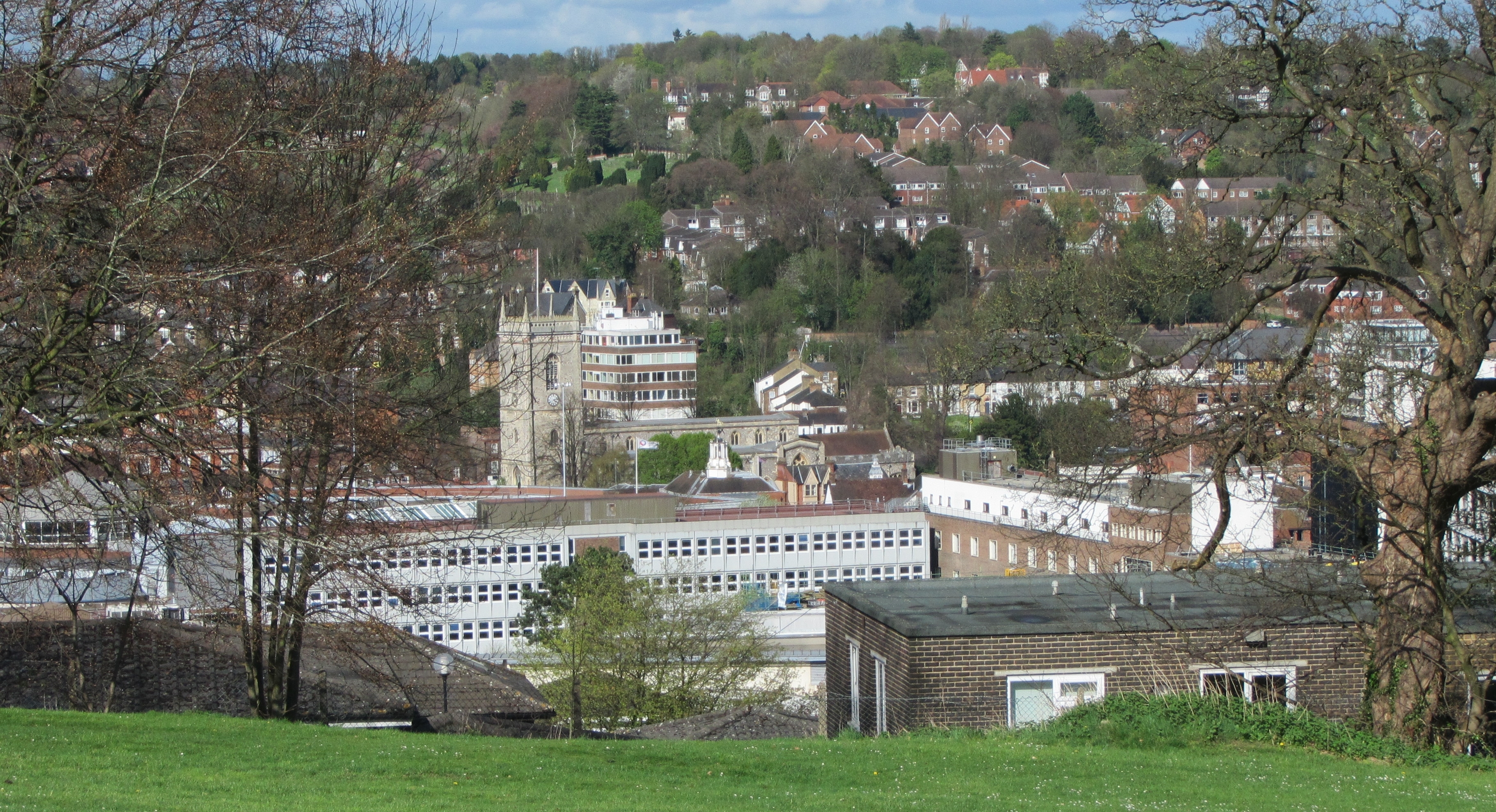
The emblem of this blog is a weathervane with a gilded Centaur, standing above a cupola on top of the 18th century Guildhall, in the market square of High Wycombe, built where two main valleys cross. There are smaller valleys too. Wherever thou goest, thou canst lift up thine eyes unto the hills, like the Psalmist; or you can catch sightlines from one hillside to another, wherever trees and houses permit. If you can see from here to there, it follows that when you go there, you can see back to here. But there are obstructions. You can’t see everything at once—which is a bit like memory. It only gives you a partial picture.
The other day I stepped out to buy a loaf of bread, intending to take the Valley Path to an out-of-town supermarket at Loudwater.

Along that route the hypnotic rhythm of my own strides, the whispers of weeping willows, the rippling of streams or the bubbling-up of springs have sometimes helped put me in a Zen-like state of no-mind. In such a state my inner eye has seen images of the past; I have mused on the state of the world, or the nature of God and angels. Occasionally I’ve had brief insights of profound meaning, as if a crack suddenly opened up letting me see beyond the surface of things. Afterwards I’ve tried to convey something of those moments here, to construct meaning as sunlight on raindrops constructs a rainbow. One of those posts was called “Infinite are the depths”. The wonder of the written word is its ability to capture evanescent impressions indefinitely. It’s as near magical as anything, but the imperfect words cannot release what they have captured until a reader comes along who can fill in the gaps from personal experience and catch the drift. One would like to think it happens pouf! just like that and sometimes it can, but only against a background of painstaking process on both sides, writer’s and reader’s.

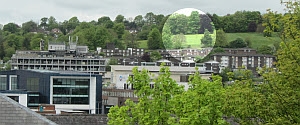
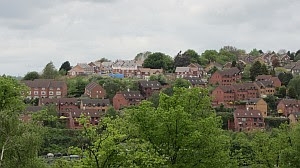
It so happened on this occasion that my feet balked at going on the valley path to Loudwater. I bought the bread from a nearer shop, with two bottles of Old Empire IPA, then lifted mine eyes to the opposite hillside, site of the municipal cemetery, a place of public remembrance. These days, the burial of bodies is secondary. It holds personal memories for me, though nothing to do with anyone deceased. I recall walking there with my younger son when he was four years old, and we made up a little game. He was just starting to read and the thing was to pick out his name William from among the weathered tombstones. Our house backed on to the cemetery gates. You can almost see its windows from photo (b). Later, when I wasn’t well enough to walk far, I could go there and sit on a bench to watch him and his sister learning to ride their bikes on the wide path. Or I might sit in a grassy hollow, leaning on a tombstone at sunset, gazing at the view in photo (e), letting my eyes walk where my legs could not. Few of the houses you see there had yet been built.
What is time? It seems like an invisible plate-glass window. With eyes of remembrance we may or may not be able to see through, but we can’t go there bodily. We’re trapped within glass walls, some semi-transparent, some frosted; some shaded with blinds against the future’s intolerable glare.
I love Wycombe for its connectedness: its views which bridge the little valleys; its people whose places of origin bridge the oceans; its seagulls who have immigrated inland; its red kites who were extinct in these parts till they were reintroduced. I love it most of all because I live here, and here is the place where I learned to love.
To get to the cemetery I’d walked up a street with a timber yard on one side, a repair garage on the other. For some reason I suddenly thought of all the years I was wedded to the teachings of an ignorant guru.
I call him ignorant from honesty, not resentment, neither for his false pretensions nor my own gullibility.
I ain’t a-saying you treated me unkind
You could have done better but I don’t mind
You just kinda wasted my precious time
But don’t think twice, it’s all right.
If our paths should ever cross again, that’s how I would like to greet him, impersonally, in words borrowed from Bob Dylan. He gave out some venerable techniques of meditation & preached their virtues with various Sanskrit terms & passed-down Indian stories. The techniques were to “turn your senses inwards” so that you could connect your consciousness to the undying reality, & thereby rise above all loss & death. Not Buddhism exactly, but that kind of thing.

In retrospect I see that the remedy was worse than the disease, for its side-effect was to encourage the devotee to be dead to the world, sometimes in chilling ways, which I shall not elaborate, except to speculate that it was a contributing cause of my own illness. Echoing Nietzsche, I give thanks that it didn’t kill me, but made me stronger.
Now, I can see from here to there, just a bit, on a far horizon, but there are various obstructions in the way, I can’t see everything. So could I see myself here, from there? Could I look across the valley of time into the future, and see myself here, now? That’s the peculiar thing about time, it doesn’t work like space. The future’s not ours to see, Que sera sera. And yet there is not chaos. Spring comes. Cherry trees blossom. Tomorrow comes. Predictability, I would like to say, comes from design, and design comes from creativity, whether human or otherwise. And it all works through remembrance.
From birth on, the “I” is built and elaborated from remembrance of yesterday’s “I” and all its encounters with the world—which is built from the same clay. We are shaped by the same hand of Nature, by the impulsion that was once called God, now Evolution.

The past is imprinted on everything, not in its original form, but as if copied endlessly by fallible monks reproducing illuminated scriptures: improved or made worse. The landscape around me preserves memories of its Victorian past, though no-one’s still alive from that era, only some of the trees, and they don’t speak of what they’ve seen. Remembrance is embedded in the brickwork. It should be the biggest part of education, to respect the past.
Across the road from my house, my personal sun-dial factory is being rebuilt, from the inside, to make student accommodation They’ve excavated some of the middle shed, taken concrete & soil away in lorries, then today a cement mixer came. They’ve filled up the trenches for foundations to new walls facing inwards to a courtyard, where Himalayan birch trees will be planted and students will lounge about taking the air.
As I see it, the more there is change, the more there is remembrance. What makes life sweet is the very fact of its transitoriness. It was ignorant for the guru to say breath was the only thing we could rely on as long as we lived, and a worthy object of meditation. Forget the breath. It is automatic. No! Let me live in uki-yo, the “floating world” of all that passes, which in Japanese is also a pun for another word meaning “melancholy”. There is nothing melancholy about a life lived to the full, which is to live now and in remembrance; for time is transparent to eternity.
This post is for Joe—a new correspondent with an exceptional knowledge of this blog. When I set out to buy that loaf of bread, I had him in mind. His remarks encouraged me to set out with a definite intention, to find some inspiration and report back—an intention which partially dissolved in the fresh air. The following day, he wrote:
I have only recently (in the last six months) begun to reflect in earnest on many of the same concepts as you have. . . . Perhaps I’m simply looking at fundamental questions such as who I am, what is going on, where I am going and how to determine what paths are no longer worth treading. Does that resonate with you or even make sense?
Yes and yes. This is by way of reply, illustrated with my own example of a path no longer worth treading, and a perspective to look at and from, literally and allegorically. Thank you for pushing me out of the door that morning.
And I’d also like to thank Chris. Twenty years ago, he was my milkman, in the days when we still had milkmen. It was a temporary job for him, I should say, and he was polyglot even then, for we sometimes spoke in French, & he started teaching it to the children.
The other day I was bound for another place of remembrance, the parish church of All Saints. You can see it best in photo (h). But I bumped into Chris first and we went to the pub, and amongst a million other things he told me about The Tale of Genji, which I believe he’s read in the Japanese (in a Romaji or Romanized version). And so I learned of the “floating world”. Synchronicity again.
 a wayfarer’s notes

