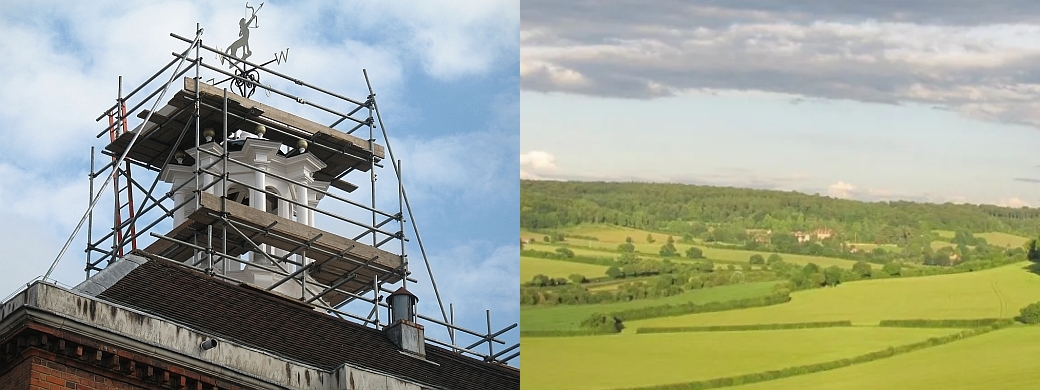


I’m on this path. I don’t know how far I’ve been, I don’t know where I am on the map. I hear planes criss-crossing distantly above the fog. I’m on the crest of a slope, looking out on rows of stubble, which bristle in parallel stripes over the curved surface of the fields. The landscape is wild, hardly a human habitation to be seen, yet deeply scored and shaped by human purpose: for example this footpath, which goes off in straight lines across the piece with a self-important certainty. It cuts across a road hidden in the fold of the valley, then continues true to its original purpose, which no living person may remember, for it ends up in a wilderness which I can’t identify. Sure, there are signposts, but most of them are worn and bleached by time, except those which say “Footpath” or “Bridleway”, which doesn’t help establish where on earth I am.
From a height I see the landscape laid out like a map. I feel a connection with it, as to some unidentified, half-remembered fragment of my own past. All I can see is that everything has its agenda: these blue-green wild-plants spread flat, star-shaped in the meadow between the stubble-stalks, catching droplets of dew, or perhaps this continuing drizzle they call “Scotch mist”, so thin and steady that I’d forgotten about it till this moment. Surely, I too have my agenda, pursuing it diligently like every other force of nature.

Why else am I drawn to cross this landscape and record my thoughts, producing these “Records of a Weather-exposed Skeleton”*? For I’m out in the weather, wondering why I am here, I mean here on earth, not just this moor; exploring my provenance and destiny, not with any focused purpose, just making incidental discoveries. I’ve never plotted my path far ahead. It’s against everything I stand for, to do such violence to the delicate intake of sense and impulse, as to pursue an ambition and force myself to follow the course set by conscious intellect. People certainly do that: they crash through the undergrowth of indolence and self-indulgence by sheer force of will, and seize their due prize, Success. But a mysterious inner part of me, which gently rules, views such an approach with horror.
Amongst the more literary signposts I stumble upon — long may life reveal itself in such a fashion! — is this, from Pilgrim at Tinker Creek, by Annie Dillard:
I am sitting under a sycamore by Tinker Creek. I am really here, alive on the intricate earth under trees. But under me, directly under the weight of my body on the grass, are other creatures, just as real, for whom also this moment, this tree, is “it”.
. . .
Hasidism has a tradition that one of man’s purposes is to assist God in the work of redemption by “hallowing” the things of creation. By a tremendous heave of his spirit, the devout man frees the divine sparks trapped in the mute things of time; he uplifts the forms and moments of creation, bearing them aloft into that rare air and hallowing fire in which all clays must shatter and burst. Keeping the subsoil world under trees in mind, in intelligence, is the least I can do.

* There is this from the poet-monk Bashō, patron saint of this blog:
Determined to fall
a weather-exposed skeleton
I cannot help the sore wind
blowing through my heart.
After ten autumns
in Edo, my mind
points back to it
as my native place.
PS I think I’ve worked out where I went, and where the footpath led from there on: to a cemetery and disused pit. Apt enough. We are all on that pilgrimage. Still, something doesn’t seem quite right. Probably my map-reading. Real life never seems the same as what’s written down.
 a wayfarer’s notes
I didn’t have a camera with me on the walk, but went back today to take the photos. The weather was different but not enough to invalidate the snaps as suitable illustrations.
LikeLike
With thanks to Steve Law for introducing me to Annie Dillard. He says my writing reminds him of her. I only wish I could write as well as Annie! But there is a similarity: not so much in writing about Nature, for she is a naturalist above my aspirations; nor in the way she writes, for she’s much more professional. But we both see Nature as the door to a mystical reality, as my quote from her demonstrates.
LikeLike
Wow that first picture at the top! One of the most hauntingly powerful ones I have ever seen.
I agree with assisting God. I think she needs our help in figuring out why she did all of this. I am happy to give my opinions to her.
LikeLike
oh … Annie D. Yep, sort of, but not the same. Keep walking .. one foot in front of another .. where they lead, we know not where. Joyous.
LikeLike
Beautiful picture of green hills with lovely trees, the second from the top.
For sure we are all part of God participating in His plans (or Her as Raymond would put it) or busy with plans of our own. We have the freedom to choose.
There is a post along these lines that i hope to write someday.
LikeLike
“Real life never seems the same as what’s written down.”
I chuckled at the truth of that. What's written down seems purposeful, a map is an explanation. But often the truth behind the path (or life) is too ancient to explain.
I, too, love to read Annie Dillard. There is an Amish farmer who writes beautifully of nature – his name slips my mind, but I'll find it and send it to you.
LikeLike
[…] “I’m on this path. I don’t know how far I’ve been, I don’t know where I am on the map. I hear planes criss-crossing distantly above the fog. I’m […]
LikeLike