

Le Mythe de Sisyphe: essai sur l’absurde
Albert Camus © 1942 Éditions Gallimard
Translation © 2010 Ian Vincent Mulder
Continued from extract (1):
So what is this mysterious feeling which deprives us of vital sleep? A world explicable with reasons, even if they are bad reasons, remains a familiar world. But take away the illusions, the guiding lights. Suddenly you could be a stranger to your own life, exiled with no way back: no memory of home, no hope of a promised land. This divorce between man and his life, the actor and his surroundings, this is the feeling we label the Absurd. Every healthy man has considered suicide at some time. Without any further explanation, we can link the feeling with the urge towards nothingness.
We’ve arrived at the topic of this essay: the link between the absurd and suicide; the exact degree to which suicide is a solution for the absurd. Let’s suppose that a man who’s honest with himself runs his life according to what he believes true. Belief in the absurdity of existence will then rule his conduct. It’s legitimate curiosity to ask ourselves, clearly and without false sentiment, whether such a belief demands a speedy exit from a situation that makes no sense. Jump or don’t jump? The required answer is a straightforward “yes” or “no”. I speak here, of course, of those who tend to live congruently with their own selves.
To put it plainly, the problem is simple—and yet insoluble. For it’s wrong to assume that simple questions have equally simple answers, and that evidence implies more evidence. A priori and reversing the terms of the problem, just as you do or don’t kill yourself, we could say there are only two philosophical solutions: that selfsame “yes” or “no”. But that would be too easy. We must have consideration for those who keep asking, without ever reaching a conclusion. I am being slightly ironic here: they constitute the majority. I see also that those who answer “no” behave as if they thought “yes”. In fact, if I accept Nietzsche’s criterion, one way or another they think “yes”. And yet, of those who have committed suicide, many were convinced that life has a meaning. Such contradictions crop up constantly, never more keenly than on this point, where you would think the guidance of logic would be most desirable. There’s nothing new in comparing what philosophers have said with how they have behaved. Still, it is worth saying that of the thinkers who denied a meaning to life, no-one but Kirilov (a fictional character), Peregrinos (a figure from legend), and Jules Lequier (whose suicide was never firmly established)—no-one but these followed their own logical conclusion and refused to go on living. In order to mock him, people often quote Schopenhauer who sang the praises of suicide whilst sitting at a well-stocked table. It’s not a laughing matter! It’s no big thing to be flippant about tragedy, but those who do may be mocked themselves one day.
Faced with such contradictions and mysteries, should we then believe that there’s no connection between one’s view on life and one’s manner of leaving it? Let us not overstate the case. A man’s attachment to life exceeds all the miseries life can throw at him. The body’s decision outbids the mind’s, and the body recoils from annihilation. In each of us, the habit of staying alive precedes learning how to think. In this race which daily takes us a little closer to death, the body maintains its invincible lead. At bottom lies an evasion, because it is both less and more than diversion, in Pascal’s sense of the word (1). The deadly evasion which forms the third theme of this essay is hope. To hope for another life earned by merit in this one, or the self-deception of those who live not for life itself, but some great overarching idea which purifies—this gives meaning to life, yet ultimately betrays it.
So, many factors play their part in clouding the issue. Till now, we’ve played on words, toying with the idea that finding life meaningless leads inexorably towards declaring that it’s not worth living. In fact there’s no necessary relation between the two. All we need do is steer clear of being distracted by the confusions, separations and non-sequiturs already noted. We must set these to one side and go straight to the main problem. One kills oneself because life isn’t worth the trouble of living: here is our truth—sterile truism as it may be. But can this insult to existence, this ultimate denial, arise from existence itself being senseless? Does life’s absurdity make us seek escape in hope or suicide? This is what we must pursue and illuminate, setting aside all the rest. If the absurd demands death, then this problem demands we give it priority over all other ways of thinking, all dispassionate mind-games. The fine distinctions and psychological approaches that an “objective” mind always manages to bring to every problem, have no place in a passionate quest like ours. All we omit is an unjust thought, I mean a logical one. It’s not easy to do that. It’s always easy to be logical; but it’s almost impossible to remain logical to the bitter end. Men who die by their own hand follow their feeling headlong to the end. Reflecting on suicide prompts me to put the only question I find interesting: is there a logic which goes all the way to death? I can only know the answer by pursuing it on the evidence, free from disordered passion. I shall use the form of reasoning I set out here: I call it “absurd reasoning”. Many have begun along this route, but I don’t yet know if they have persevered to the end.
Karl Jaspers, explaining that it’s impossible to treat the world as a unified construct, exclaims, “This limitation leads me back to myself! I cannot hide behind the pretence of an objective viewpoint. Neither my self (my I) nor the existence of the Other can be the object any more.” In this, he conjures up, like others before him, that arid desert where thought reaches its furthest limit. Like many others, certainly, but how anxious they were to get out of there! To this final bend in the journey, where thought falters, many have arrived, amongst them some of the humblest, who let go of what they held dearest: their own lives. Others, princes of the mind, let go too; but it was a suicide of thought, the purest form of revolt. The real effort, by contrast, is to stay put, to the extent one can, whilst inspecting the bizarre vegetation of these far-flung regions. Those who are tenacious and clear-sighted take their privileged seats at the gladiatorial contest where Hope, Death and the Absurd engage one another. It’s a dance, basic yet subtle, in which the mind can analyse the steps before doing them, before enacting them in real life.
Notes
1. “Man finds nothing so intolerable as to be in a state of complete rest, without passions, without occupation, without diversion, without effort. Then he faces his nullity, loneliness, inadequacy, dependence, helplessness, emptiness. And at once there wells up from the depths of his soul boredom, gloom, depression, chagrin, resentment, despair.” Blaise Pascal, Pensées. [Translator’s note]
 a wayfarer’s notes
Vincent said…
I have never considered it, but I do consider myself healthy.
It’s a salutary reminder that Camus, like every non-fiction author, speaks for himself. It’s not necessary to agree with him to find his thought interesting.
Luciana said…
Sometimes I think some kinds of heavy depression and suicide may be linked to the absurdly high expectations people have in their search for happiness.
When Camus says that even knowing life has a meaning some people consider it´s just not worth living, I can´t help but think of those who spend their lives trying anxiously to find happiness at any cost, and then end up not living.
Life can be disappointing, absurd, and monstrous sometimes. That´s the way it is. And we should allow ourselves to grieve when it is.
Not being pressured to be happy, we might come to realize that living life fully is what really matters, and then it becomes worth living.
raymond said…
For me the equation is simple. I tell my complaining self that suicide is throwing out the baby with the bathwater. Both the baby and the bathwater are far too interesting to do that sort of plumbing.
Vincent said…
I see from remarks on this and my previous post, that there may be myriad reasons why we reject the suicide option.
I’m planning to put down my own thoughts on this, and perhaps become a philosopher too!
Hayden said…
Despite the clarity of your translation I find it hard to follow him at times. When he declares that there is no necessary connection between finding life meaningless and committing suicide, and then shortly after “puts these aside” – is it the idea that there is no connection that he is putting aside? For to me, looking with today’s eyes, that is at the heart and cannot be ignored, for it has the potential to destroy the argument in it’s entirety.
His assumption appears to be that without hope or meaning, life is intolerable and therefore must lead to suicide if one is rigorous about following philosophy. One could as easily say life is absurd and without meaning, but filled with wonder and delight, and it is the sheer adventure of wondering “what’s next?” that is reason enough to live another day.
I recall that I was quite embarrassed when I finally shook off my depression and sense of the absurd, for at the core it then seemed I had been staging a giant temper-tantrum. The real message seemed to be “if I can’t have life the way I want it, on my terms, I don’t want any part of it!” That seems now to be a very adolescent attitude. The world can also be a place of wonder and joy if we decide to seek it.
It does seem that our modern way of living masks that, by isolating people from each other and nature and convincing them to work very hard for things that have no intrinsic value.
Vincent said…
When he says we must set these things to one side I think he refers to “playing with words” and “toying with the idea that…” In fact he’s been holding a discussion with the reader so as to survey the territory and let the reader catch up with his thought, ready to appreciate the significance of his statement “One kills oneself because life isn’t worth the trouble of living: here is our truth–sterile truism as it may be.”
In the excerpt published in this post, you’ll note that he calls hope a “deadly evasion”.
On the other hand he does acknowledge that meaning is crucial in the equation which makes us decide whether to end it all:
“To die from choice presupposes that you’ve instinctively recognised how pathetic it is to live just by habit, devoid of meaning, enduring each day’s crazy turmoil, and the uselessness of merely putting up with it.” (see last sentence of the previous excerpt).
Vincent said…
Opening the currently published translation (my own has not gone far enough yet) I find this:
“I am not interested in philosophical suicide but rather in plain suicide. I merely wish to purge it of its emotional content and know its logic and its integrity.”
It certainly appears to me that mood, not logic, is the key factor in suicide. I lie awake for three hours in the middle of the night, and fail to find sufficient meaning in my life, to guide me into one course of action or another. It disturbs me. The next day I walk out on an errand—trivial, not meaningful—and it takes no more than fresh air and weak sunshine to restore my joy in living.
I haven’t found the meaning that I diagnosed as lacking in those insomniac hours. But my mood has changed.
Luciana said…
Vincent, no one becomes a philosopher. You can study philosophy for years, but It’s either in you or it’s not. In my case, it’s not. The way I’ve found to hold life in my hands is art, either by comsumption or creation. What’s your way?
Vincent said…
My way is to become what I’ve always been, by a process of discovery!
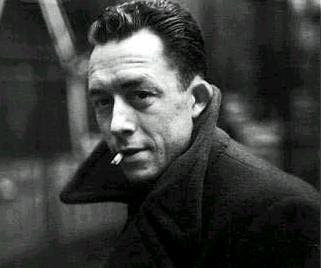
As for the photo, I always try to illustrate each post with a relevant picture. To me a philosopher must be seen as a whole person, the writing being just a creative by-product of the life.
Hayden said…
yes, I did see that, but it precisely names my objection. The underlying assumption is that each day is crazy turmoil and useless and must be put up with.
If one says instead (and believes, not simply posits it as argument) that life is without meaning, but, oh-by-the-way, for the most part it’s interesting, gorgeous, fascinating and fun and sometimes makes me simply laugh out loud from surprise….. the entire interest or desire for suicide leaves the building.
Life still has no meaning, but instead of something one endures, it is something that is delightful on it’s own.
In this view of living, absurdity itself is shrugged off as meaningless.
Anonymous said…
By George! I think she’s got it!
brad4d said…
Any thought of doing harm to anyone repulses me but I must exercise my repulsion to understand living so I subject myself to movies, tv & other stories for surrogate experience.
brad4d said…
Vincent said…
And yes, that surrogate experience is important. I used to avoid movies containing violence & lurid crime, but I’ve seen more recently that some of them are not designed to excite the audience by these means, but to convey an anti-violent message. I think of, for example, The Hurt Locker and Clint Eastwood’s Gran Torino.
As for wishing death on someone being symptomatic of suicidal tendencies, you might be right, especially in the circumstance you relate. I tend to think that any act of recklessness shows suicidal tendencies.
brad4d said…
I recently read The Parable of the Sower by Octavia Butler that was a journal of a girl with a hyper-empathy disease from a mother that took “intelligence” drugs. . .
brad4d said…
Vincent said…