

In the beginning was the void. How big was it? How long did it last? It’s impossible to say because time and space had not yet been created. Let’s imagine it as an empty matchbox. The Prime Mover, impatient for things to start, opened the box and the void escaped like a genie from a bottle. Time, space, matter, energy all came into existence.
Matter divided into elements, gases at first, coalescing into hot stars, and sometimes planets. Some parts hardened into rocks, the rest slopped around in a chemical soup, tethered by a newly invented force, gravity. “It is good”, said the Cosmic Intelligence to itself.
On a planet of days and nights, excited elements danced all day in the chemical soup, excited by the warm rays beamed from the local star, and by close proximity to one another. Randomly following their impulses—attracted here, repelled there—they endlessly swapped partners and formed gangs. Not the Montagues and Capulets, the Sharks and the Jets, but the Alkalines and Acids. When they attacked one another, debris was formed, resulting in new compounds of varying stability.
Thus it was that the Amino Acids became dominant, a tribe noted for their endless variety of structure, which folded up into braids called proteins. By some mysterious transformation, these formed into organisms. Thus was born Life.
Life differs from simple rocks, gases and water. Its characteristic is to generate individual organisms which come into existence and then die. Instead of being constantly created from scratch, they reproduced themselves, in endless generations. Successive generations were more complex and better adapted than the ones before. This came about through sexual differentiation—each organism being either male or female. The new generation wasn’t just produced from the production of spores, or eggs, from an old organism before it died. It resulted from a reproductive act, an act of creation as extraordinary as the one which brought forth something from the void of nothing at the beginning of time.
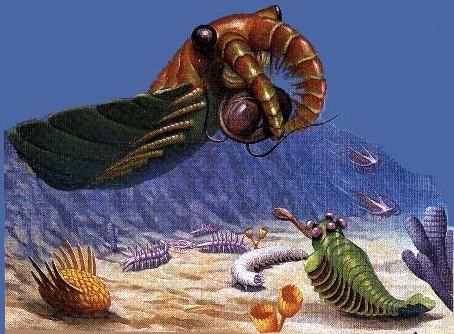
And so there were animals, which miraculously developed into a teeming variety of unlikely shapes and habits of life. My illustration shows an artistic reconstruction of some of the creatures whose fossil remains were discovered in the Burgess Shale, in the mountains of British Columbia, Canada.
Somehow or another, the various lineages, branching over the generations, produced hominids (great apes) and then the genus Homo, of which you and I are the species homo sapiens sapiens. A characteristic of our species is to accumulate hereditary lore, not all of which is wisdom, for it takes many generations to winnow the grain from the chaff. By the time I was born, and grew to absorb some of it, Sigmund Freud had come and gone, leaving his mark which inspired Ernest Becker (see my previous post) to say this:
“Man is literally split in two: he has an awareness of his own splendid uniqueness in that he sticks out of nature with a towering majesty, and yet he goes back into the ground a few feet in order blindly and dumbly to rot and disappear forever. It is a terrifying dilemma to be in and to have to live with.” (Becker, The Denial of Death, p. 28)
Clearly his words have struck a chord with many, if not with me personally. He’s making a claim about the difference between man and the other animals and it prompts me to set out this, my own creation myth, that is, to summarise those parts of hereditary lore which make sense to me, and which I can live by.
Till recently I was writing a book of my own, entitled I am an Animal. It was well advanced, but I got stuck on the structure. I seemed to have produced a dinosaur, which could not adapt to the changing environment of my constantly developing ideas; or a winged bird too large for flight by some law of engineering unknown to me. And now I see that one of the (very many) weak points of my manuscript was its failure to adequately express what I meant by my title; and more generally my failure to express what I most profoundly wanted to say.
I usually find myself most grateful, in the end, to the person or idea I most mock at first. It is Ernest Becker who makes me see that my creation myth must address the difference between man and the other animals in a manner that’s cogent but also resonant. I need not worry about the science: my myth will inevitably reflect it, having been constructed in an ambience permeated with science, mostly transmitted through Wikipedia and BBC Radio 4.
Quickly and superficially, I scan the options for what differentiates man. Two-legged walking can’t be it, for the birds got there first. To the poetic imagination, it’s their ability to fly that excites wonder, not two-legged locomotion, which bestows no towering majesty. Skill with the hands, the ability to construct tools? It’s certainly important, but there are some parallels in other animals.
I conclude that the development of facial and laryngeal muscles that lets us talk, and a brain development which allows limitless elaboration of language, are the key factors. There is also the matter of soul. I started this blog with the question “Do fish have souls?” and concluded, in the five years since, that if man has a soul then so has every creature, so have the rocks, so has the air, so has the empty space, if there is such a thing. This, you may say, is God: except that I don’t see evidence of just one God, acting in a co-ordinated manner.
I’ve left my creation myth very incomplete. I still haven’t explained, in this my first attempt at a twenty-first century equivalent of a Kipling “Just So Story”, why human beings are so different from one another.
Nor have I explained why a profession has come into being where people like Sigmund Freud have laboured to try and cure the freakiness of their patients and themselves, and been listened to with some seriousness, even when they say things like this:
“What I have tried to do … is to suggest that the problem of heroics is the central one of human life, that it goes deeper into human life than anything else because it is based on organismic narcissism and on the child’s need for self-esteem as the condition for his life.” (Becker, The Denial of Death, p. 7)
Perhaps human beings are so different from each other that each of us compiles his own creation myth.
 a wayfarer’s notes
I meant to point out that man has evolved over a long time from organisms which evolved over an even longer time. Death was and remains of the essence, in the very concept of an organism. I have not yet found a satisfactory explanation, to include in my creation myth, of the phenomena observed and analysed by Freud.
But Freud merely offered a new explanation. Prior to his, we would have had to be satisfied with the Fall of Man, and Original Sin.
LikeLike
My own leaning is towards the kind of simplicity advocated by Chuang Tzu:
“Cut off sageliness, cast away wisdom, and then the great thieves will cease. Break the jades, crush the pearls, and petty thieves will no longer rise up. Burn the tallies, shatter the seals, and the people will be simple and guileless. Hack up the bushels, snap the balances in two, and the people will no longer wrangle. Destroy and wipe out the laws that the sage has made for the world, and at last you will find you can reason with the people.”
LikeLike
good explanation if you mind to explain a bit more. how about starting with the origin of the “Prime Mover”?
LikeLike
Hi ghetufool, I may be old but I wasn't around at the beginning of this fairy tale, to know any more information.
LikeLike
First, let me congratulate you on your break-through in understanding your material/structure. Re-writes are annoying but inevitable, and it sounds like you've got a deeper grip on your material now.
Second, I love this tale, this myth! I love the excited elements dancing in their chemical soup, the void escaping like a genie from a bottle.
Third, looking at the excerpts of Becker you provide, for myself I am drawn to focus on the intrinsic and unnecessary alienation between “human” and “other” that we've come to. We are animals, on that you and I fully agree. Perhaps, tongue in cheek, it would be useful to think of ourselves, vis a vis the rest of the world, as “differently abled.” We are not deer, with their hair-trigger senses and fleetness, nor are we fierce as wild boars, able to stand off most predators. We aren't ants or bees, with their ability to unite into a selfless, communicating whole. Nor are we plants, with roots that plumb the mysteries and fraternize with millions of micro-critters in the soil. Maybe it is fear of our difference that creates the alienation and the puffed up ego.
In human social groupings, when someone brags too much about their superior capabilities we know they feel deeply inferior and are trying to convince themselves as much as us.
Perhaps this is why we harp on our supposed superiority as a species: deep in our bones, we know it to be untrue, and this frightens us.
LikeLike
but it's your theory and you brought that whimsical Prime Mover in between. Now you cannot wash your hands just like that. who are parents of this enterprising young man (or whatever)?
LikeLike
My dear Ghetu, it's not exactly my theory, but the best attempt I can make to knit the most credible theories into a single narrative. If you were writing a story, in which a bus comes along the road and stops to pick you up, it would be a strange incredible story if the bus had no driver. But you wouldn't have to say who the driver's parents were and so on.
For myself, I think every aspect of the myth is equally mysterious. So it isn't so much an explanation as a rough description of successive events.
LikeLike
Vincent I agree with and like the portion of your essay that says if man has has a soul so do fish. That is only logical.
ghetufool has a valid question but an answer to it has escaped all humanity. Some things must remain a mystery. It is said that not even the angels know everything about God. Only He knows himself.
In eastern philosophy two kinds of evolution take place, one is the evolution of the soul that moves through different forms like fish, reptiles, insects and eventually human. A second kind of evolution is the physical evolution of life forms from fish, reptiles, apes etc. to humans and beyond – other forms like gods etc. that have not yet evolved on earth (they may have visited though).
LikeLike
Hayden, thanks for your congratulations. I don't think I have much grip on my material, if any. Sometimes I feel I am the sounding-board, the instrument, but not the player.
Yes, we are inferior in various qualities to other creatures. I would not be surprised if every creature surpasses us in some way.
Now I’m beginning to see Becker’s book as an expression of angst rather than a viable theory for how the angst has originated. I think he’s attracted to psychoanalysis because Freud and his practitioner followers concoct theories apparently from pure speculation, without any need for research, testing or proof.
LikeLike
Ashok, do you believe that separate evolution of bodies and souls is in any sense a feasible theory?
Isn't it a million times more likely that eastern philosophy must step aside as a superseded set of theories, just as the creation myth as presented in Genesis chapters 1 to 3 has been superseded by the fossil record and theory of evolution?
As for the pantheon of Indian gods, or gods in general, are you suggesting a kind of fundamentalism whereby they exist “in flesh and blood” on other planets – as opposed to being purely mythical, like the Norse & Greek gods, existing for the purpose of stories?
LikeLike
“I think he’s attracted to psychoanalysis because Freud and his practitioner followers concoct theories apparently from pure speculation, without any need for research, testing or proof.”
laughing loudly, Vincent, thank you for that! Perfect way to begin my day.
It seems to me that writing mostly/always? has an element of being played rather than being the player.
Don't know if that's because the mind has undercurrents that haven't drifted up into cogent thought yet, or if it's because inspiration is “inspired” – as you've talked about in the past.
For me, it's the hard work of writing that eventually gets me to the core of my thinking, not contemplation. So from my perspective, you're making important strides!
LikeLike
“the creation myth as presented in Genesis chapters 1 to 3 has been superseded by the fossil record and theory of evolution?”
This theory has been superceded vincent. Check Pansmeria.org. We have discussed this in an older post.
“Ashok, do you believe that separate evolution of bodies and souls is in any sense a feasible theory?
Isn't it a million times more likely that eastern philosophy must step aside as a superseded set of theories, just as the creation myth as presented in Genesis chapters 1 to 3 has been superseded by the fossil record and theory of evolution?”
Yes of course it must be. Eastern philosophy is not rigid . It permits that and there are several new versions that have superceded older ones. Vincent is'nt it a million times more likely that understanding of such matters is unlikely by you, to the extent of being able to frame a valid question even?
“As for the pantheon of Indian gods, or gods in general, are you suggesting a kind of fundamentalism whereby they exist “in flesh and blood” on other planets – as opposed to being purely mythical, like the Norse & Greek gods, existing for the purpose of stories?”
My reference to gods in my comment was not to Hindu gods but to a different speices in the universe. Perhaps pigs thoughy they are the most evolved before humans evolved on the planet and apes thought it is impossible tht there would be anything like human in he universe until they appeared.
As regards the millons of Hindu gods there are images by individuals who try to express a visin of the infinite consciousness. Each individual is like the blind man in the blind man and the elephant theory seeing and interacting with a different aspect of the divine universal infinite consciousness. It cannot be otherwise with a finite mind trying to visualise the infinite. Hence the millions of Hindu god images. The evoees know that these different imges are just different aspect of the one Divine.
As for you attaining any understanding of spiritual matters – that will require an open, enquiring mind filled with humility,and free of cynicsm, otherwise im my opinion it is a futile waste of time to delve in spiritual matters.
LikeLike
Apologies for the several spelling mistakes in my response. I pressed enter before checking and correcting.
LikeLike
Thanks again for taking so much trouble in your reponses, Ashok. I admit to being cynical, sceptical or just plain cheeky in my attitude to spiritual matters, as you call them, but it suits me to be that way, and doesn't seem futile at all.
Certainly my understanding is limited, but it won't stop me asking questions, and you don't have to answer them. I gather that my question about the feasibility of separate evolution of bodies and souls isn't a valid one. I think you are right.
I wasn't clear about what I meant by “soul”. I mostly consider soul to be part of body, though sometimes I consider body as part of soul. And as to what soul is, I think that the individual soul, or Atman, is actually Brahman, the World-Soul.
I didn't know about the new versions of Eastern philosophy. I guess I was referring to the Upanishads, Bhagavad Gita & so forth, all written long long ago.
LikeLike
I feel I must take up arms in protest against your dissing the Norse and Greek gods, Vincent! Their devotees would have been shocked to see them treated “just as myths and stories!”
Actually, while that was fake indignation, I do believe that all historic gods are as valid and as likely as the current crop. Either as different faces of the same, or perhaps as different spirits more suited to the time. I started to say “protective spirits” but when I think of Jehovah's reputation I hesitate.
Odin? I have no inclination to diss or ignore him, am delighted to light a candle to him. Inanna? One of my favorites. (Much maligned Astar is a daughter of Inanna.)
While it's easy to slip into fun when discussing all of this, to me there is a very serious core. I find it easy to believe that a couple thousand years from now – if we survive – Christ will have receded and some newer god will have taken his place of priority… Just as many no longer pay much attention to Jehovah and acknowledge that all of that smiting and smoting is a bit over the top.
Nor do I think that this succession of gods – a pantheon through time – makes them less likely to represent some kind of truth, some real spirit or being.
We need different cloaks, in different eras, to make our gods understandable. Perhaps we need to snip them to fit our own limitations, and ignore the bits that confuse.
Maybe the god-trappings are a magic coat we put on them, to hide all that we can't accept, understand. We give them a beard or a motherly body or a halo because it evokes ideas that comfort us. Those are not them, but the cloak we add to make them recognizable and acceptable.
LikeLike
Sorry Hayden, calling them myths is not dissing them in my view. I was suggesting the gods described did not exist in flesh and blood. Myths are real to their adherents, and represent a profound investment. If I stand outside their culture I cannot help but be sceptical. Is it permissible for gods to be dissed in private so long as no disrespect is intended, and no sensitivities trodden on?
When Christopher Hitchens writes a book with the title God Is Not Great I tend to think he is offending against good behaviour. He may have a valid argument in the text but his title is public. He will offend many who should not be targets of his dissing.
I shall try to be more careful when referring to myths, so that no one could get the impression that I'm accusing them of having no more truth than some trashy novel.
LikeLike
Vincent it appears that embodied souls have egos and that can lead them to misunderstandings. I am quite certain that apes and whatever other animals that have some brain take great pride in their understanding of the world and universe, whatever it is. In my opinion humans are precisely in that very same position.
We tend to think that our understanding is supreme but in my humble opinion it is not so. The universe is far too large and mysterious for us to understand and we can at best hope to make gross approximations or develop incorrect understandings. It requires humility to think like this and that is a prerequisite for improving upon our understanding.
Thus when it comes to genesis or whatever other vision of a highly regarded seer my attitude is to either ignore it if it does not appeal to me or to think that there is a chance that it is beyond my understanding. Thus when genesis says that god did something in a day that a know involves millions of year in my reckoning I would rather realise that here the time unit is different -God's day rather than human and that might be million of years. And as regards Gos having created the universe and humans etc. that is completely in agreement with my scientific knowledge as well as philosophical knowledge. The only difference is that I regard all of the universe and its laws such as gravitational law etc. as manifestations of God. The Genesis never said that God was a two legged creature. That is as silly as a monkey thinking God has a tail and a creature with a tail did not create the universe so Genesis is baloney. I am not saying that Genesis is necessarily correct but I do not wish to judge it and rather believe that my own understanding is deficient.
Darwin or Panspermia did not say that evolution theory has a full stop attached to it that gets released as soon as humans appear on any planet. Evolution is an ongoing process and it will be no surprise if other wonderful near miraculous beings evolve on our planet or indeed already have on other planets. For lack of a better name for some of them they may be referred to as gods ( with a lower case g) and there there is no to Hindu gods although i know you are interested in them so i will again mention that in contd—-
LikeLike
Now as regards Hindu gods and there are millions of them, the Hindus at least most educated ones regard them as a manifestation to them of the one universal God that is beyond comprehension. There are individual versions confined to one individual – his or her model to communicate with the Infinite – local village one – developed by a village saint – or others visualised by a a highly regarded saint that are accepted as a possible image by many others who cannot make their own personal visualisation. MOst cannot make their own personal visualisation and the Hindu system allows them to choose one or more from the existing images that appeal to them.
These gods are not flesh and blood creatures living on earth or elsewhere in the universe since these are a facet of the infinite formless universe. However for the convenience of a devotee the universal spirit out of love may act on the senses of a devotee to appear as one.
This Vincent is my understanding of Hindu gods i.e my current approximation and I hope for no more than a very gross approximation with my limited human mind.
LikeLike
Hayden, it is interesting that you mentioned Inana – She with different names such as Nana -, Nainaiah and Naini has been highly regarded in Asia since ancient times. She is my favorite Goddess as Naini – the goddess of Nainital and I have had a a blog largely devoted to her for several years that you have visited.
I see in goddess Naini a female facet of the Universal spirit as a mother goddess.
LikeLike
Vincent – your good manners on all things religious are without peer. I defended partially in jest, partially in earnest. I don't know what the spirits or gods are, only know that if any are valid, all are. (It's this thinking that has kept me in hot water with Christians for my entire life!)
ashok… how very cool! I didn't know that Inanna was the same as the goddess of Nainital! I first found references to Inanna about 20 years ago, and have loved her deeply since then.
Some say the semetic Ashtar is the same, or is her daughter. To me, the legends/what each honored are so different that I don't see the sameness, and like to go along the path that sees Ashtar as a daughter, as befits the difference in eras. (Understanding, of course, that the entire family construct is just a way of comprehending a mystery, not a reference to flesh and blood.)
I will report a strange fact: One day, maybe 6 or 7 years ago, when I was still a firm atheist, I was driving to San Francisco, turning onto 101 which runs along the coast facing east. As I came around that corner the sunrise burst out in amazing glory, and without hesitation or thinking I spoke outloud, thanking/praising Anu! It was an odd moment for an avowed atheist, and one I was unable to forget or comprehend. I ended by thinking of it as a poetic emotion… and no one is a greater testament to the power of poetry than Inanna, right?
LikeLike
Right on Hayden!
The worship of Goddess Nana or Inana was brought to central Himalayas by the Kassites in ancient times. This has been confirmed by archeological findings. As this ancient Goddess of love, fertility , war and protection travelled through the ancient world different mythological stories were associated with her. A temple of the goddess was established on the banks of the Nainital lake in ancient times. The word Tal means lake in the local language and Nainital is actually Naini Tal i.e. Naini Lake.
Anu was was the ancient Sumerian god of the heavens and inana the queen of the heavens I think. But my knowledge of ancient mythology is weak and confused. Perhaps ancient mythology is confusing because of many conflicting versions but through them all the Goddess shines resplendant as a glorius representation of the female aspects/facets of the Universal Consciousness
LikeLike
Yes, Inanna comes down to us as Queen of Heaven and Earth in the beautiful songs/poetry written to her by her priestess in ancient Sumer. Anu the Sun was her father, the moon was her mother; Inanna was represented by the morning and evening star, or Venus.
LikeLike
HAPPY BIRTHDAY, VINCENT!!!!
Hope you are taking time for something special… maybe a walk along one of your beautiful wayside paths, maybe special time in some other way.
I wish you well….
LikeLike
Thanks very much Hayden. Deeply touched. No one else has wished me happy birthday today. Possibly because my birthday is in March.
Still, your good wishes have not gone amiss, and if it were not raining, I'd be out there now. Or if it were not Sunday (K is less keen on all weathers than I.)
LikeLike
Ah, you tricked me! So Happy Halloween, and no treats for you!
LikeLike
Am getting satellite internet connection soon; will argue this point.
Cheers and best wishes,
Davo
LikeLike
That's double good news Davo, the staellite connection and the anticipated arguing of the point!
LikeLike
Many Happy returns of the day Vincent for your birthday.
Perhaps the wishes are a bit late but sincerely meant.
LikeLike
Thanks Ashok. Very late or very early, because as I told Hayden, my birthday is in March. (She was confusing me with someone else!)
LikeLike