

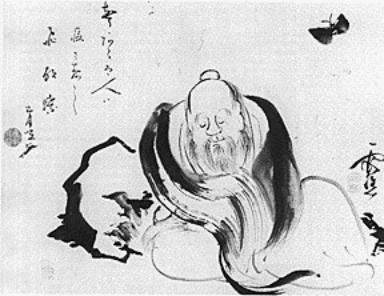
Raymond Sigrist, by doing nothing and making no recommendation, finally got me to start reading Chuang Tzu.
When I write about books, I adopt the same strategy as an unscrupulous professional reviewer: read a few pages, then rush headlong to the typewriter. Not that I can’t be bothered to read it through, but there’s nothing more effervescent and heady than initial enthusiasm. Read it doggedly to the end, with the intention of sharing your thoughts afterwards, and you get a heavy feeling, an indigestion; or such a kaleidoscope of fleeting impressions that you realize that you can’t say anything coherent unless you read the whole thing again. So now that I’ve read a few pages of Chuang Tzu, I reach the conclusion that he’s a comedian.
Take the Bible, reputed to be the world’s best-seller. It has few if any jokes, despite having been written entirely by Jews, who these days at least have more than their fair share of humorists and clowns. Raymond tells me that the prophet closest to Chuang Tzu is Ecclesiastes, so I open his Old Testament book in high hopes, till they are dashed by this:
Sorrow is better than laughter: for by the sadness of the countenance the heart is made better. The heart of the wise is in the house of mourning; but the heart of fools is in the house of mirth. (Eccl. ch.7, vv. 3,4)
Now I open at random The Complete Works of Chuang Tzu, in the sparkling translation of Burton Watson. You can imagine a philosophy student copying down as best he can a session where Master Chuang has them rolling in the aisles of a packed lecture hall. I’m not saying it will make you laugh. You have to be there, hear it in context.
But to wear out your brain trying to make things into one without realizing that they are all the same—this is called “three in the morning”. What do I mean by “three in the morning”? When the monkey trainer was handing out acorns, he said, “You get three in the morning and four at night.” This made all the monkeys furious. “Well, then,” he said, you get four in the morning and three at night.” The monkeys were all delighted. There was no change in the reality behind the words, and yet the monkeys responded with joy and anger. Let them, if they want to.”
I wouldn’t exactly call Master Chuang a teacher—he’s more of an unteacher, an eye-opener to make us question everything we think we know. But something in me wants to offer some quote that might even encapsulate Chiang Tzu’s “message”. Well, I don’t know.
Master Tung-kuo asked Chuang Tzu, “This thing called the Way—where does it exist?”
Chuang Tzu said, “There’s no place it doesn’t exist.”
“Come,” said Master Tung-kuo, “you must be more specific!”
“It is in the ant.”
“A thing so low as that?”
“It is in the panic grass.”
“But that’s lower still!”
“It is in the tiles and shards.”
“How can it be so low?”
“It is in the piss and shit!”
Master Tung-kuo made no reply.
Chuang Tzu said, “Sir, your questions simply don’t get at the substance of the matter …”
22 comments
Hayden
whew. Left here yesterday to go off in search of this book, which I hadn’t heard of before. You may have just turned me into a library member, sir! $90. here, through Amazon. I shudder to think what it might cost through a standard bricks and mortar bookseller.
Ashok
I would much rather just read Ecclesiastes than spend $90 or even $9 for that! Perhaps there’s a version in google books.
Later:.. Checked out google books – there are more than twenty on Chuang Tzu (some readable online) directly and another 100, 000 or so with references to him.
Hayden
will check and see if they have the same translator. I tend to figure that if something has been around that long it just might be interesting. Actually, I’m a bit horrified that I haven’t run across him before, given the rather in-depth approach to world literature and culture that was served up in grad school.na
We got to know how to ask the right questions. We keep forgetting that…
Your reference to the Bible reminds me of a sarcastic comment by Jose Saramago – we should not let our youth read the bible; it’s full of bad examples: incest, murder, betrayal etc
Vincent
Luciana, yes that’s the heart of it: asking the right questions.
I love your “Jack” soliloquy. Everyone will love it. This boy, puzzled by life and rather simple in the head, is led by his trusting naïveté and some transformational magic to restore his father’s treasure.
It shows that you don’t have to be intelligent to ask the right questions.
Vincent
Hayden & Ashok: most of us have heard of Lao Tzu and the Tao te Ching. It’s a puzzle why Chiang Tzu is less known, but let others work out the reasons. Most translations of the Tao te Ching give you a sense that the Way is a mysterious thing that can’t be defined, coming in a corrupt text from some forgotten culture that we can’t understand today.
I’ve borrowed my copy of Chuang Tzu from the library. Actually I ordered four different translations. The others were Thomas Merton (he didn’t translate, merely anthologized and made up his own translations by cannibalizing others); Herbert A Giles (1926); Thomas Cleary (1992).
In my opinion it’s only the Burton Watson translation that’s worth bothering with. He cuts through all the mists and delivers you the man in full colour and several dimensions.
Hayden
whew. Left here yesterday to go off in search of this book, which I hadn’t heard of before. You may have just turned me into a library member, sir! $90. here, through Amazon. I shudder to think what it might cost through a standard bricks and mortar bookseller.

ashok said…
I would much rther just read eccelesiastes than spend $90 or even $9 for that!
Perhaps google has a version in google books.
ashok said…
Checked out google books – there are more than twenty on Chuang Tzu (some readable online) directly and another 100, 000 or so with references to him.

Hayden said…
will check and see if they have the same translator.
I tend to figure that if something has been around that long it just might be interesting. Actually, I’m a bit horrified that I haven’t run across him before, given the rather in-depth approach to world literature and culture that was served up in grad school.

Luciana said…
We got to know how to ask the right questions. We keep forgetting that…
Your reference to the Bible reminds me of a sarcastic comment by Jose Saramago – we should not let our youth read the bible; it’s full of bad examples: incest, murder, betrayal etc

Vincent said…
Luciana, yes that’s the heart of it: asking the right questions.
I love your “Jack” soliloquy. Everyone will love it. This boy, puzzled by life and rather simple in the head, is led by his trusting naïveté and some transformational magic to restore his father’s treasure.
It shows that you don’t have to be intelligent to ask the right questions.
Vincent said…
Hayden & Ashok: most of us have heard of Lao Tzu and the Tao te Ching. It’s a puzzle why Chiang Tzu is less known, but let others work out the reasons. Most translations of the Tao te Ching give you a sense that the Way is a mysterious thing that can’t be defined, coming in a corrupt text from some forgotten culture that we can’t understand today.
I’ve borrowed my copy of Chuang Tzu from the library. Actually I ordered four different translations. The others were Thomas Merton (he didn’t translate, merely anthologized and made up his own translations by cannibalizing others); Herbert A Giles (1926); Thomas Cleary (1992).
In my opinion it’s only the Burton Watson translation that’s worth bothering with. He cuts through all the mists and delivers you the man in full colour and several dimensions.
Hayden said…
Yes, the Burton Watson edition was absolutely raved about by the reviewers I read. And a good translation is always crucial to enjoyment & appreciation. You’re right, I’ve read Lao Tzu’s Tao te Ching – and candidly, remember almost nothing about it. Perhaps I should blame the (also forgotten) translator… or maybe at that moment in my life I wasn’t ready to *hear *.
Vincent said…
Here is the monkey anecdote from the 1992 Cleary translation:
To labor intellectually to make things one without knowing they are the same is called “three in the morning.” What does “three in the morning” mean?
A man who raised monkeys said he would give them three chestnuts in the morning and four in the evening. The monkeys all became angry at this. Then the man said instead he would give them four in the morning and three in the evening. Now the monkeys were all happy. There was no lack in name or reality, but the effect was joy in one case and anger in another. This too is based on assumptions.
Therefore sages harmonize right and wrong, leaving them to the balance of nature. This is called double efficiency.
Yawn. I have a project currently to translate Albert Camus’ Myth of Sisyphus There is only one English version in the world at present. It’s not an easy book. I may give some parallel translation examples here.
Vincent said…
Example from the hard-to-read literal translation of Albert Camus’ French original of Le Mythe de Sisyphe:
If I ask myself how to judge that this question is more urgent than that, I reply that one judges by the actions it entails. I have never seen anyone die for the ontological argument. Galileo who held a scientific truth of great importance abjured it with the greatest ease as soon as it endangered his life. In a certain sense, he did right. The truth was not worth the stake. Whether the earth or the sun revolves around the other is a matter of profound indifference. To tell the truth, it is a futile question. On the other hand, I see many people die because they judge that life is not worth living. I see others getting paradoxically killed for the ideas or illusions that give them a reason for living (what is called a reason for living is also an excellent reason for dying). I therefore conclude that the meaning of life is the most urgent of questions.
Vincent said…
My own translation of the same passage:
When I ask myself how to tell if one question is more urgent than another, my reply is “See what actions follow”. I never heard of anybody dying for the sake of the ontological argument*. Galileo set great store by scientific truth, but he let it all go without a qualm the moment it put his life in peril; and thereby did well, for his truth wasn’t worth being burnt at the stake. Who cares if the earth goes round the sun, or the other way round? The question is plainly futile. On the other hand, I see many people die because they find life not worth the living. I see others who end their lives defending ideas or illusions which give them a reason to live. What a paradox, that a reason to live should make an excellent reason to die! So I see that the meaning of life is the most urgent question we have.
* “Ontological arguments are arguments, for the conclusion that God exists, from premises which are supposed to derive from some source other than observation of the world—e.g., from reason alone.”—Graham Oppy, Stanford Encyclopedia of Philosophy. [Translator’s note]
ashok said…
Parle Vous France, Vincent?
Your English translation is most elegant because you write such good prose.
Hayden said…
Vincent, your translation is a wonder! Please, please do this project! I’ve read it in the current translation and did like it – but yours is lovely, clear, simple – all at once. Bravo, Vincent, Bravo!

keiko amano said…
Vincent,
I usually read Chinese classics in Japanese, but a while ago, I bought one Chinese book published by Beijing: Foreign Languages Press. It was a brand new, good quality and inexpensive English translation. I think it was about 10 dollars or so. Have you seen one? As Hayden wrote, I was also surprised at first with the enormous prices like 90 dollars when searched in Amazon. So, I was pleasantly surprised when I received the product.
For the Chinese history and classics, I like the books by Kaiduka Shigeki and other old time Japanese scholars. But, it seems none of those books are translated into English. I guess it must be very expensive to initiate such translation projects. And new books are always coming up, and sometimes with a fresh new perspective or information. It’s quite exciting. “Taoism” by Imaeda Jiro is pretty new, I think. I just paged through to get some new information. It explained Kukai’s activities in China, and why he became successful. His success is obvious, but I didn’t know how he was in China. He promoted shodo which was developed side by side with Taoism and Buddhism. “Do (we pronounce like doh)” of Shodo is tao. 道 And chado, kendo, judo, kado, koudo, kyudo, and all those traditional Japanese arts have “do” at the end of their names because each is tao. So, Taoism is everywhere, and I see it in your blog, too, especially at the beginning: the words by Basho.

gentleeye said…
I have Merton’s ‘The Way of Chuang Tzu’ and have always loved it. It’s far from the complete works, of course, but a lovely taster! The Burton Watson sounds good but I MUST NOT BUY ANY MORE BOOKS JUST NOW! I’ve still got the Sigrist on my wish list at Amazon, and the Pessoa, and it’s ALL YOUR FAULT, Vincent!
Vincent said…
Ashok & Hayden: yes, I have the qualifications to be a translator I suppose. My degree was in French & Italian literature, though I didn’t work at all hard at it. For example I never read Le Mythe de Sisyphe there, though Camus was on the syllabus. I recently bought the Justin O’Brien translation and found it almost impenetrable. That’s what inspired me to do my own.
Vincent said…
Keiko I think that if the Burton Watson edition is $90 it’s probably because it is out of print, but recognised as being very good.
What was the Chinese book you got from the Foreign Languages Press? I remember the Foreign Languages Publishing House of the USSR – a propaganda exercise of course. I imagine their translations are of a higher quality than the signs all over Beijing prepared for the Olympics!
I accept that “do” is Japanese for the Chinese “tao” but “tao” just means Way, doesn’t it? So how can “do” imply any connection to the religion called Taoism?
My copy of Basho is the Penguin Classics edition, translated by Nobuyuki Yuasa. It says that Basho was strongly influenced by Zen Buddhist meditation and makes no mention of Taoism.
However, I know little about Japan, and whether hado, kendo, judo, kado, koudo, kyudo are considered as culturally part of Taoism. And I don’t even know what Taoism is. Wikipedia suggests three distinct things.
Vincent said…
Well, Gentleeye, I have less fear of your wrath with my latest post. It’s a book review but not exactly one designed to make you go out and buy.
keiko amano said…
Vincent,
I let you know that I included something about Taoism in my new blog: A Taiwa by Yang Yi and Shirin Nezammafi.

ZACL said…
It seems that one person’s humour is another’s sadness.
There is much to be learned from how things are said.
Asking the questions may follow on; who assesses what is the right questions and for whom?
Vincent said…
Thanks for the note Keiko, I went and read your post!
ZACL, yes, it matters a lot how things are said. And even more what questions are asked. I don’t care if anyone assesses them!
ZACL said…
Assessment is part of all the thinking processes, of those who are deemed to think. What is done with the assessments, or what is thought about them is a further level of assessment.
 a wayfarer’s notes