
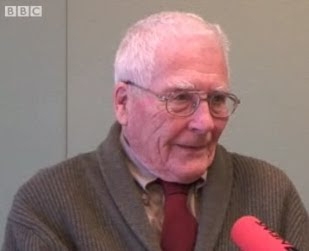
Humphrys: I’ve been talking about climate change to one of the world’s most respected scientists, Professor James Lovelock, the man who developed the Gaia theory, which says the earth functions as a kind of giant self-regulating organism. His new book is called “The Vanishing Face of Gaia”. I asked him in what sense Gaia is vanishing.
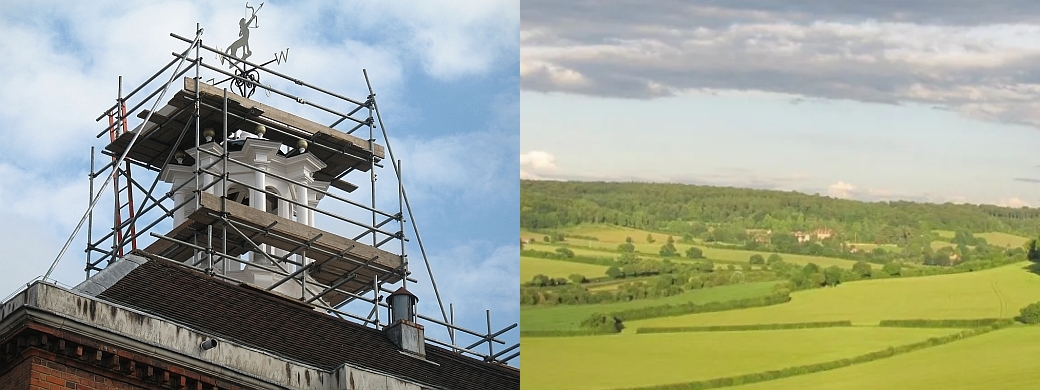
Lovelock: Vanishing from the kind of face that we remember as children. I remember what an incredibly glorious country this was. I mean England the great and beautiful land: people came from all over the world to see it. And it was like that and slowly it’s changing, slowly becoming more and more urban. Slowly more industrial, more roads, more everything. And it’s not just here. The whole world is changing in that sort of way. And Gaia for me is the living earth. And it’s changing. And if global warming really happens, and I think it probably will, then it’ll change an awful lot more.
Humphrys: You say if global warming happens. You believe it both is and will get a lot worse?
Lovelock: Yes. I do believe it’ll get a lot worse. You can’t put something like a trillion tons of carbon dioxide into the atmosphere without something nasty happening. It’s happened in the past in the earth’s history as a result of geological accidents. And always it’s followed by a rise in temperature of about five to eight degrees Celsius. So why should we expect to escape if we do the same thing? Moreover, the sun is putting out more heat now than it was back then.
Humphrys: But many of your scientific colleagues, most of them perhaps, tell us that what we should be doing is changing our behaviour. So we put less carbon dioxide into the atmosphere from now on. You are at the very least sceptical of that and actually rather scornful of the idea.
Lovelock: Well it is. I mean if you think of it anywhere in the industrialised world for example, most people who put the carbon dioxide into the atmosphere are ordinary working people driving to work in their old bangers, not very efficient cars. They can’t go and sell them tomorrow and buy a hybrid or something. They’re just obliged to go on doing what they’ve been doing, and they’re going to have to do it for a very long time, if they’re to stay in work and carry on life as usual. And in the winter, we have to keep warm, and we’ve got to burn fuel to do it. You can’t just expect people to suddenly become vividly green and stop all carbon emission. It won’t happen. In fact, it probably won’t happen for anything up to twenty or thirty years. Which will take us to the trillion tons. We’ve sort of pulled the trigger. We’re not really guilty. We didn’t deliberately set out to heat the world, but as a result of what we’ve done to build our civilisation, we’ve set things in motion.
Humphrys: It’s a counsel of despair, isn’t it?
Lovelock: Not really. We’ll survive.
Humphrys: But how many of us in your view will not survive in the process?
Lovelock: Well that’s a rotten question—
Humphrys: —it’s the only one that matters in a way—
Lovelock: —it is and it happens and I could be completely wrong, but if it does really warm up as badly as I’ve said in that book, and it might well do, then we’ll be lucky if there’s a billion left. And that’s a lot—
Humphrys: So in other words, seven out of eight will die—
Lovelock: Well, something like that—if it happens. Yes.
Humphrys: And they’ll die because of a combination of things including rising seawater, because of extreme weather, because of floods—
Lovelock: No, mostly from starvation, I think—
Humphrys: —and because of food production, yup—
Lovelock: —starvation and disease. And of course, wars will occur. We’re already seeing it, in the [..] sort of war. Global warming is forcing the migration of tribes into regions where the people who live there at the moment don’t want them.
Humphrys: Tomorrow we’re going to be seeing the report into what’s been going on at the University of East Anglia—all those leaked emails suggesting some rather dodgy things have been happening there, at the climate change centre. Do you believe that the science has been misrepresented to us?
Lovelock: No, I just think there are too many people doing it. You see, science has changed in our lifetime. It used to be a vocation, rather in the way nursing was a vocation. You did it almost as a calling. You had your own discipline and rules of behaviour. When I started science, most scientists would consider it a sin against the Holy Ghost to fudge data. But the moment it became a career job, which it did during the last century, then, if you were under pressure, and your job depended on your producing the right results, you tended to adjust the data, to fit what your bosses wanted.
Humphrys: And that’s what’s happening now, is it?
Lovelock: I suspect.
Humphrys: It’s a slightly—it’s a more than slightly worrying prospect, that scientists, who we are encouraged to believe—and I think probably most of us do believe—are dispassionate—it’s deeply worrying if that is not the case?
Lovelock: I don’t think things have changed very much. It’s the result of the media, the widespread investigative types like yourself, John, that have begun to make everything much more public than it used to be.
Humphrys: One final thought. When you talk about us being prepared, what should we be doing now?
Lovelock: I think the main thing we should do is keep a watch on what’s happening. For example: if it looks that warming really has set in, and Europe’s becoming uninhabitable, as many of the modellers seem to predict it would, then a lot of thing are going to start changing. One of them is going to be absolutely massive migration here. Now we’ll have some of the best farmland still, and a climate that’s suitable for growing in, so it’s going to be a very different sort of nation in the future if it moves in that sort of direction. And if on the other hand, the climate moves in the direction it’s going in now, we’re going into a cold period, lasting say fifty years or something. Then all bets are off. We just carry on more or less as usual, and hope for the best.
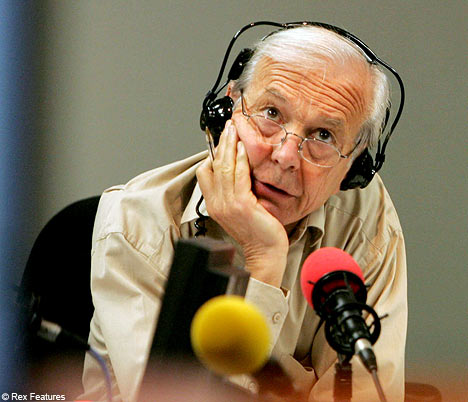
Humphrys: As you say “hope for the best”, there’s a big smile on your face. You’re pretty cheery throughout this interview. Every time I’ve interviewed you, you’ve been pretty cheery.
Lovelock: Well that’s because I believe in “enjoy it while you can”! And I’ve got less time to enjoy it than most.
Humphrys: So make the most of it, really—
Lovelock: Yes, exactly. It’s been an incredibly beautiful world—
Humphrys: It’s “been” an incredibly beautiful world?
Lovelock: Yes, it still is, in many places.
Humphrys: James Lovelock, many thanks.
Lovelock: Thank you John.
Comments
Vincent said…
James Lovelock is 90; John Humphrys a mere 66.
The interview was aired on Radio 4’s Today programme, yesterday on 30th March 2010.
To hear the interview, click here. It’s BBC policy not to offer transcripts of any item on that programme, so I have done it on the world’s behalf.
March 31, 2010 11:30 am
ghetufool said…
Thank you so very much Vincent! you are a sincere soul. God bless you.
April 01, 2010 8:22 am
Vincent said…
Thank you Ghetu. God bless you too. May God bless you with “her story” soon. Both in fiction and fact.
April 01, 2010 5:26 pm
 a wayfarer’s notes