
Nothing posted here for a long time. I wanted to, but too busy. There was a time two years ago when I could book an hour at the internet café and write one straight off, but these days I convince myself I don’t have an hour to spare, and in any case a gushing torrent of spontaneous words presupposes a dam recently burst. Approximately ten blog posts have been planned; but the ideas grow stale, if not taken at the flood.
We live in a world constantly flooded with beauty and blessings if only we know where to look. It’s as if we stand on a seashore where every pebble is a precious stone. In the affairs of men or otherwise, it’s not a question of identifying an opportune moment, but savouring the essence of the moment already before us.
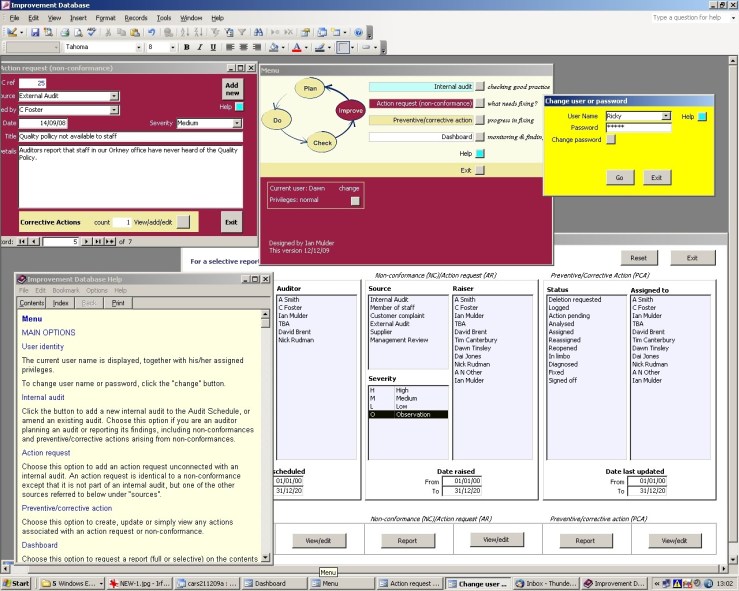
Which is exactly what I was not doing this morning when the angel showed up. I was panicking at the enormity of a commitment I had taken on, with no idea of how long it will take me to finish. It’s a piece of software I’m writing. It has a deadline.
So when an email arrived from a dear friend, who respects me perhaps more than he should, I suddenly felt ashamed at being so far from a state of grace, so sunk in my role of assassinating the day.
Angels move in mysterious ways. A few months ago, I came across Raymond, whose comments on various blog posts fascinated me. I tried to beard him in his lair but he didn’t have a blog himself. He did have a Facebook account, so I got one too and discovered he had set up discussion groups, particularly one about Apophatic Mysticism and his forthcoming book on the same. (My spell-checker denies that there is any such word as apophatic. But then, it still doesn’t recognize blog, either, after all this time. Nor online, for that matter.) I wasn’t interested in being on Facebook, preferring cloistered anonymity to an online blogospherical social whirl. But I have digressed to tell you how I got on to it.
Then, in an idle moment (such as I have been denying myself lately), I had looked up my dear friend Anup from India, and saw that he did have a Facebook account, though he’d never mentioned the fact to me. His name is common enough, so I examined his photo closely. It was rather a distant shot, young man leaning against a rock, for all I know it could have been the Marabar Caves, famous in the West from EM Forster’s A Passage to India. I thought it looked like my friend Ghetu! So on 9th October I had left him a message asking if he was indeed Ghetu. No reply. Until this morning, when an email arrived in my inbox:
Anup sent you a message.
Re: hello
“HI VINCENT
how are you? actually what are you doing? because are you vagabond like me?”
Young Indians speak a dialect form of English with nuances unknown to those of us in England who think we have a copyright on the language. So perhaps “vagabond” referred to laziness. He recently wrote a guest post on a blog called Lazybox.I followed the link and saw he was online. So there followed a chat session notable for its absurdity. He didn’t answer my questions (such as where he was at the moment), merely asked similar questions of me, as if he didn’t know me at all. I didn’t answer them because I thought he was fooling around, but when he asked why I didn’t show a picture of myself, I replied that I did, and he could see for himself that I am half man, half horse. To which he replied in words to the effect that my picture was no proof. I could be an impostor, not a centaur at all. So true. And that was the moment that I realized he might be one too (an impostor, not a centaur), though quite innocently.
So, dear Ghetu, your friendship worked on me, rescued me without you doing a thing. Your impostor-namesake irritated me. Forgive me for imagining for a single moment that it could have been you. Even in phantasmal form, you send me angelic messages, making me see that the cause of my irritation was myself.
When you treated me so strangely in our online chat, my soul felt that you could see through my pretensions and were disgusted at what I had let myself become. I felt your disapproval, even though it wasn’t you. That’s how much you are a true friend.
For you (or is it my imagined version of you, as a watchful angel?) I shall be more sensible, and refrain from panic.
 a wayfarer’s notes
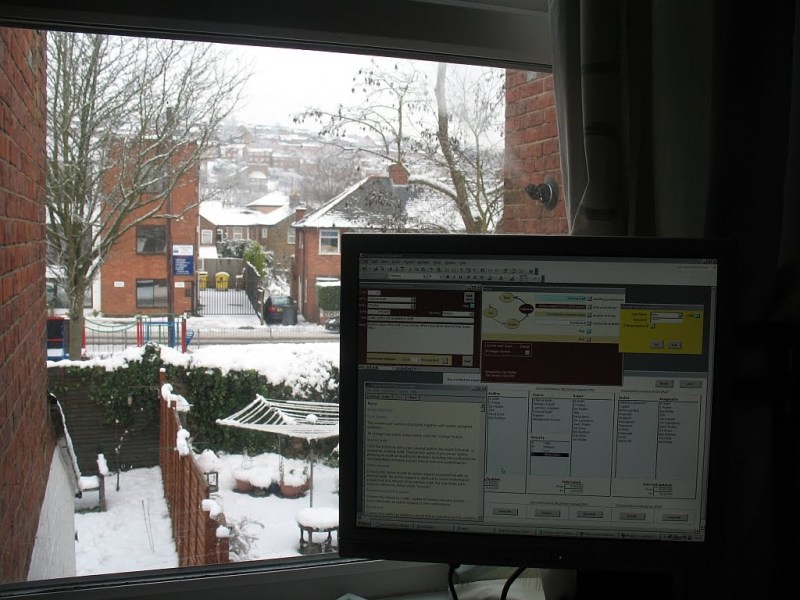
Vincent,I love the photo. Inside is warm, but outside, cold. The photo shows many squares, but snow seems softening all the corners.About “vagabond,” I thought the Indian man meant “free spirit” because I use it that way. But it occurred to me to check my dictionary because of the meaning of “lie” which I wrote in my blog Lie, Stupid, Starving. According to Oxford Dictionary of English, one line is written as follows: “, a dishonest or unprincipled person.” Gee, it’s very negative. I don’t think he meant that at all. But other meanings seem neutral. The language is dangerous. We don’t look at dictionaries or think each word deep enough. And often dictionaries do not tell all the meanings. On top of that, we can’t assume people’s feeling when they speak it.
Like
i am at home in kolkata ian. just bought a new computer for my home here. and this is the first time i am online after five days. so that’s not me. now that you have a facebook account, i must now search and add you. i have a facebook account but i was not very active there. in between i had deleted it too. but in facebook, you cannot completely delete an account, unless you have written the administrator in san fransisco. at most, you go out of site from your friends. after even a year, if you log on with your old id and password, things get started from where you left. but i guess, that vagabond word is a patented indian one, though the origin could be english.
Like
angels are all around, even sometimes delivered in cases of mistaken identity…happy holidays to you, dear friend
Like
Well, Ghetu, it’s wonderful to find the genuine Anup, not a bit like the wrong one. He must have thought I was mad.Now I shall have to look up the origins of the word vagabond. It doesn’t sound like English. Sounds like a gypsy word. But it comes ultimately from Latin and literally refers to wandering about – like a wayfarer. So yes, Keikuccia, it does mean in that sense “free spirit”. Like many other words it can be used negatively but I never care about those meanings. Like “bastard”. I am a bastard in its proper meaning and am not ashamed of it.True, we don’t know what people’s feelings are at first. We can mistake their behaviour. Words are elaborate signs, a medium of behaviour so much more sophisticated that our cousins the apes have been able to achieve!Happy holidays to you also dear Joanne! It’s funny how we can get to know one another with this sign-language transmitted such huge distances instantly. It’s a kind of spiritual getting-to-know, I think: much deeper than if you met the person at a social gathering, for example, don’t you think? Or even a one-to-one meeting of some hours . . .
Like
This post was truly worth waiting for.I know exactly what you mean when you talk about seizing the moment to air your thoughts, else they become stale. There are the rare occasions when a thought or two has developed and life has too, allowing for more mature ideas to flow. It is not always so.Your Damascene moment must have been an absolute need for you and you were open to its benefits.I hope you have a good Christmas and I wish you a happy 2010.
Like
Vincent,This afternoon, I was surprised to find out from two American published authors that they also think about “vagabond” as a romantic one. In Japan, a French song was hit long ago. I don’t know if it is Japanese French song or not. The title is “A man who sells happiness.” In that song, the word vagabond appears. It’s very cheerful song, and with broad smile, a singer would sing, “I’m a vagabond.”I checked the meaning on Japan Yahoo site. All said “wanderer” only. Because most of us are not wanderers, we seem to admire wanderers. Because the music of the word sounds fun, the name appears in many products as below. Musashi – a sword man http://shop.kodansha.jp/bc/comics/vagabond/Fishing tackle product sales . The site mentions “a free spirited man.”http://www.lure-fly.com/vagabond/http://www.lure-fly.com/vagabond/english/vagabond/index.htmlOne of the most popular anime(Cartoon) in 60s. “Genius Vagabond” by Akatsuka Fujio. All the characters appear as follows..http://www.koredeiinoda.net/charalist.html
Like
Happy holidays, Vincent! I think sometimes when I go online to play I am indeed being a vagabond…wandering here and there, meeting people, enjoying a laugh and a virtual glass of wine while still having my bottom pressed firmly in my seat. When I was young a friend used to call from time to time and invite me “out for a vagabond evening.” Usually it meant long walks and a bit of bar hopping…. seeing where the laughter of the night carried us.
Like
Vagabond – great word. It simply means “wanderer,” but derives most of its meaning from the connoatation attached to it. I think of it as not only wandering, but wandering as a profession, a fulltime gig of wandering around, with a slightly shifty reputation. It is interesting how words develop connotations that change their meaning. And sometimes the meaning only applies regionally. For instance, a “scheme,” in the US, implies something devious, whereas in the UK it is simply a plan.So said a rogue to a vagabond.
Like
Patrick it is true that “scheme” tends to have a neutral meaning in England, but “scheming” and “schemer” are devious, where “planner” is a respectable profession.”Scheme” as a noun is a little suspect over here too. I believe it may have gone sour here first in 1951, with the collapse of the great Tanganyikan Groundnut Scheme. I was nine at the time but everyone was talking about it as a big scandal.
Like
Happy holidays to you, dear Hayden in chilly Michigan! I think of you in the ice, sliding to the nearest village in your station-wagon, & perhaps wondering if the Amish would have fared better with their horse-drawn buggies in the winter weather.
Like
Keikuccia, indeed you have hit on it, as others have confirmed here, that “vagabond”, whilst it has some negative connotations, is in spite of that or partly because of that, a proud boast or a kind of compliment. Everyone (almost) wants to be seen as having a wild side!And the music of the word, as you point out, is fun too, hard-edged yet colourful, with a little laughter and softness.
Like
ZACL, thanks for your good wishes & for brightening this space with your comments. I’ll see you over at yours when you resume posting. You’ve been prolific till 22nd Dec and quiet since. Hope you will speak a bit about the intervening adventures!
Like
Ah, the great Tanganyikan Groundnut Scheme! Little did you know, but my father was heavily involved in that. We have some wonderful old photographs (proper official ones). My father wasn’t terribly impressed with the ‘scheme’ either, but it was a job at the time…
Like
Oh, and another thought. What is the difference between a ‘vagabond’ and a ‘drifter’?
Like
VincentMy daughter read your comment and said, “It’s interesting about scheme.” Yes, I agree. And I read up about the great Tanganyikan Groundnut Scheme. Wow, it was an amazing story. I enjoyed reading it and thought Hollywood could turn it into a great comedy. But probably British wouldn’t laugh about it. Perhaps, someone can write a manga novel about it. In the manga, the father of Genius Vagabond often concludes philosophically about their chaotic and wacky life as saying “Koredeiinoda (これでいいのだ).” This phrase means “This is okay the way it is.” It became a famous phrase. It has authoritative and therapeutic tone of great judgment with warmth. I love this phrase. Nowadays, I say it more often.
Like
Hi Keiko“This is okay the way it is.”That reminds me of: 譬如秋水澄渟清浄無爲.澹泞無礙。喚他作道人亦名無事人。Isan ReiyuPi ru qiu shui cheng ting, qing jing wu wei. Dan ning wu ai. Wan ta zuo dao ren. Yi ming wu shi ren. Like the clear still water of autumn, the pure tranquility of effortlessness. Placid depths without obstruction. Call this one a daoing person. She is also known as “the one who need not do anything more.” Isan Reiyu
Like
Hi Vincent I like to think of apophasis as love that survives beyond the death of reason. The validity of this love requires no outside support or proof.
Like
Thank you for the Zen quote. It took me a while, but I found in the Web, 潙山靈祐 (J., Isan Reiyu, 771–853).He is a master of Zen in the Tang period. With your help, I could read the quote. This gives me immense joy. Thank you. I especially like the following. 喚他 Call it 作道人 Dao practitioner,亦名alias,無事人 Person of peaceWhat an economy of language! I love it.
Like
Raymond! I’m glad you have demonstrated your existence by commenting here (refuting my feeble attempts to pass off my writing as fiction). I’m glad of your definition of apophasis too. My post of today, as you will see is about reason and religion. It doesn’t mention love but that was merely choice of words. It could have been all about love.
Like
Raymond & Keiko! When I started seeing comments with chinese characters in them I was ready to delete them as spam, because they usually offer erotic aids and the like (as I discovered from using the Google translation service). That same service translates your quotation, Raymond, as “Cheng relaxed and clean stagnant water such as doing nothing. Dan Ning not affect. Call he made nothing of people Yi Ming Taoist.” Oh well!
Like
“This is okay the way it is.” That is a beautiful saying, Keiko, and one which (in slightly different words) I refer to in my next post.I do wish I had direct access to your language and culture, but I’m so glad to get a wonderful selection of it through you.
Like
Vincent,About Chinese spams, that’s funny. I wonder what kind of Chinese language they use to solicit such items. Well, I’m curious, but nobody needs to send me copies! About your translation, it shows the word “Taoist.” I’m impressed because I wouldn’t have known it without Raymond’s translation. I’ve never thought of using online Chinese translation before, but with such help, I probably can venture into Chinese sites. This is exciting. But, wait a minute. I can’t type modern Chinese characters because I can’t speak Chinese. That means I can’t read Chinese newspapers from Peking, but I can partially read ancient texts from the Tang Dynasty. Hmm. I’m disappointed and glad at the same time. Vincent, I’m learning a lot from your site. Thank you for this valuable and fun conversation. I’m glad I started blogging on Ebloggers.