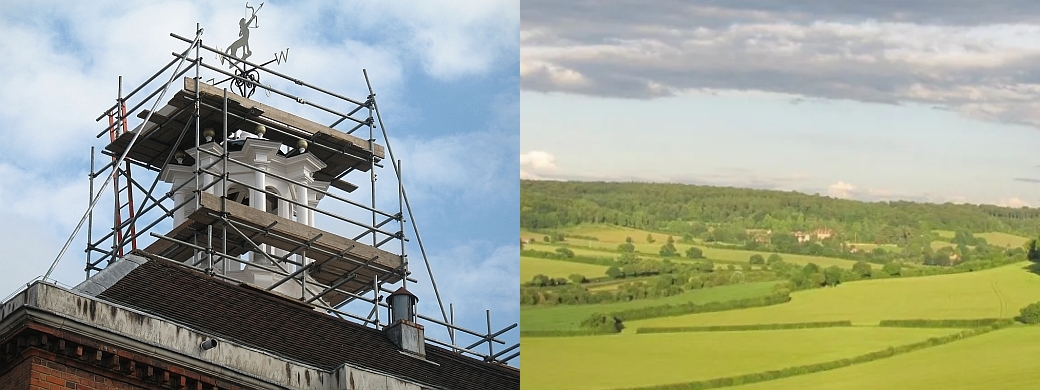

 What would it be like to be someone else? I suppose this is why we read literature, to see through others’ eyes, gaze into their souls. I like unusual views and the best way to find them in books is to avoid what’s popular today by delving into the past, or seeking out those who’ve chosen a solitary trail, previously untrodden. In ordinary conversation, we look for topics of common interest. In the best literature, the author’s word-skill takes us effortlessly to places we’ve never been, places worth visiting and making our own.
I think of Gerard Manley Hopkins: famous for his sprung rhythm and inventive use of language; for being a Jesuit priest; and for expressing ecstasy and despair in his poems.
When I was someone else, that I am not now, I used to read for spiritual enlightenment, as if the very act of reading would make connections, give flesh to the bones of my vague intuitions. There was no pattern to my reading, but if I stumbled on a famous mystic, like Meister Eckhart, I would see therein the teachings I was already following, but in a different light, from a different angle, such as from the inside, when I had only been looking at the surface. If I retraced my steps now, I’d extract value from the same texts by being deeply critical. Once I saw commonality—“All paths lead to God; one blind man is holding the elephant’s trunk, one hugs its leg, one clings to its tail, so they all have different ideas of the elephant, but so what?” But later, it became interesting to see differences—and reject all views. I would tell myself that I don’t need someone else’s insights.
I was introduced to a few poems of Hopkins at school, by my teacher, the Rev. Bowyer. They included The Wreck of the Deutschland and The Windhover. Bowyer was a Church of England country parson, with a passionate interest in literature. He was fortunate to have in his parish J.B. Priestley, celebrated novelist and playwright. I imagine them joining for literary soirées. Might Tennyson have joined them, if he had been still alive? Rev. Bowyer had scant respect for Tennyson, who was unfashionable in the Fifties among the literati. My headmaster on the other hand cared nothing for literary fashion. He loved old England, Chaucer, Milton; perhaps Tennyson above all.
It was three decades later that I discovered Hopkins’ poem, The Blessed Virgin compared to the Air we Breathe. At that time, I practised breath-meditation till it seemed bleak and dry; till it hurt.
To find this poem was truly “a breath of fresh air”:
WILD air, world-mothering air,
Nestling me everywhere,
That each eyelash or hair
Girdles; goes home betwixt
The fleeciest, frailest-flixed
Snowflake;
It starts as above, expressing in different words a sentiment I mentioned in my last post: “I see the highest fulfilment in being consciously part of my environment. It wraps us on all sides like a blanket, and caresses us on the inside too, for we breathe the ambient air, and use it to re-energize our cells.”
But Hopkins, committed to his religion as only a Jesuit who has taken the three monastic vows can be, carries baggage that will either weigh him down in sleepless nights, or liberate him with visions of loveliness. He makes the best of it, dedicating his gift on the altar of his life’s sacrifice. In the poem, he universalises the dogma of his church till it dissolves into the world’s beauty and wonder, much as his fellow-Jesuit Teilhard de Chardin did, in a later generation, with his Mass on the World. To Hopkins, Mary is the world, in the shapeless shape of air embracing all creatures:
I say that we are wound
With mercy round and round
As if with air: the same
Is Mary, more by name.
She, wild web, wondrous robe,
Mantles the guilty globe,
Since God has let dispense
Her prayers his providence:
Nay, more than almoner,
The sweet alms’ self is her
And men are meant to share
Her life as life does air.
What would I do without literature, this tourism into others’ souls? Not forgetting literature’s miraculous god-child, the weblog.
 a wayfarer’s notes
Love the picture, but where are the teletubbies?j/k, nice post.
Like
I wouldn´t do without literature as well, except that being in touch with other people´s souls shows me the path to my own. In the experience of being someone else, I´m aware of my own existence.P.S. Keiko asked me to let you know that she wrote to you in my blog. 😀
Like
Thanks Luciana, I did draft a reply to Keiko, but was not satisfied with it. Will return soon!
Like
Thanks Patrick, you rogue. Indeed it looks like teletubby country. I remember the day I first saw that programme. Instantly seduced, especially by the bit where one of the characters kept saying “again!” and some little song or dance was repeated. But then I remember lots – apart from names and faces of people I know.
Like
Some interesting concepts. Robert Frost encapsulated ‘paths never trod’ perfectly for me. I loved finding his other works and reading them in the house and garden and the immediate surrounding area from which he drew a lot of his inspiration. It was meaningful. Reading current day and recent literature can also offer the opportunity to graze in the pastures of other writers.
Like
I am sure the reason I thought of the Teletubbies is because I have a 3 and a 4 year old. Sadly, I’ve became too much acquainted with children’s television. It is probably a testament to my poor parenting skills that so much TV is involved in my kids’ lives. Oh, and I saw that you list Tennyson among your faves – I must comment – he is a god. Ulysses is just a damn masterpiece.
Like
I have connections with Tennyson. Lived on the Isle of Wight, near his place Farringford. Stayed at Swainston – a school boarding house, where Tennyson visited and wrote a poem about it, you can find it here. And from a schoolfriend who lives near Farringford, I have taken cuttings of a myrtle bush which was grown from the remains of a myrtle wreath worn by Tennyson’s bride at their wedding. The cuttings have taken, and I intend to plant them out soon!Good luck with the parenting. My youngest grandchildren are 7 (approx).
Like
Robert Frost, ZACL, thanks for the recommendation. So much to read, but will make a note. Indeed we “find” authors, perhaps at a certain time of life; just as we find everything. My life seems to be guided at every step by angel messengers.
Like
Not to spoil the mood, but your elephants reminded me of a mystic joke: Holy man says that the earth is balanced upon the back of an elephant. Seeker answers: but then upon what does the elephant stand? “He is standing on an elephant below, my student”. But then upon what is the second elephant standing, master” Why upon the elephant below him”. Student is dismayed and answers “I see, but upon what is the third elephant standing, master”.Master, flustered and done answers “Well student you see, it is elephants all the way down” . . . Breathe easy
Like
Literature? Interesting concept. have just been reading half dozen or so “Westerns”. Some well written. some not. All of them give me some sort of insight into the thinking of “America” .. well .. the ‘Untied States’ part of it.
Like
(there are no elephants in the patch of ground situated between Canada and Mexico .. heh)
Like
“When I was someone else, that I am not now …”this is worth investigating. lovely photo, so much of space and clouds …
Like
Vincent, Hopkins wrote some very lovely sermons, too, that I consider essays on spirituality in Christianity. They are moving, very deep and solemn, yet fluid and sophisticated. I have had a literary crush on Tennyson ever since reading In Memoriam when I was 20.
Like
I studied some Hopkins at University -but can’t remember much now…the phrase “feel of primrose hands” sticks in my mind for some reason.It’s good to pick up on your enthusiasm.