
Scattered amongst these pages is a series of sketches which, extracted and sorted in chronological order, constitute a personal memoir; more of a collage than a coherent portrait.
But I’ve never yet managed to cover the era between the ages of sixteen and sixty-four. Until this moment of writing—in which dawn has not yet broken, there’s just a grey sky slowly lightening—I’d thought my narrative might reach eighteen at least. But I see that the abyss was already opening, even at sixteen. There had been signs before that: cracks in the solid ground, always present, though I have chosen to skirt round them in earlier narratives. There was never a time free of possible vertigo. I could choose to remain silent about it—as almost everyone does. But then I could no longer proclaim “the personal is the universal”: for I would not have been personal enough.
How to depict this abyss? This morning, as the new day brightens in the sky, I recall it as a flush of self-consciousness and dread, an embarrassment of showing my face to the world, a sense of lack and inadequacy, a lostness. These are not the emotions of today, I’m glad to tell you, but emotions remembered, or rather a single emotion, harvested periodically across the decades like unripe fruit garnered uselessly, a fruit that never ripens, just rots in shame.
I know the abyss exists for others too, not through any revelation of that flush of shame on their faces that I’d instantly recognize. Everyone tries to hide that. But you know them from the desperate strategies they adopt: addiction, fake happiness, religion, suicide. Or, if so blessed (or cursed), they take up an activity which, repeated obsessively, becomes a talent valued by the world, and can be traded in exchange for consolations.
I’m sure the existential abyss, or at least the cracked surface of life’s path, is known to everyone. At the mildest end of the scale, it’s a game of hopscotch, where we mark the ground with chalk, to hop across the squares. Or we walk as if superstitiously, avoiding the gap between the paving-stones.
Me, I was almost engulfed; but with the instinctive caution of an animal, I kept clear of some sticky traps—addiction, fake happiness and suicide. Then, after surviving to the age of thirty, I succumbed to a guru cult and a chronic illness, two kinds of patched-up boardwalk over the abyss. I’m cured of both now. I no longer fear that steep ravine, which Albert Camus in his Myth of Sisyphus makes part of the landscape of The Absurd.
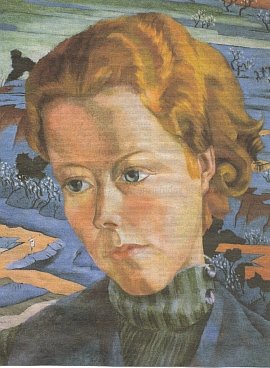
The young woman in the painting is Jane Aiken Hodge, elder daughter of Conrad Aiken. Like her father she became a writer. Like him she was drawn to suicide. At any rate, whilst in sound mind and good health at the age of 91, she recently died of a self-administered overdose. Nobody seems to wonder why. [Picture scanned from front page of The Times, 29th July.]
 a wayfarer’s notes