

 Mahatma Gandhi tells me I must be the change I want to see in the world. He didn’t say this lightly: you only have to look at his life to see he was deadly serious. Nor do I argue with him, though till now I haven’t bothered myself with consciously wanting any change in the world. It is too complex for me to impose my limited understanding upon it. Conscious of unintended consequences, I’m a bit shy of imposing will or interpretation on anything, preferring to trust my own instinctive nature and use intellect in a subordinate role only. I have seen myself as “an animal” and “part of the Universe” and for the rest have allowed the accretions of learned ideas and beliefs to slip from me, leaving only those which seem innate.
When I compose one of these posts in its final shape, having brooded on it for days, I sit at my desk overlooking the backyard, and whenever I turn my attention away from the screen, which is probably eighty percent of the time, I observe the wild creatures about their business. Today a blackbird is helping itself to the last of the cherries on my little tree which has fruited for the first time this year. What do I want to see in the world? I want it to flourish like my own tiny backyard, in which flowers, vegetables, fruit, lawn, pests, cats, birds and insects coexist in harmony, or at least interact in time-honoured ways. I like to try and enter their worlds of perception, even working out why a snail takes the trouble to crawl up the side of this two-storey house to the eaves and back down again. At first I thought it must be disappointed by its labours, wanting to see something in the world which it could not find, but now I don’t think so. [That’s another story! – Ed]
What Mahatma Gandhi wanted to see was an India no longer subservient to Britain. Indians should wear their own homespun cloth, so he led by example, going around like a “half-naked fakir” (in Churchill’s words) even when attending a political conference in London; and spinning cotton himself. His last granddaughter, Tara (Mrs Mrs Bhattacharya) says:
The creators of this supreme handicraft are the spinners and the weavers. Khadi [traditional hand-spun cotton] can not survive without the welfare of these artists. … Even when we do not have the need for hand spinning as a source of livelihood, it is a great mental therapy and creative outlet. It has a universal appeal and its creative force will bring people together against violence and divisions. Hand spinning should be introduced in schools and colleges and clubs and hobby programmes.
Well, I do lots of things with my hands. But what do I want to see? Freedom, justice, democracy, God’s kingdom on earth, or a more harmonious relation with the beating heart of this planet, to prolong its health? These things don’t quite move me. I see in them a confrontational political agenda, arming itself with aggressive words, supported by bombs, to condemn (or “liberate”) the unfree, unjust, undemocratic or godless.
Less controversially, more insidiously, the West has in two centuries crafted its most potent graven image: Efficiency. The ruling Powers present it before us as the Almighty and Inevitable, demanding our worship and sacrifice. We are to give up our lives in its service and receive in return Comfort and Leisure, things we might have had in the first place had we not sacrificed them. I’ve been powerless against this god, though personally I’m able to choose the slow meandering path instead of the highway, now that I am retired; but I’ve been powerless to find words to denounce Efficiency. Till now.
Some time in the last couple of weeks, I don’t know when because it was no sudden revelation but the flowering into words of something subterranean in me, I thought of Grace and Dignity. These are my answer to the question “what do you want to see in the world?” and therefore, by Gandhi’s formula, are what I must henceforth strive to embody in my own life. Grace and Dignity, not efficiency, must shape the pattern of my life and the world’s too, if I can have any influence.
Actually I have not been striving at all, just sometimes thinking about these exquisite endowments—what they represent. They are the last refuge of the poor and oppressed. But in the rich, powerful and talented they are the crowning glory.
I know others perceive the world in terms of good and evil, virtue and sin; I know, without understanding. I see things more in aesthetic terms. I know that Grace and Dignity, like all matters of taste, exist in the eye of the beholder. Before that, they take birth in the creative genius of the creature, whether snail or human makes no difference; except that we humans have been given this special blessing, that we have to work on being graceful where the snail performs it naturally.
I have not being trying to put more grace and dignity in my life, but only to see these endowments in members of my species. Nevertheless the effect on my life has been magical. I’ve felt closer to people, and they in turn, I’m sure, have felt closer to me. A barrier has dropped. I was like Harry Haller in the first part of Hesse’s book, The Steppenwolf. And now it’s as if I move forward to the second part of the book, consorting with my new-found friends Hermine and Pablo; learning to touch new forms of life, new joys; and be transformed.
————–
I couldn’t find an illustration adequate to the theme, so I’ve taken the Chinese characters for the Tao.
17 thoughts on “Grace & Dignity”
Charles Bergeman
I agree. Efficiency at what cost? A question I have pondered for a long while now. The dignity of the craftsman has been denied in favor of “more efficient” methods of production. Have it faster, cheaper and producing it in higher volume, at what cost? And worst of all, motivation to increase profit margins, has pushed the concept of efficiency to an unreasonable limit. A friend was working with a team who was asked to taper some pipes from 6 to 4 inches on one end. The team had developed an approach that was brute force, via hammers and such to do the job. It was inefficient. My friend worked out a method using hydraulic jacks to speed up the process ten fold. Much to his chagrin, the team was resistant to using the new method. As it turns out the brute force method was therapeutic. A release for tension, and stress. The new method, although efficient, had none of these benefits. As it was a volunteer effort, there was no enforcement of the more efficient process.
Tim
Vincent, I like this. Gandhi’s famous mantra is good advice to follow, because it leads to a new sense of awareness — by subtly forcing the question: “What do I want?” I think for most people, the idea of “what do I want” tends to be an impulsive and thoughtless process too easily guided by a comparison of self to outside influences, rather than being derived from the inherent uniqueness of “self.” Part of that is due to culture, as you say. However, as you and I are aware — people in places are waking up to how distracted they truly are by this electric “hum” of efficiency… bigger, better, faster, more!
When we slow down long enough to really think about it, we can see the highest form of existence is in the beautiful and noble: things like Grace and Dignity. I would add things like Creativity and Perseverance to what I’d like to see in the world. Unfortunately, modern culture doesn’t well reward these traits, leading people into chasing “ghosts of self” like pride and wealth. Fortunately, as you’re discovering (and your readers along with you) — that which you seek, you will find.
Vincent
Ah, Charles, I was volunteering too for the last year, as handyman for the elderly. I would have liked to talk about it in blog but felt it ethically wrong to betray their privacy. The final job I did was the one that took longest, and being a volunteer, I put as much effort in as it deserved: old-fashioned work building door-frames, putting in new barn doors, stripping off paint, painting bare wood and finishing with gloss: jobs that wouldn’t be done commercially except for wealthy clients, because it’s so much quicker to use synthetic materials that don’t need painting. And so many skills to learn in the process.
Vincent
Tim, I fully agree with your first paragraph; second para, I challenge on the basis that nobody knows what “most people” think. Still, you might be right and I might be wrong.
It’s funny, the “electric hum” of efficiency has been going a long time, and it’s seductive of course. But everyone ought to ask themselves what they sacrifice to it.And also what they sacrifice to the getting of the rewards offered by “modern culture”. Karl Marx famously said “religion is the opium of the people” but he was biased. Modern culture is the opium.
There is so much in this business of finding what you seek. But first you have to “Emancipate yourselves from mental slavery; None but ourselves can free our minds”, as Bob Marley says in a song.
ghetufool
Of course you are loved by people who you interact with. Beautiful thoughts Vincent, although I am no great fan of the Mahatma.
Vincent
Well, I’m no fan of the Mahatma either and intended to convey that in a subtle way, consistent with the respect due to all – hence the quote from Winston Churchill. But I understand, Ghetu, why as a fellow-Hindu you feel a special urge to distance yourself from this annoying man. Mandela has never been annoying like him, not to me, at least.
ghetufool
that has got nothing to do with Hindu. I am from Bengal, and in Bengal, we prefer Subhas Chandra Bose more than Gandhi. Subhas Bose was on his opposing camp. there were some politics involved which is beyond the scope of this blog. Gandhi’s non-violence means were also not entirely acceptable to us. that doesn’t mean that we were violent, but we believed that British won’t leave the country except when their interest ends and they would continue to do lip-service, which actually happened.
Vincent
Yes, he’s an ambiguous figure: politician or saint? I only suggest he is seen as a saint because someone saw fit to call him Mahatma, & the British have done so ever since, not being imperialists any more.
Tim
Vincent, you’re right. I can’t explain what most people think … that’s why I generalize! Bob Marley was another great philosopher. It’s a shame he’s so closely associated with the “drug” culture, or he’d likely have a far wider following.
Vincent
Well, I don’t know that Marley was associated with the drug culture (another generalization). He was a Rastafarian, which is a semi-Christian religion (it reveres the Bible for example) but which is rather Afro-centred and happens to consider that cannabis is a holy weed, to be used ritually. As with any religion, one can pick and choose one’s practices and if I were a Rasta, I’d avoid the weed, the dreadlocks and the belief that the late Emperor Haile Selassie of Ethiopia, the original Ras Tafari, is God.
Brett Johnson
I’ve found Kevin Kelly’s “Technium” a good place that he’s been hashing out the forward march of technology and efficiency with thoughts of its broader impact and implications for what it says about us as humans. http://www.kk.org/thetechnium/Nonetheless, efficiency is a powerful modern deity, that both resources and creativity can be laid at the altar of – and give in return the benefits of itself. ”Grace and Dignity” – I like that. They’re laden enough with meaning to incorporate the physical and the deliberate – such as ‘perseverance’ being a part of dignity.
Vincent
Brett, I’ve already today discovered the value of your links, and now you provide more. Despite having worked in the computer industry since 1965, I’m less seduced than Kevin Kelly by artificial intelligence and all that stuff; actually less seduced than almost everyone I know. Efficiency is indeed a deity in today’s world, but shouldn’t be. There are limits to its benefit, beyond which it enslaves us. It has already gone far beyond its limits. Obviously I cannot speak against these computers or this Web by which our minds are connected in this conversation.
But I would say that efficiency was optimised about fifty years ago. Since then the West has enslaved itself and indirectly the other countries too, and the benefits of cheapness and convenience) are overbalanced by the loss of intangibles which I have labelled with intentional inclusivity “grace and dignity”. The debate is worth having though and the older generation has a different view from the younger, which lacks direct experience of earlier decades for comparison.
Brett Johnson
Thanks for the response, Vincent. (would love to hear what other links besides the one forcibly given you found/found interesting!)I’m not AI apologist by any means, but I can appreciate how KK breaks some concepts down and lends some historicity to his process.I’m not comfortable making a call on ‘making it’ as far as something like efficiency, not knowing what breakthrough-and-slingshot moments we’re yet to have. What I wonder is, have we been continually losing what is lost through persuit of efficiency ever since we first started the creation of, say, tools – ever since we’ve tried to find a better way to do something that we were already able to do. The case could be made for that, of course…something about that pondering has taken us away from the grace and dignity of the bird and the squirrel. Though this also must then tie back to the Witness inside us, the Mind’s Eye that we hear separate from our thoughts inside.–yes, the younger gen. lacks the “direct experience of earlier decades for comparison,” though surely also is blessed with this ignorance as well – (the child and the young alike) having certain capacity to imagine what could be because they haven’t seen as much of what has been, it could be put?
Vincent
Brett, I shall now shy away from sweeping statements, if it is not too late already. The link I most valued was to Stanley Fish and his references to Terry Eagleton and Paul Campos. When I want to break free from generalisations (which implicitly posit the existence of a rule) I ask myself what image is in the back of my mind when I make the sweeping statement. Have I direct experience of it?The first one I think of when I say that efficiency has gone too far is the issuance of invariable scripts to personnel in call centres, with the warning to caller that “calls may be monitored for training purposes”. I understand the rationale and indeed was involved in a development of call centre technology in 1997-8.In the call centre I see the conflict between a human being and a not-fully-automated mechanism. The live person is offered to the caller reluctantly, only after a series of options to interact with automated functions.
So I speak to the human being and am delighted at his or her humanity – genuine willingness to help, sympathy with my predicament and so on. And then at the end, “Is there anything else I can help you with today Mr M—?”It comes as a shock. I realise that the employee is not free, but forced to do this slave-like job through economic necessity; initiative always crushed in favour of a rigid rule which puts the employer’s interests first.I know the example is relatively trivial, and that a young person today, brought up on Nintendo games, might not understand my point at all.
The same young person may have read Hamlet at school, and not seen the irony in this:
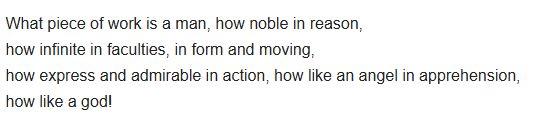
What dignity can there be in learning a transitional job which is only there pending its replacement by some form of artificial intelligence?To be able to develop life-long skills involving hand, eye and brain—I mean skills that can go on being developed one’s whole life—this is something I would fight for with something like religious fervour. Even to the point where I feel that the solution to the ugly world we have created may lie in a global catastrophe that for example deprives us of a universal electricity supply. This would be drastic, but bring us down to earth, in terms of connection to the earth that we have allowed to slip through our fingers. Finally, I am intrigued by this and wonder if you can expand, or link me to something that expands it: ”Though this also must then tie back to the Witness inside us, the Mind’s Eye that we hear separate from our thoughts inside.”
Brett Johnson
Ironic that you use Customer Service for your example, as I currently work in a customer service department. Thankfully, we are not scripted, nor is there an automatic structure/labyrinth for the caller to navigate through. (It’s also not actually a “call center” job, but the similarities are there). That said, since I’ve worked there the structure has grown around us, in some understandable ways to increase the measurable of things for the business’ sake. In the way you’re describing, however, i agree – them forced into that box applies directly to the choices that person is allowed and able to make – it’s crushing. They’re denied the (right?) to be able to actually, genuinely respond and react to the other person. I wouldn’t lump efficiency pell-mell with these sort of negative aspects of modernity and organization- they are done in the name of efficiency, but it itself as a concept aids everything from vaccines to transportation. I agree wholeheartedly regarding the long-term value of certain skills to build- this is something frustrating re: my position. (among other less negatively-framed things) I get daily practice in…applying the skills I’ve learned in using this very specific order processing system, day after day. Not exactly a long-term value skill (outside of the more general positives like adeptness with a computer/electronics).RE: Witness/Mind’s Eye — The Witness is a term my wife recently came across when reading about Pranayama, the Yoga of Breathing – a specific framing and application of it, but a term to mean our inner awareness – blurbed from this link: “The second stage is developing cooperation between the physical and psychological self. We invite the Witness self, or Seer, to the practice. Richard Rosen suggests that we begin and end each pranayama practice with the question; “Who is breathing?” A question that conceives its own answer over time.”
When i wrote Mind’s Eye, i was thinking this similarly, from this interesting link on children’s minds: “…they also have less inner consciousness of the kind that helps manufacture a distinctive sense of self, that autobiographical centre of memory and planning which is the “me” in all experience.” This self-awareness/consciousness/ability to gauge oneself (to such a degree) reflectively is something that makes humans distinct.
Vincent
There’s a great deal in your latest comment, Brett, not least the link to A.C. Grayling’s review of Gopnik’s book about child development, both of which authors I would like to listen to a lot more, and question them too. And then Kelly Murphy on Pranayama. I wouldn’t want to talk to her at all though, having been immunized and rendered personally allergic to pranayama from thirty years of it (an hour a day!), which I now realize was part of my own way of “compensating for the lack of what ought to typify an ideal childhood” (to quote from Grayling’s review).
Nowadays, when I ask myself “who is breathing?” and so forth, it’s a signal that something has got out of order, and needs fixing. Which is where I am currently at. But these things are immensely complex, or rather, hard to talk about because we tend to get lost in generalizations & intellectualizations which deviate from actual experience. I pick up from your comment “What makes humans distinct”. Someone must anthologize the various formulations that for thousands of years have been put forward under this heading! It’s an interesting line of research, especially as the “self-awareness/consciousness/ability to gauge oneself (to such a degree) reflectively” is not something we can see in others, whether human or insect, so I wouldn’t know how to perform the comparison. But then I perceive things not as a philosopher or scientist. The other day I walked at the edge of a field, finding only the narrowest margin between nettles (I was foolishly wearing sandals) and ripe barley. In the margin were wild grasses taller than me, but I didn’t want to crush any barley. And on a swaying blade of grass were a pair of metallic-green flies, absorbed in the mating act. How could I pass without disturbing their amours? So I waited. Nothing happened. Whatever mechanisms flies employ to reach climax and flood the female’s eggs with fly-semen, no movement seemed to be involved, and I had no idea how long their coupling might take. Nor could I know what consciousness they had. Should I not give them the benefit of the doubt, and assume they experienced an ecstasy as great as that of humans, if not more so? In the end, I couldn’t wait, and started to move forward. They decided to heed the old United Airlines ad, and “fly united”, landing on a barley-stalk, so I need not have waited so long. But this trivial incident illustrates my notion that we can have no idea of the inner life of any other creature. Perhaps it also illustrates the sense, which may exist in all creatures, that we are all part of one whole, and that this is the basis of all ethics and morality. But I cannot explain what being “part of one whole” means, except mystically (experientially).
zewt
we all have our very own “perfection” vision of this world, so to speak. but like i said, the real world kinda sucks, even if it means swimming against the tide ;)i think we should not aim too big. if you really want the world to flourish like your own backyard… start with the backyard… then your neighbour… then the neighbourhood… then the community… … … … …
 a wayfarer’s notes