
 It’s the 6th of August 1962. I’m sitting on the steps outside the Duomo, Florence’s cathedral, trying to work out whether I’m a student, an ex-student or merely a tourist. I’ve recently arrived from Marseille, where I spent some weeks—I’ve no idea how many; and I have not yet located my fellow-students of Italian language and literature. They are not the reason I’m here, but it would be nice to find them.
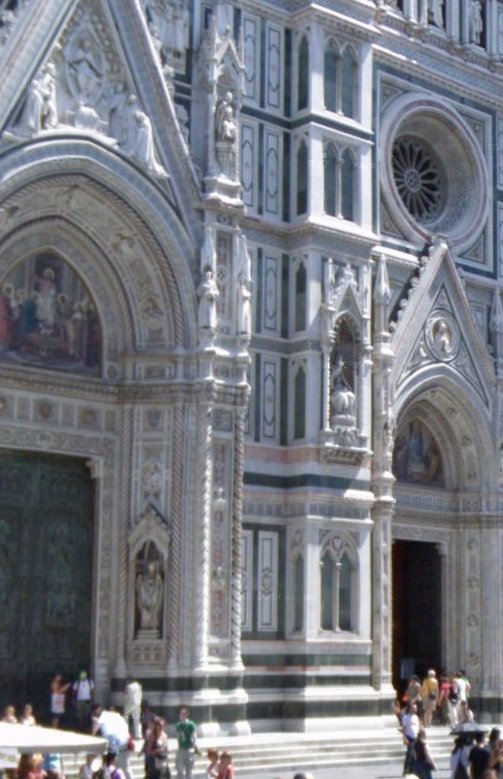
At least the Duomo casts a cool shade on these steps. My photo, from Google Maps, must have been taken at a different time of day, but it shows to advantage the deliciousness of the cathedral, like an ornate wedding-cake. I sit waiting for Godot, in no mood for contemplating sculpted marble, even if it looks good enough to eat. Food is my main concern now. I could sleep anywhere, as in Paris, but if I run out of food money, I’ll have to surrender my passport at the British Embassy, and get the fare back home. (Which is what I did, at the end.)
Godot arrives, or at any rate a man sidles up and asks, in what I would call a Brooklyn accent, whether I would be interested to work in a movie. Politeness prevents me from laughing out loud at his clichéd pickup line. I flinch at his physical closeness. He is sensitive to my concern, and hastens to introduces himself, with a business card, as Leo Rogelberg, cinematographer, Coronet Films, Chicago. Why me, though? Hunch, he says. I look intelligent, with time on my hands—and needy. I’m not exactly a tramp; my ragged clothes are clean, but I’ve had a little problem with footwear, solved for the moment with string carefully applied to my sandals. I’m suspicious, but in no position to turn him down flat, for surely all Americans are rich, by European standards? Aren’t film-makers the richest of all? Cecil B De Mille for example. Leo sets me straight.
Coronet Films have given him a low budget for an educational film on the art works of Michelangelo, painter of the Sistine Chapel ceiling; sculptor and architect of other works surviving in Rome and Florence. He’s just come from a difficult few days in Rome. First, the Vatican wouldn’t give him permission to film in the Sistine Chapel. So he had to make do with a series of colour photographs, carefully pasted together, filming those as if they were the real thing. Second, his van was broken into, his cine-cameras stolen. He phoned Coronet but they weren’t sympathetic: he’d damn well better have insured them properly; and surely he knew what Rome was like?
So, he now wants an assistant who’ll work for peanuts, or more precisely, nice fresh salami sandwiches and Coca Cola whilst we’re filming. (And in the event, plenty of beers when we got to know one another.) I am in no position to refuse. I am to be lighting technician, that is, I will set up the lights, switch them on and off; I will help carry the equipment; and I will chalk scene references on the clapperboard, holding it up to the camera at the beginning of each take.
There must be many whose climb to movie stardom started on a lower rung.
*****
 Our first assignment was in the Battisteria, or Baptistry, a polygonal building facing us as we sat on the Duomo steps. After much negotiation, we got permission to film at night, when there were no visitors and we could set up lights as we wished. We were supposed to pay for a museum attendant’s overtime, but the budget was too tight. We opted for plan B: to be locked in the building from closing time in the evening till opening time in the morning—fifteen hours.
Incarcerated in this Tomb of the Medici (I guess it had the dual function of baptism and entombment) for hour upon uncomprehending hour, in an eerie, bleary sleepless stupor, I remember best gazing dully at the breasts of Night. Yes, you may ask. The statue in my illustration is called Night, and I still suspect that Michelangelo used an androgynous young man for a model, adding breasts based on the shape of a pomegranate. Its partner, known as Day, is equally disturbing. I consoled myself with the thought that no one since Michelangelo himself might have gazed on those breasts so continually (and so critically).
Naturally we took victuals with us. After all, they were my only payment. The knights in Malory’s Morte D’Arthur fasted and stood vigil over their arms all night in a chapel, and prayed. But they weren’t stuck in one for fifteen hours.
Another day, we entered the Duomo to shoot the Florentine Pietà, or Deposition from the Cross. (The artist carved several others.) This one, a late work, has Jesus with only one leg, a peculiarity about which art critics speculate and disagree. The hooded figure of Joseph of Arimathea is a self-portrait of Michelangelo as an old man. It’s in the Cathedral museum today but in 1962 it was the centrepiece of its own chapel. A “typical American family” had been recruited as unpaid extras, to admire it. I had to read out the script at a certain speed, in a loud clear voice, to synchronise shooting and actors. You’d think statues were easy to shoot, compared to children, animals and demanding superstars: but to a beginner they are complicated enough. I put all I had into the reading, as if I would be in the final cut, and not replaced by a voiceover.
I won’t bore you with details of all the subjects we covered, but my proudest moment was to play the artist himself, in a scene when he stands on the bank of the river Arno, tossing in pebbles abstractedly. Only my hand was in the shot, and for all I know, it was cut out in post-production.
Soon after meeting Leo on the cathedral steps, I tracked down my fellow-students, and briefly considered signing up for summer courses with them al’Università degli Studi di Firenze. But I thought better of it, chose to remain, for the time being, an ex-student. But I did start going to the student canteen, and quite coincidentally met a sculptor, for Leo asked me to look out for one, as he wished to commission a fig-leaf. Our film was to be shown to schools across the USA, and in the Southern States, it seems, attitudes were a little Victorian. The problem was the famous statue of David. Queen Victoria had a fig-leaf made for her visit to the Victoria and Albert Museum in London, which housed a cast of David. Not that ladies were ever offended when the anatomically correct details on this fine piece were put on open display. The director of the Museum reported:
‘The antique casts gallery has been very much used by private lady teachers for the instruction of young girl students and none of them has ever complained even indirectly’. (Source: V&A; Museum website: “David’s Fig Leaf”.)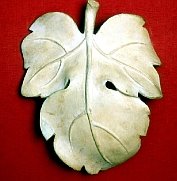
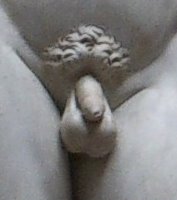
The museum attendants at the Accademia Gallery seemed to think we were perverts when we asked to climb a stepladder for measurements. At any rate, they refused our request. We had an idea. Under a disapproving glare, we measured David’s right big toe. In the gallery shop we bought a postcard of the statue, and used arithmetic to calculate the required fig-leaf coverage.
As for the movie, it survives in several libraries, summarised as follows:
Michelangelo and his Art, videocassette (16 min.) : sd., col. ; 1/2 in. VHS.
Traces the life and career of Michelangelo–sculptor, painter, architect, and poet–pointing out that his knowledge of the human body and his skill in portraying human emotion through the body made him one of the great artists of all time as well as a leading figure of the Italian Renaissance. Photographs analyze some of his original works, including David, Pietà, Moses, Deposition, and the figures of the Medici Chapel.
Subject: Michelangelo Buonarroti, 1475-1564.
Author/Illus: Coronet/MTI Film and Video.
Before we parted, Leo typed out a “To whom it may concern” testimonial, which I kept proudly for many years. We promised to keep in touch and never did. The Web has nothing to say about him after 1968, when he had a company doing documentaries. But I’ve written to another documentary company, run by two Rogelbergs. I think they must be related to Leo! Will let you know the outcome.
 a wayfarer’s notes