

 By kindly grace of destiny, I have a whole house to roam in, so there should be no need to go wayfaring outside, where it’s cold, especially as my leg hurts and I’m waiting for the postman, who’s due to deliver a package that won’t fit through the slot in the door. I can roam around indoors: so convenient for writing, and I can do tidying in the meantime, for I can’t seem to get any inspiration gazing at a screen.
I don’t think we can exactly choose our mood, despite what some say, any more than we can blow into the sails to make our boat go forward. What we can do is be sensitive to the breeze and trim our sails to take advantage of every zephyr that could possibly take us where we need to go: need, not want.
Being a savage, and not a whit ashamed of it, I’m neurologically wired to a sense of place. The whole visible, smellable universe is redolent with associations; thus something happened in this spot, or reminds me of something that happened somewhere else; the scent of the resin from pine, laurel or holly evokes this or that. I cannot pass a certain telegraph pole in the street without its weatherworn tarred surface reminding me of Australia, a land I left sixty-two years ago. Many things remind me of the ocean journey that brought me to England, with its smell of fresh paint, diesel oil, sewage and salt spray. Memory provides its own kind of presence, one sense invoking the other, so now I feel the constant shuddering of the ship’s decks and bulkheads, the warm exhalations from the ventilator cowls, the daily adventure of getting lost and feeling quite safe, for on board everyone knew me, almost all were women, war brides predominantly. I suppose I used to feel on that ship as a rock star must feel when he dives into the audience and they combine to hold him aloft. Leaving Australia was an exile and loss, but the shipboard journey was a consoling interregnum. I was only four at the time, but all the same I could feel, as I feel now. It astonishes me when I hear a person confess to nothing but vague memories before the age of eight, when up till that age mine are at their most clear and poignant.
This house, too, reminds me of a ship, an imaginary one, not the one in which I sailed from Fremantle to Tilbury. It’s cosy and narrow: a 12-foot-wide slice in a row of similar houses all joined together. But from front to back—I just ran a steel tape measure between the two—is 38 foot. Te rooms are furnished simply, and though they are rather dark, the furniture and doors are of real wood, whose glow is derived from the sun’s fecundating rays. Where I sit now, which we call the middle room, for it leads to a smaller room at the back, has an arrangement of five washing lines strung across the room, where in winter drying sheets hang slackly like the sails of a becalmed schooner.
My savage’s sense of place is illogical. I do all my writing up here in the middle room with its view of a south-facing hillside, but since I also have the use of a laptop, I sometimes check my emails downstairs at the oval elm table. Logically and in cyberspace, upstairs or downstairs will give the same result; but my savage mind—to whom ritual, place and raw sense-input mean so much—can never quite accept that. Whether revering the sacred or fleeing a life-threat, my savage-mind responds to associations as tree-fronds fluttering in the breeze: sensitively. Another example: both of the times I visited India, in ’90 and ’92, I got sick; and what I judged to be after-effects persisted for years. So when a cyber-friend proposes we meet physically in Bengal, in a future incarnation, I’m forced to decline. He thinks I’m a fool, for other reasons, I should add, but it’s hard for a Westerner to avoid that fate. It’s easier to be wise in India, where the air is clear enough to refract thought and imagination in ways that would never occur to us within these foggy shores; ways which, here, we might consider foolishness.
BBC Radio 4 had a programme on Metaphor, a word which in modern Greek means Transportation. So how could you explain to a Greek trucker that in English we only use the word metaphorically? He earns his whole living being metaphorical, i.e. travelling from A to B: what’s poetical about that? Someone on the programme spoke of metaphors buried so deep we don’t notice them, like using space as a metaphor for time. We treat “long ago” like “far away”.
“The past is another country: they do things differently there.” But why shouldn’t I accept time as it actually appears to me? Here upstairs in the middle room, I may try to visualise the kitchen below, but my imagination can summon my grandmother’s kitchen ten times more vividly, in spite of or perhaps because of the fact it has gone; furthermore, she died in 1963. The big house in which she had a kitchen installed on the middle floor in 1948 has long been demolished, replaced by a block of flats, with the large garden converted to a residents’ car park. But I can revisit her kitchen, smell it, know where everything is, help her by putting leftover cold meat through the mincer. Travelling in space involves real distance. You can’t see beyond the horizon. Time travel can be instant, needing only memory and imagination.
God is another metaphor—for something inexpressible & known only in the present, as near or far.

Later: It’s not dawn yet, but I’ve turned on the heating and lit a candle. Through this study window that keeps a secret eye on the wider world, I see in the street’s yellow lamplight the snowflakes falling. I’ve just finished the last few pages of Crime and Punishment, illuminated at the very last by redemption and love, a longed-for future. I’m encouraged to learn that this great and complex novel was written swiftly, its author being spurred on by crippling debts as a result of losing everything at the casino. It’s good to know what resources one has to call upon when necessity hammers on the door like a bailiff claiming his due. In Dostoyevsky’s case, he invents a character who’s in a similar predicament, and conceives a drastic solution, attempts to justify it morally. That is to say to persuade himself that he’s not murdering the old moneylender for money’s sake; only as an “existential act”. Still, I see enough of myself in him, enough cause for guilt. My penance has been longer than his eight years’ penal servitude in Siberia Taking Dostoyevsky’s harrowing tale personally, living his character’s feverish dreams and his daily reality in the streets and tenements of St Petersburg, I get a vicarious shot at redemption. And whilst his tale had immediate meaning in the Russia of 1865, it’s open-ended, many-faceted. I have been and am still that young man who thinks he knows better, can make his own rules. Like him I yearn eventually to be received into the common blessing. There’s a world here, for Crime and Punishment “represents the first act in a gigantic Shakespearian tragedy, the other three acts of which are The Idiot, The Devils and The Brothers Karamazov” (says its translator, David McDuff). Will I complete that literary journey? I don’t know, but have discovered that my favourite Christian, the only one who would bring me back to the Church of my childhood, Archbishop Rowan Williams has recently written a book on Dostoyevsky.
I wonder if he and I will agree on why Raskolnikov’s deed is a sin as well as a crime? Not because “Thou shalt not kill” is one of the Ten Commandments, say I. No, it is one of the Ten Commandments because, as Dostoyevsky shows, the deed causes such enduring distress to its perpetrator and those he meets. It’s that distress which separates him from redemption. This is a Christian lesson we don’t get in the Bible.
The book is not about murder, then, but the very concept and origin of sin, in terms so much more relevant than the eating of the forbidden fruit, or the slaying of Abel, or the merciless punishment of the Flood. Come on Rowan Williams, come out from the library through which I have summoned your phantasm (your book, I mean)! Let us duel.
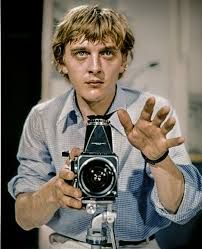 Straight after Raskolnikov, I’ve been letting my soul go for a ride with another reprehensible protagonist: the unnamed photographer of Antonioni’s Blow-up, played by David Hemmings as a bored playboy, who in one scene reminds me of a remark by Marc, commenting on my last: “Every time I ever pointed to a passing girl or woman and, in a commanding voice, said ‘You! Come over here,’ they did so”—as indeed in the scene where Hemmings commands Vanessa Redgrave to sit on the sofa. (NB, it’s Varuschka, not Redgrave, in the photo.) She surprises herself by meekly obeying, but then she’s come to get possession of the incriminating negatives and will stop at nothing. Other dolly-birds of the Swinging Sixties throw themselves at him, anything to be photographed, and they romp and strip in a roll of violet backdrop paper. But this was just the cappuccino froth on the director’s intent: according to the audio commentary, “we impose a narrative on our life, forcing the inchoate reality to carry a meaning”. And then the commentator says, “All meaning is interpersonal,” explaining how Hemmings needs someone else to also see the corpse in the park, to validate that he didn’t just imagine it. The corpse is gone. So he joins in a game of tennis without a ball: the others believe in it, so he can too.
A becalmed schooner; Raskolnikov; the playboy photographer of Blow-up; Dostoyevsky; the current Archbishop of Canterbury; the late mincer in my late grandmother’s late kitchen. What do these have in common? Only this, that as in life, as in a Dostoyevsky novel or an Antonioni film, they may suggest different perspectives.
 a wayfarer’s notes