

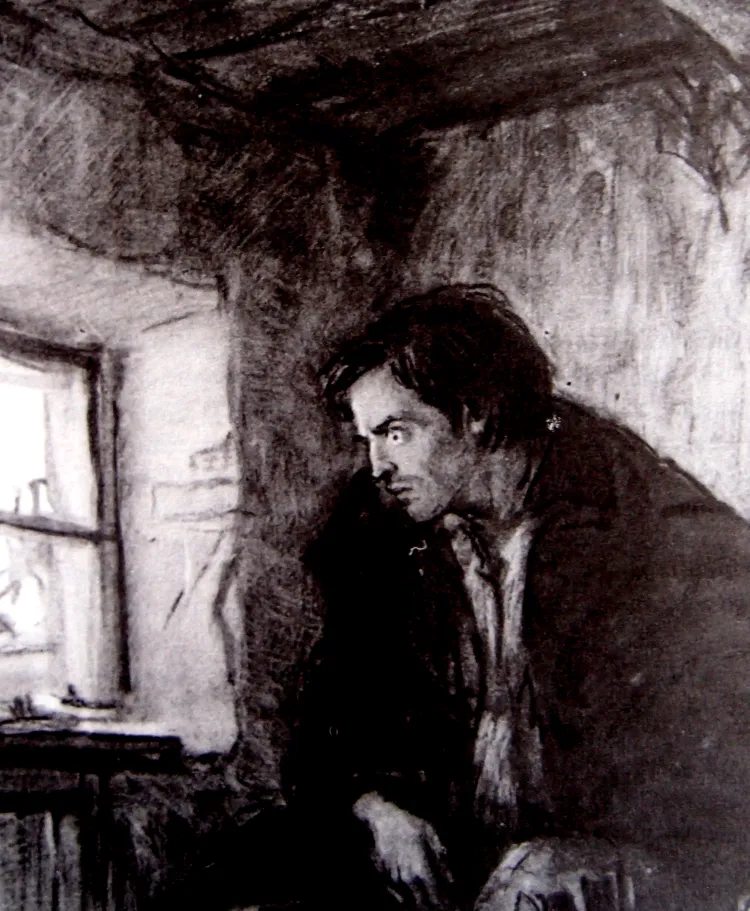
It’s not dawn yet, but I’ve turned on the heating and lit a candle. Through this study window that keeps a secret eye on the wider world, I see in the street’s yellow lamplight the snowflakes falling. I’ve just finished the last few pages of Crime and Punishment, illuminated at the very last by redemption and love, a longed-for future. It encourages me to discover that this great and complex novel was written swiftly, its author being spurred on by crippling debts as a result of losing everything at the casino. Not because he is like me in that—quite the opposite. Nor, superficially, do I resemble Raskolnikov, for I have murdered no old pawnbroker, neither for money nor as an existential act. Still, I see enough of myself in him, and my own penance has been longer than eight years’ penal servitude in Siberia, without washing the guilt off my hands. Yet by taking Dostoyevsky’s harrowing tale personally, living his character’s feverish dreams and his daily reality in the streets and tenements of St Petersburg, I too get my shot at redemption. And whilst his tale had immediate meaning in the Russia of 1865, it’s open-ended, many-faceted. I have been and am still that young man who thinks he knows better, can make his own rules. Like him I yearn eventually to be received into the common blessing. There’s a world here, for Crime and Punishment “represents the first act in a gigantic Shakespearian tragedy, the other three acts of which are The Idiot, The Devils and The Brothers Karamazov” (says its translator, David McDuff). Will I complete that literary journey? I don’t know, but have discovered that my favourite Christian, the only one who would bring me back to the Church of my childhood, Archbishop Rowan Williams, has recently written a book on Dostoyevsky.
I wonder if he and I will agree on why Raskolnikov’s deed is a sin as well as a crime? Not because “Thou shalt not kill” is one of the Ten Commandments, say I. No, it is one of the Ten Commandments because, as Dostoyevsky shows, the deed causes such enduring distress to its perpetrator and those he meets. It’s that distress which separates him from redemption. This is a Christian lesson we don’t get in the Bible.
The book is not about murder, then, but the very concept and origin of sin, in terms so much more relevant than the eating of the forbidden fruit, or the slaying of Abel, or the merciless punishment of the Flood. Come on Rowan Williams, come out from the library through which I have summoned your phantasm (your book, I mean)! Let us duel.
 a wayfarer’s notes