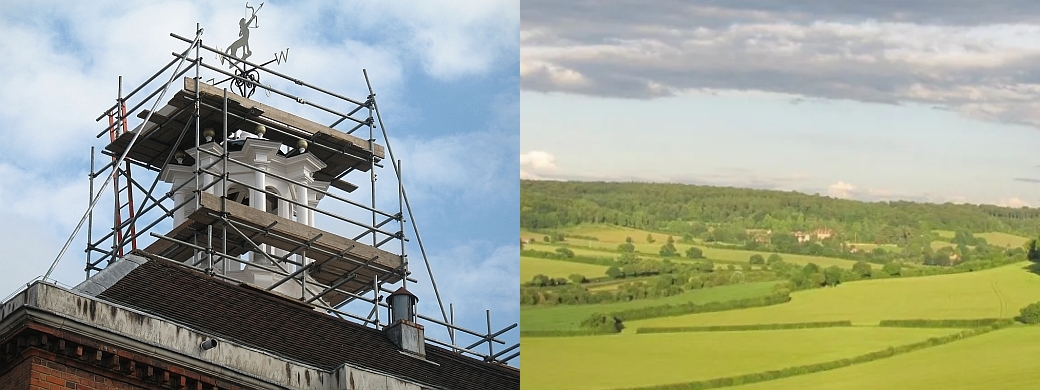

 In hindsight, my last post sounds a little Quixotic: retired man goes on mysterious Quest, tries to attach importance to his ramblings — the ones on foot and the verbal ones, both. That’s a fair enough summary, especially the reference to “hindsight” — a theme I’ll develop further.
On the walk I partly described in my last, I encountered no windmills to charge at, only a field of young bulls. Their behaviour makes perfect sense when you see them as male teenagers, alert to strangers setting foot on their territory, competing to be the boldest.
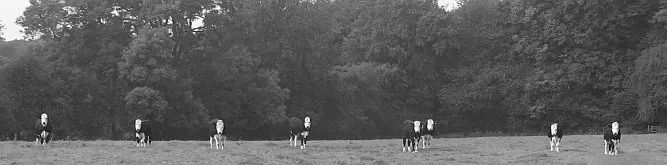
In my last, I had wandered, in Dante’s words, per una selva oscura — through a dark wood, all the while glimpsing sunlit meadows through the dappled leaves, but frustrated in my attempts to get there; increasingly rebellious, hemmed in by barbed wire and the limitations of public rights of way. At last I was back on the official footpath, but, with warnings to keep my dog on a leash, it led straight through this gang of truculent bovines. I was mindful of Hayden’s wisdom about animals: to look them fixedly in the eye is a provocation, as it would be with us. So I lowered my gaze to the ground and kept my distance from the bull who stood in my way on the path I was to follow. Soon after I had passed, the gang decided to follow me, their snuffling breath hot on my heels. I was tempted to make a run for it but kept a steady pace till I reached the stile, a toreador in an audience of bulls. After 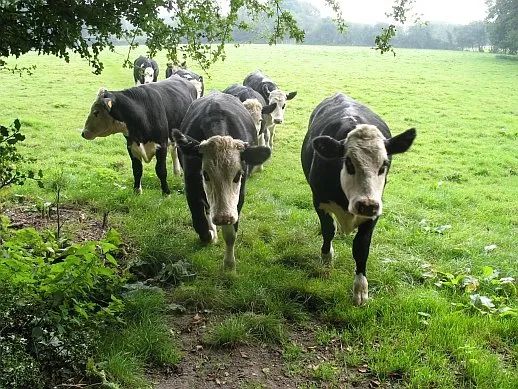 climbing over, I was safe, and so were they from me, so we could test one another’s valour without risk. Beneath their aggression they were shy, and the flash from my camera startled them a little.
Beyond the guardian bulls, the other side of the rustic stile, I arrived at a different terrain. All at once I was put in mind of two books I’d found at my grandparents’ house as a child, by Gene Stratton Porter: The Song of the Cardinal and Girl of the Limberlost. I had not wanted to read them. They seemed like books for girls and moreover they spoke of the solitary life in forests. That wasn’t what I wanted. I missed the adventurous company of my cousin Mark, who was still absent in Kenya, or his mother my Aunt Peggy, who was adventurous in her own ways and always had suggestions for how I might spend my time. My intrinsic wayfaring nature has not changed: but in adolescence we boys are swayed by powerful ungovernable forces which predispose us to swagger in gangs, and later hunt for the female prize: sex and reproduction.
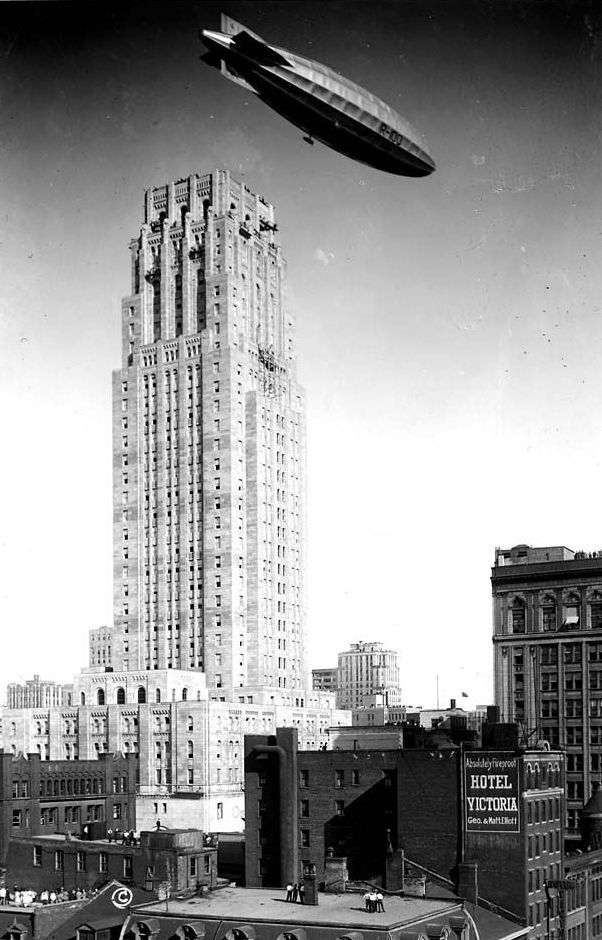
Before entering that new terrain beyond the bulls, I want to mention another book: Slide Rule, the autobiography of aeronautical engineer and novelist Nevil Shute. Much of his story is devoted to contrasting two projects which ran side by side in competition. These were to develop airships. One, the R100, was developed using private capital, and Shute was its “Chief Calculator”, responsible for determining the stresses on components and assembly, a repetitive arithmetical task in the days before computers or even electronic calculators: hence the slide rule of his title.
The competing project was sponsored by the British Government and managed by civil servants. It produced the R101, notorious for crashing with much loss of life on its maiden international flight.
Why did one project succeed and the other fail? Shute offers many reasons. As an engineer he is passionate on the subject, and as an engineer myself (if only of the software variety) I was fascinated by the wealth of detail. As a novelist fascinated by human motivation he noted something which has stuck in my mind for twenty years, since I first read his memoir. It’s rather too long to quote in full, but it goes like this. Those whose remuneration is subject to their status in a hierarchy, who depend on their jobs to support themselves and family, can’t afford to speak out (blow the whistle, as we would now say) when they see things happen which offend their professional judgement. Greed distorts vision, as we see in this world financial crisis. Those with private means, on the other hand, can afford to be brave and speak the truth. Shute wraps up his observations as follows:

I do not know the financial condition of the high officials in the Air Ministry at the time of the R101 disaster. I suspect, however, that an investigation would reveal that it was England’s bad luck that at that time [around 1929] none of them had any substantial private means. At rock bottom, that to me is probably the fundamental cause of the tragedy.
I was going to describe the “terrain beyond the bulls”. The above digression may appear irrelevant to that thread, but all will be revealed. I wrote in my last:
I’m fulfilling the obligations of retirement from professional life. The shackles are off now, so I must act like a man released to freedom.
I don’t know who has private means these days, or what they do with it; but retirement on a small pension is pretty near to it, when you’re in good health and free from encumbrance. It’s not a time to pursue money or fame. I suppose many of those boys I went to school with are school governors now, or sitting on committees or charity boards, giving their views fearlessly, their honesty being its own reward. I can understand the pull towards community which some may feel: to pay back something of what they have received.
I’m a lifelong avoider of community, though I help my neighbours, whether on the street, or, through an old people’s charity, those who need the services of a handyman to fix things they have no longer the strength to do. Beyond that, I feel the urge to explore certain mysteries of life: to leave the safe flock and pursue certain inner impulses. This global weblog is a log of those explorations. A tentative hypothesis will be revealed in my next: or perhaps the post after that. Anyway, sooner or later.
 a wayfarer’s notes
Interesting ramble, vincent, both the physical jaunt and the mental journey. I don't think I'd have had the courage to not look at the bulls at all (grin) – I tend to imitate a cat in such situations, and spend a lot of time gazing into the near distance past the target of my interest, blink, glance, look away.
I don't know cows/bulls at all, but I'm reminded that I've been told they are intensely curious creatures when not feeling threatened. I'm told if you lie or sit on the ground they will come from across the pasture and stand in a ring around you to stare and wonder. By sitting/lying you are no longer acting like a normal 'human' in their minds, and they can't figure out what you are up to.
Could be they followed you for a similar reason. You walked past and beyond, and they just wanted to see what would happen next.
LikeLike
yes–good ramble. often times they follow–waiting to be fed. Is that a metaphor?
LikeLike
We shall not cease from exploration… eh? Good ramble, both in the field with teenage bulls, and in pondering the ways of the world. But as Eliot says, at the end of all our exploring we arrive at the place we started and know it for the first time.
Happy rambling 🙂
LikeLike
Me being a city boy I think I may have sprinted like Dwayne Chambers on happy pills had I encountered a field full of living, breathing quarter pounders! Give me an estate full of hoodies anyday of the week!
LikeLike
Lehane, don't you wonder if there is a wish-granting angel, or a bottle-raised Genie, listening to your every utterance, oblivious to your figurative rhetorical expressions?
Give me an estate full of hoodies anyday of the week!
“Yes, O Master! I shall choose the day, when you least expect it!”
LikeLike
Hayden, now you have given me food for thought. All the fascinating animals in my life (cats, spiders, slugs, rats, various types of birds, sheep, cattle, the occasional dog). I wonder to what extent they judge whether I am acting like a normal human in their minds, studying me as I study them. The neighbourhood black cat, who has not managed to tame any human fully enough to act as its “owner” for example.
LikeLike
Abs van Aty: indeed. I think the whole objective of my writing is to arrive back at the millions of places I started and know them for the first time.
And I discovered some things about Eliot that may be woven into my next …
LikeLike
Scot, I tend to think everything turns out to be a metaphor, though it may not have been apparent at the time, to author or reader.
Indeed, putting that down on the screen a second ago, I tried those words out on life. Isn't life like a blog, where every reader is also an author; or to put it in normal words, isn't every observer also an actor?
Perhaps this is the unfettered effect of trying to think after being awakened at 4am, and being pursued gently by a small herd of metaphors who think they are in a dream; or perhaps it is I who think I am awake.
LikeLike