
I went for the fourth time in a week, on an errand to Slough. It’s a town occupying a special place in the British imagination: perhaps from The Pilgrim’s Progress, which describes the Slough of Despond. “Slough”: a strange English noun, meaning a muddy place: does it rhyme with “cough”, “through”, “though”, or “rough”? With none of these: it rhymes with “now”.
Others will remember that our late Poet Laureate, Sir John Betjeman, dedicated a 1937 poem to Slough. It starts:
Come friendly bombs and fall on Slough!
It isn’t fit for humans now,
There isn’t grass to graze a cow.
Swarm over, Death!
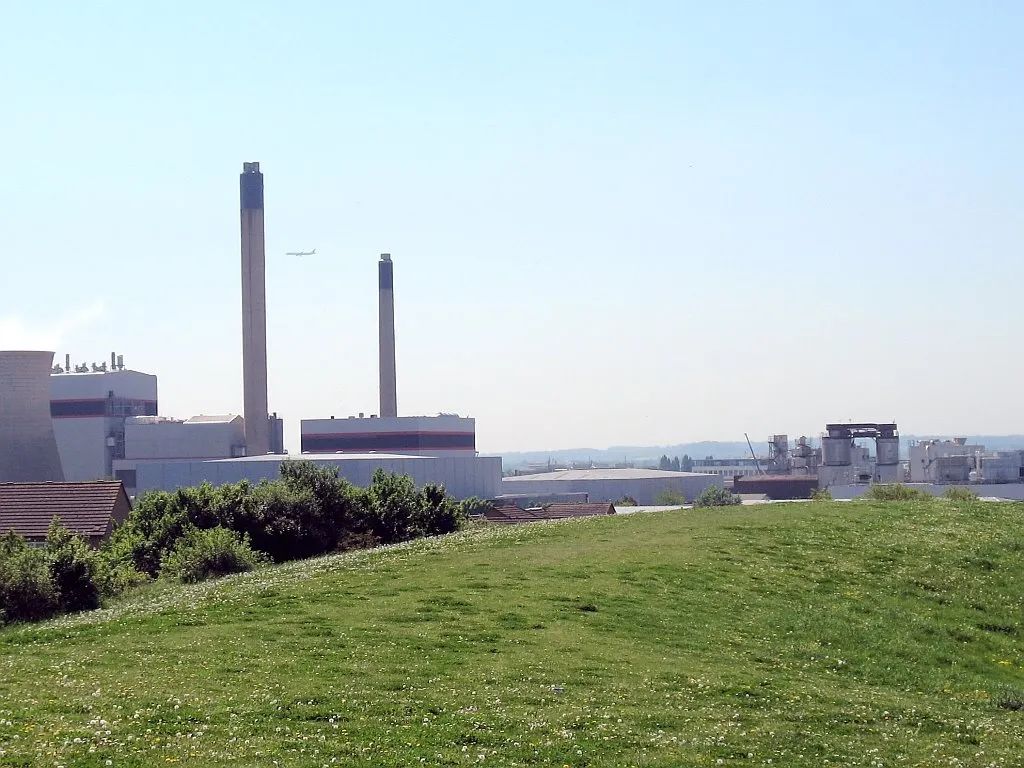
I have always liked the town. I was about to say “despite …” but there is no need to balance it with negatives. It’s a brash defiant ants’ nest; a town on the plain which expanded quickly, not quite in the overall grid-iron pattern of an American city but more grid-like than most English towns. It has some wide tree-lined avenues with headquarter buildings of glass and steel with names like Federal-Mogul, set behind lawns. It has the Mars factory, manufacturing chocolate bars, owned by the famous American family: you can see it in my photo, along with enough grass to graze several cows. I took it from Kennedy Park. Don’t think of an ornamental area laid out to commemorate the late US President. It’s a few acres for walking dogs and flying kites: hollows and thickets provide opportunities for other activities requiring seclusion. It’s really waste land spared by the developers. The little hill I stood on was probably soil dumped when they excavated the land for a building programme.
Why am I walking around these mundane streets of Slough, so unlike its sister towns just the other side of the river Thames: Eton with its aristocratic College, Windsor with its Royal Castle which has given a surname to the Queen and her direct descendants? I’m walking here because it was here three years ago that I found I could walk again.
I sit here at the very spot, the Sheffield Road Rest Gardens, a little quadrant next to a busy crossroads and rows of shops. It has trees, flowerbeds and benches. I’d like to choose the shadiest bench but it’s occupied. A man sits alone there, quite still. I respect his space. That’s the bench where I sat with K that time, to eat the pizzas we’d bought, after our trip to a nearby village. There I’d consulted a doctor specialising in my condition: one which caused a kind of allergic reaction to the slightest exercise. The flare-up could last days or weeks, so I had to be careful at all times; but on that occasion I insisted we could leave the car and go over to the gardens to eat our pizza. “Are you sure?” asked K. I was. Something had happened in the doctor’s surgery. All he did was tell me the theory and ask some questions. Answering one of those questions, I knew that I became well at that instant. He had asked me about the onset of the illness. It was in 1973. I saw that I had repressed a desire to be free, for an altruistic motive. As talking therapies go, this was like laser surgery done with pinpoint accuracy. I saw the repression, acknowledged it freely, laid my burden on the ground and walked away from it. The doctor had no idea what had happened; didn’t quite believe me when I emailed him the next day to say I was well.
I think this is how the miracles of Jesus worked. A simple encounter and you throw away your crutch. I didn’t have a literal crutch but I donated my wheelchair to charity. I developed more stamina each day, gave thanks for the ability to go and post a letter without fear; to travel to a place without having to park the car close by. Since then the act of walking, healthy like a young man again, when I’d been getting ready to die, is a sacred act of thanksgiving.
So here I am, sitting on a nearby bench in the Rest Gardens with my Explorer Map—2½ inches to the mile. I find the spot and mark it with a tiny dot, as if to say “Here was a miracle”. The man on the other bench comes over and asks “Are you trying to find your way?” I tell him briefly why I’m here. He listens intently, but he stands four feet away, as if respectfully. Perhaps he doesn’t want me to smell his worn and grimy clothes. His face is lined and weary but he’s bright enough.
He’s a carpenter, but cannot work due to epilepsy. He could fall off a ladder, hurt himself with tools. For the same reason he cannot drive a car. We talk, discussing possibilities. In this of all places, I think, there must be hope. Our encounter must have a meaning. I tell him about my application to work as a handyman for an old people’s charity. Perhaps he could do that? He seems interested. It’s a voluntary scheme, but it could restore a man’s self-respect. I explain that I haven’t started: still waiting for my Criminal Records Board check to be completed. He tells me insistently that he has no criminal record. Poor man! Does he think I suspected otherwise?
I wonder if our encounter could change his luck, could in some way answer his unspoken prayer. But why should I need to know the detail? I know miracles can happen.
 a wayfarer’s notes
Following my mention of Federal-Mogul, having seen a sign with that name on my visit to Slough, I discover that this blog post is being referenced on a financial web page, showing a graph of the corporation's share values on the Nasdaq index. A bit scary, especially as I implied they have a headquarters building in Slough, which was poetic licence. It was a small sign in a back street possibly with no connection to the global parent.
LikeLike
No wonder you adore your walks through the countryside so fully!
LikeLike
so you have experienced god! this post was refreshing.
LikeLike
thanks for the post–I have also experienced a miracle complete with angels though it did not directly affect my health…
LikeLike
Altruistic captivity? I don't quite know, but can possibly identify.
I agree with you about the Jesus method possibility, I think so. I also think that we as a species are further from that possible method than ever before. Sad. But your story grants hope Vincent.
Coincidence maybe, but just this very evening, I retired my wheel chair. My crutches I couldn't do without were retired several months ago. The wheelchair, I just realized this very night, has been causing me physical problems other than the one I had it for, serious problems that just became overpowering this past weekend.
I am hoping the casting off of the chair will allow, now, the other problems to heal. You give me hope.
I totally enjoyed the reading Vincent, excellent as usual, and most interesting, I would love to go for a walk with you, albeit would be a short one due to my foot and leg, but it would be interesting and certainly real.
Thanks Vincent. I am having computer problems so have taken the previous two posts with me to read and return for commenting. Thanks for a great visit, I'll be back Vincent.
LikeLike
Funny how things happen. My wife was diagnosed 2 days ago with pneumonia. Her doctor was close to checking her into a hospital for an IV.
Since I work from home this has provided us with some much overdue time together. She is recovering slowly, and we are enjoying the time together.
It has been a healing process in more ways than one.
A happy coincidence, and one we will likely reap the benefits from for a long time to come.
Lovely writing as usual Vincent.
Thank you.
LikeLike
Charles, that is a very positive way of looking at pneumonia! May she get well soon and you both enjoy the time meanwhile.
LikeLike
Jim, you mention hope. It is surely the greatest healer in the pharmacopoeia. Yes, I too would enjoy that walk, but where? I invite you here to England, as an excuse to avoid travel to Texas!
LikeLike
Beth, yes, it is a reason for enjoying the walking so fully but the mania was there before, mostly unrecognized. I was a lone wayfarer as soon as I could walk. One day in Australia my mother left me unattended on the veranda in a wooden playpen. She was horrified to find me gone, the playpen too. Neighbours saw me going down the road towards the river, pushing the playpen forward like an elderly person with a walking-frame.
LikeLike
Ghetu, experienced god? Well, everything is there to be experienced all the time. Religions try to make it sound hard! But suppose it isn't hard at all?
LikeLike
Scot I would ask you to tell that story of miracle and angels. Except that I know from my own such experiences that they are not always easy to tell, being so intimate. But you are a writer, you could find a way!
LikeLike
You made me think of a very short poem by Peter Riley (in The Day's Final Balance), titled “Against Betjeman”:
A back garden in Slough, a young woman
sits on a kitchen chair under a tree,
suckling a baby.
This is what is happening in Slough.
LikeLike
Michael, that is such a perfect poem that it could easily make me believe I witnessed the scene itself, on that walk.
LikeLike