

If you have been following the halting progress of my childhood memoirs on this direct and intimate medium—where it is possible to publish worldwide before the ink has dried on one’s words though ink is not actually used—you might not be aware of just how halting the progress actually is. You might think that Vincent is a busy man who dashes off a new instalment as fast as his other obligations permit, and posts them on Blogger just as a housewife would peg out her washing to dry in the breeze. Well, I’m the housewife round here and the weather hasn’t been favourable for pegging out clothes. In the same manner, my second instalment of the Cherrydown era has been lying damp and half-drafted for days like washing that might go spotty with mildew if it’s not soon not hung out for all to see. But please understand that there are difficulties. I’d love to do a thousand words each day, but the subject-matter is often delicate.
In this instance, the memories are vivid, resonating strangely with my present life. It was at Cherrydown that I discovered an interest in crafts and engineering. My stepfather Blackett was an engineer himself, a failed one from his point of view, so till the end of his life he tried to redeem himself by inventing things in his shed, sending prototypes to manufacturers, or installing them around the house. I seem to have inherited similar traits. I’d just as soon pit my wits in some minor design-and-build project, as write this thousand words. The same kind of creativity is involved but the physical activity of bricklaying (which I was doing today) seems more primitively human than tapping away at a computer, and therefore preferable. But now I worry that my rendering mixture had too much sand and too little cement. (I always push myself to the point of worry.)
I remember where I was—in the kitchen of Cherrydown—when Blackett said I should go into electronics: “It’s going to be the big thing soon!” He was so right. It was in 1956 that I discovered the germanium diode, which made crystal wireless sets so much easier to construct. Yes, I discovered the germanium diode. I didn’t of course invent it. I mean that I went to a shop in town which sold radio components and discovered that they had this magical transistor thing in stock. Before that I had used a galena crystal with a phosphor-bronze “cat’s whisker”. They had to be positioned so that the wire touched the crystal on a good sensitive spot. Replacing these components in the circuit by a factory-made diode—two wires sticking out of a little glass thing half-an-inch long—made one less thing to be obsessive about. There were still the other components: the variable condenser to tune to the different stations, the coils for capturing the long, medium or short wave ranges; the aerial which needed to be long and high; the earth connection for which I used a copper rod of cruciform cross-section hammered into the earth itself, rather than attach it to the cold-water pipes or earth-wires of the house electrical circuits. Crystal sets are magical because they work entirely without electricity.
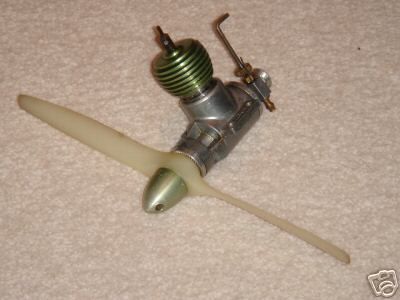
Blackett gave me a little diesel engine, similar to the one in my illustration. I never got as far as putting it in a model aircraft, never mind the reasons for now. I clamped it to the work-bench in the shed. Blackett could not have functioned without a work-bench in a shed or cellar. It was where he connected to his soul and coincidentally, when my mother instructed him to give up smoking, it was the place where he secretly lit up his menthol cigarettes, till he died of lung cancer. For two entire weekends, I wrestled with the diesel engine, adjusting throttle, compression and fuel mix: all so that it would come to ear-splitting life. That was the longed-for goal, but then it would splutter and die. So I would have to adjust it again and spin-start the propeller till my finger bled.
My obsessions have always been fired by the intoxication of success and driven by the humiliating sting of failure. Buying Christmas presents was another example. It was a matter of pride to obtain some suitable token from Woolworths for each person on my list. I’ve hated shopping ever since. With the constraints of the shop’s range and my budget it was almost impossible, so one year I resolved to make things instead. I remember making Christmas cards, using a technique Mr Bell had taught us in art class: cut out positive or negative stencils (e.g. candle, stars, holly), position them on the card, dip an old toothbrush in paint and then pull back the bristles with finger, so that they spray dots of paint around the stencil outline. It wasn’t that I couldn’t afford to buy Christmas cards in a shop: I wanted something superior. The most elaborate thing I remember making was for my sister. I had a man’s wrist-watch with no strap, so I cut a square piece of Perspex and using a fretsaw made a hole in it for the watch. With two more squares of perspex, I hinged them all together, to make a miniature travelling-clock which stood in an equilateral triangle, or could be snapped shut like a powder compact. The biggest job with Perspex is to file and then polish the sawn parts to a smooth shine using Brasso, which contains a fine abrasive like jeweller’s rouge.
I haven’t mentioned my drawings and paintings, hand-weaving and chemical experiments—not with a “chemistry set” but with various household chemicals like sodium bicarbonate, vinegar, bleach, permanganate of potash, borax, hydrogen peroxide. Later I made gunpowder and a rocket fuel from two liquids. I’m not intending to boast of my skills: quite the reverse, for it’s more of a confession that my home life was lonely.
When Blackett mentioned electronic engineering as a career, I pitied his ignorance, because I saw myself as a scholar, and him as a poorly-educated man who couldn’t easily express himself. I must at some point have told him I wanted to write books because he said “Odhams Press is a good publisher”. Quietly I looked down on his ignorance. Oxford University Press was closer to my ambition. Odhams was a publisher of popular science, mechanics and encyclopedias. These were the kinds of books he liked to read, as well as war memoirs in Pan paperbacks (e.g. Reach for the Sky, The Latter Days at Colditz). I see now how much he influenced me, even though for most of my adult life I looked back and thought that we never got on. My recollection was that he resented me, glowering silently or muttering to himself, or sometimes he would protest bitterly at “the way yer treat yer muther” in his Tyneside accent that to me sounded so tortured and incoherent. When he addressed me by name, it was usually to deliver a reproach, but when he called me “boy” it brought tears to my eyes for those were the times when he approved of me. It’s only now I realize how much I must have felt to him like a threat: it was I who felt superior to him, with his lack of education and working-class ways. We must have each seen the other as the cuckoo in the nest. He who had spent all his life trying to acquire skills and be recognized for them, must have resented my easy ways of learning, my voracious and scholarly reading of books he would never understand: my perfect spelling and grammar. I discovered by trial and error that only with my exaggerated humility and deference, a kind of tiptoeing so as not to challenge his absolute supremacy, could we get along. Our conversations would be about tools and metals and wood and Perspex; or any other topic in which I would ask him about his knowledge or skill. I don’t blame him for his fierce pride. I wish I could have done more to please him.
 a wayfarer’s notes
Do you mean to tell me, Vincent, that you English think in 'inches' instead of the metric?
Your stories remind me so much of me, but with deviations in the 'motives' and 'intents' department I think. Always make me 'remember' deeper than I would otherwise, if at all in some of the areas.
Speaking of your relationship with the 'man', did you ever, as a youngster, directly and harshly (and very ignorantly, looking back), lash out at adults who were simply doing the best they could and regardless of your estimation, doing very well considering their 'real' situations? I did, and you have reminded me of those. I have made peace with myself long ago about it, acknowledged my youthful ignorance of 'age' and since forgotten most of it, hoping for forgiveness from the victims even as they are deceased for the most part. But remembering that 'age gap' is a good thing, a real thing.
Again, great writing and subjects, thoroughly captivating!
LikeLike
Interesting Vincent, about the metric conversions being resisted there, here they are just totally ignored, what use there is of them is like empty words inside of certain measures.
You have, in your new post, (3), indicated some remorse for your youthful inability to understand the realities of age, that is what my comment referred to, like my criticism and verbal abuse of someone who HONESTLY couldn't see so well anymore, I thought it was just an excuse…and other things like that.
As to going back and apologizing to individuals, there are just too many and too long gone, I have moved around so much and so have they, it is easy to be lost in this country if you are poor and without phones and such. I have learned to be prepared to apologize should our paths cross, but in the meantime, I am very able NOW to forgive myself and all that was done to me by others, without any remorse or grudging.
I enjoy your posts for bringing these things forward and giving me a review, these things are never really finished, they all live with us, like old friends, best to stay acquainted with them.
Thanks Vincent, for the dialogue, wish I had more time, maybe soon.
LikeLike