
What is it to be oneself? “V” commented on my last, à propos Vincent van Gogh, thus:
He was being himself and being well-adjusted to society and his personal circumstances. He became a victim too.
Being oneself doesn’t immune anyone from insanity.
Well, actually being oneself doesn’t really mean anything.
Doesn’t mean anything? Sure, it sounds like a tautology: “I am what I am”. Yet a person who says something invariably means something. So if V says van Gogh was well-adjusted to society, he means something, even though many people would say quite the opposite.
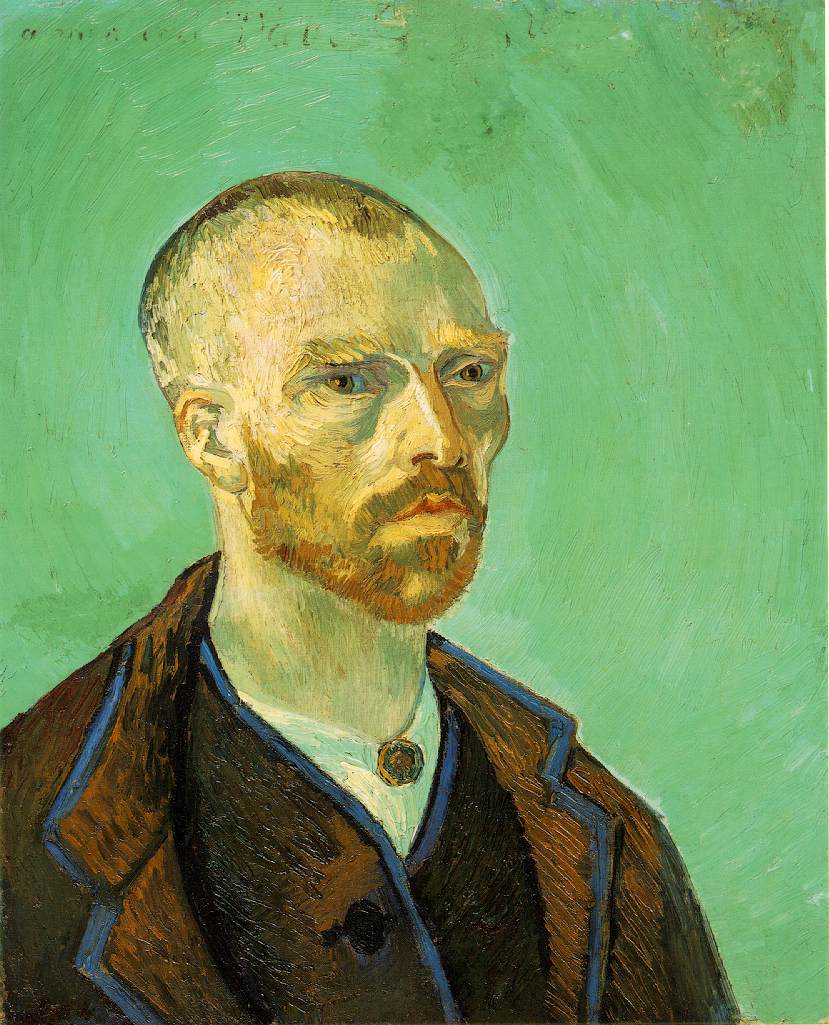
V cannot be ignorant of the man’s life, for its factual details are well-known and not mysterious, with biographies and biopics galore. The richness of information is largely due to the letters exchanged between Vincent and Theo, his art-dealer brother who supported him financially. We know that Vincent’s life was eccentric and tortured at the parental home; also when he was a missionary amongst the Belgian coal-miners; also in his time with Gauguin at the Yellow House at Arles; also in the outbursts of mental illness which persuaded him to seek refuge in an institution; and finally in his stay with Dr Gachet, whose ministrations did not prevent him shooting himself and dying a few days later.
I’m not disagreeing with V, just trying to make sure we are able to find expressive words to explore and compare our attitudes . The matter is crucial to me, because if that Vincent was adjusted to society then I must be too, even if I think I’m not. That Vincent is a hero of mine, as artist and person. And I’d rather talk about him than myself, because I’m shy about my own maladjustments.
Vincent was himself. His inner promptings were more compelling than any urge to meet society’s expectations. To be yourself doesn’t immunize you against insanity—Siegfried is right on this. Nor does it guarantee you happiness.
We could say that being yourself is a calling, with the corollary that not everybody is called. It goes beyond reason. Rational motivation seeks happiness: finds it through moderation and compromise. Being truly yourself may ask you to say goodbye to all that. You enter a realm of mystery, one that’s never solved, because the explanations never work.
Simple things are the most wondrous. Education tries to normalize the mystery within. It tells children there’s nothing to fear in the dark. It denies the existence of a cold lonely road where I don’t know anything but yet desire to go.
There was a time when I thought Buddhism offered a logical answer. Its Four Noble Truths demand that we focus on suffering: (1) it exists; (2) it’s caused by craving (3) the craving can be tackled (4) thus the suffering may be overcome by travelling the Noble Eightfold Path. It is true that I craved and suffered. But I would have done better to find out who I was.
The express train of adulthood came at me furiously, roaring and hissing; I stood on the tracks paralysed with fright. The Noble Eightfold Path had no rescue for my urgent peril. I needed a quick fix and thought I had it in Zen and its offer of instant enlightenment. “There’s a goose in the bottle: how do you get it out without breaking the bottle or killing the goose?” The existence of such a koan hints at a magic answer, the satori moment. So when the express train comes, perhaps I can float up weightless off the tracks; or make my molecules porous, so the train can pass through whilst I am still me, without the bloody impact that seems so imminent.
I knew a man on Death Row in Florida. We exchanged letters for a year or two. I used to tell him my news, illustrated with photos. He was particularly interested when I sent pictures of women that I knew. Through him I heard of Bo Lozoff’s Prison-Ashram Project, which he called Buddhism. I’m in no doubt that it helped him in that place of waiting where the only meaningful action was to make appeals against his sentence forever, one after the other, aided by the least competent lawyers in America.
What is the Noble Truth of Suffering?
Birth is suffering, ageing is suffering, sickness is suffering,
dissociation from the loved is suffering,
not to get what one wants is suffering:
in short the five categories affected by clinging are suffering.
If van Gogh had been a Buddhist, could he have led a “happy life”? Would he have painted? I don’t even believe the questions, much less any answers proposed.

 a wayfarer’s notes
Vincent hello,
all i know (and it ain't much) is that everything alive suffers. I can't change that. All i can do is help. Out of suffering comes many beautiful things, like art for example. compassion is another that comes from suffering. Nobody wants to suffer and we humans come up with all kinds of stuff to help make it go away.
(((hugs)))
LikeLike
I have a question..
To be well-adjusted to society means what?
LikeLike
Like Kathy I am going to choose to address the concept of being well adjusted to societal expectations. Personally, I don't think anyone on this planet ever feels fully competent in society. Often we pretend, but everyone is worried about something. Had Vincent van Gogh conformed to what was expected from those around him I don't think he would have shared his brilliance on canvas. In conforming he would have lost part of himself … thus it is with all of us.
LikeLike
Zo…
The typical Dutchman begins his short or long expressions or statements with “So”. Which gives the impression of himself being a logical and careful thinker. I do the opposite. I tend to inject a lot of nonsense in what I am saying and try to be spontaneous as much as possible. And not worry about whether people understood me or not.
I also tend to try not to think too much. Yesterday I had just wasted myself at a party, drinking and dancing until one o'clock in the morning; I'll probably write about it soon.
Zo, let me just think aloud and write my comment – I don't really like writing long ones.
I thought Van Gogh was being himself. He was being society. Living up to the expectations of society. Conforming. Going along with tradition as well as with modern ideas, especially as it is being explored in art and lifestyle. He was being a typical 19th century man. Obsessed with modern art. Impressionism or expressionism. Whatever.
There is really nothing wrong with this. Conforming is not something we should avoid like a plague. But we must not forget that conforming can lead to much conflict in personal relationships when there is also a lot of non-conforming involved. Either you conform or don't conform. Either you keep the commandments or you suffer the consequences of not keeping them. If there is a lot of non-conforming inspite of tradition, beliefs, social control, etc., there will be a lot of conflict involved. Zo, Vincent was in conflict not only with society but also with himself — this too doesn't mean much. Because in reality there is not much difference between society and oneself. One is society. We are society. Including our instincts. To state it simply.
Zo, what is the solution?
LikeLike
There is also the question of fear and “trembling” when there is a lot of “transgressions” involved. Let's not forget that the Dutch or European society was very much Jewish-Christian, not only because of the Bible, but also because of its large Jewish community (I tend to be very direct and short in my expression to avoid wasting time.)
This situation or condition is still happening or being present in our modern society. And there seems to be no real solution. Fear is always present even among modern thinkers. Whether you see it or not. Whether you feel it or not.
Zo, again what is the solution?
LikeLike
Zo, how do you conform and/or not conform without fear?
LikeLike
BTW, I noticed the Passport.
LikeLike
dear vincent,
i am sure, if there is no craving, a man can never indulge in art. art is the highest form of lust, if i am allowed to say so. it satisfies every urge instatly.
urges and cravings are indeed the most essential components in an artist's life. i think so.
LikeLike
I'm not nearly as familiar with visual art as I'd like to be, but Van Gogh caught my attention early on. Love his work; know only the most general outlines of his life.
My own feeling is that a certain amount of adversity – “suffering” – is probably necessary for creativity. But go beyond that, and the person's creative output doesn't happen or is less than what it might have been. Maybe Van Gogh illustrates both points – the wonderful work, but the periods of debilitation and a life cut short.
LikeLike
I truly adore Van Gogh, because of his true self.
All I can tell you of him is, he couldn't ever have been a buddhist, because of the underlying reality of himself…but that is only my opinion, who knows?
For me, Vincent had to have Christianity, he aspired to that which only Christianity represents and offers one. Vincent today is not bound by the symbols of Christianity, but surpasses it, Thank God for Vincent.
To speak of these, how I would love to go into depth, but brevity is essential, so here Vincent, here is what I think of him. Unlike the Christian today, Vincent was one who took the giving seriously, it was him, and he was no one but the other, this is how he could be the sunflowers, how he could be the sun itself, how he could be the night sky, how he could be the crows, this is how he could paint! It is called Empathy, some call it Compassion, but it is more than Compassion in that it means he connected in reality, he felt what he saw, he didn't just see it, he became it!
It became him! Art has become Vincent! And LOVE is Vincent!, for Vincent was LOVE!
But out of time and place, Ahead of his time, unable to break thru the illusions and problems, he succumbed to the injuries of his day, his story is not of insanity of an individual, his story is of his day and society! We just read it wrong.
So, was I thrilled to call you Vincent? The sounds just wet my tongue with the reality of life, the face of truth of nature and mankind, Vincent.
Yes, he was himself, in spite of how it looks that he failed.
Lots of clichés about happiness! Was he happy? What is that, happy?
I believe in the American constitutional statement (even tho I have to fight to get it), 'the right to the pursuit of happiness!'
Did those who wrote that know of Van Gogh? Did they know of me?
I am happy! And I am happy to know you, Vincent!
Work of art, this post, you are good at this!
LikeLike
After reading some of these comments, (I will be reading them all), I want to say that Vincent, in being ahead of his time, was a victim of the impossible, but the impossible existing in a person is a sign, a sign of problems in the society of which that person is a part, and a sign of the future thereby.
(I am not promoting insanity or mental illness, just explaining some problems caused by the failure of time in relation to society, and society bears the burden, not time)
Now I also don't want to encourage revolution, but society today fights these signs with medication, society today would love to stop tomorrow. But the plan won't allow it, we are caught in the situation, we have to make the best of it. I tell people to follow their heart in taking or not taking the meds. No one can speak for another.
LikeLike
Paul, you raise fascinating points about the relationship of adversity to creativity. Yes, if a person suffers too much, creativity may be impossible because he or she may take refuge in madness. For isn't it the case that madness is almost a choice: a way to deal with distress, by blocking it off?
LikeLike
I'm just not sure what the word means when someone says that someone is adjusted to society.
I'd like to see the connections between mental illness/depression/suffering and creativity decoupled. This false association causes many to love their pain. Creativity can and does also spring from joy, but that's not as titillating to wonder about. Because many who have these problems are creative, it doesn't necessarily follow that the problem CAUSES the creativity. As another who has suffered much of my life from depression, I've found that I'm much MORE creative (though my work isn't as bleak) now that I'm taking little pills to help me control the chemistry.
It is just possible that the way our brains are wired causes depression AND causes creativity, without either being dependent on the other. I have noticed that I'm not creative when I am neither joyful nor depressed…. it's the stasis, the moderation where there is no creative tension. (and no, I'm not manic/depressive, I've never had the productive, work-all-night highs)
LikeLike